
On this article, you’ll find out how speculative decoding works, why it produces actual pace features on the {hardware} stage, and what fashionable implementations appear like in follow.
Matters we’ll cowl embody:
- The core memory-bandwidth bottleneck that makes commonplace autoregressive token era sluggish.
- How the draft-and-verify loop works and why it preserves the goal mannequin’s output distribution precisely.
- Fashionable variants of speculative decoding — together with Medusa, Eagle, and Immediate Lookup Decoding — and the sensible trade-offs concerned in enabling the method in manufacturing.
Introduction
Each time you ship a message to an AI chatbot, the mannequin generates its response one token at a time. That single constraint is likely one of the most important limitations to deploying massive language fashions at scale. As fashions develop bigger and extra succesful, the time it takes to supply every token turns into an actual downside, particularly for purposes that demand immediate suggestions like coding assistants, customer support bots, and real-time brokers.
Speculative decoding sidesteps this downside with out altering the mannequin, retraining on new knowledge, or sacrificing output high quality. It achieves 2x to 3x quicker inference purely by a better era technique. This text breaks down the way it works, why it’s quicker at a {hardware} stage, and what fashionable implementations appear like in follow.
The Core Drawback: LLMs Generate One Token at a Time
Massive language fashions generate textual content autoregressively. The mannequin reads all earlier tokens, performs a full computation throughout its billions of parameters, and produces precisely one new token. Then it does the whole factor once more for the subsequent token, and so forth, till the response is full.
The bottleneck isn’t uncooked computation pace. Fashionable AI {hardware} like NVIDIA H100 GPUs is awfully quick on the sorts of matrix math that energy these fashions. The difficulty is that the mannequin’s billions of parameters are saved in GPU reminiscence, and earlier than every token could be generated, all of these weights must be transferred from reminiscence into the processor. This knowledge switch is the precise constraint, not the computation itself.
Producing one token at a time means the GPU is repeatedly ready on reminiscence transfers whereas its compute models sit largely idle. Engineers name this being memory-bandwidth sure. Including extra uncooked compute to a server doesn’t meaningfully pace issues up, as a result of the limiting issue is how briskly knowledge could be moved, not how briskly it may be processed.
What Speculative Decoding Does In another way
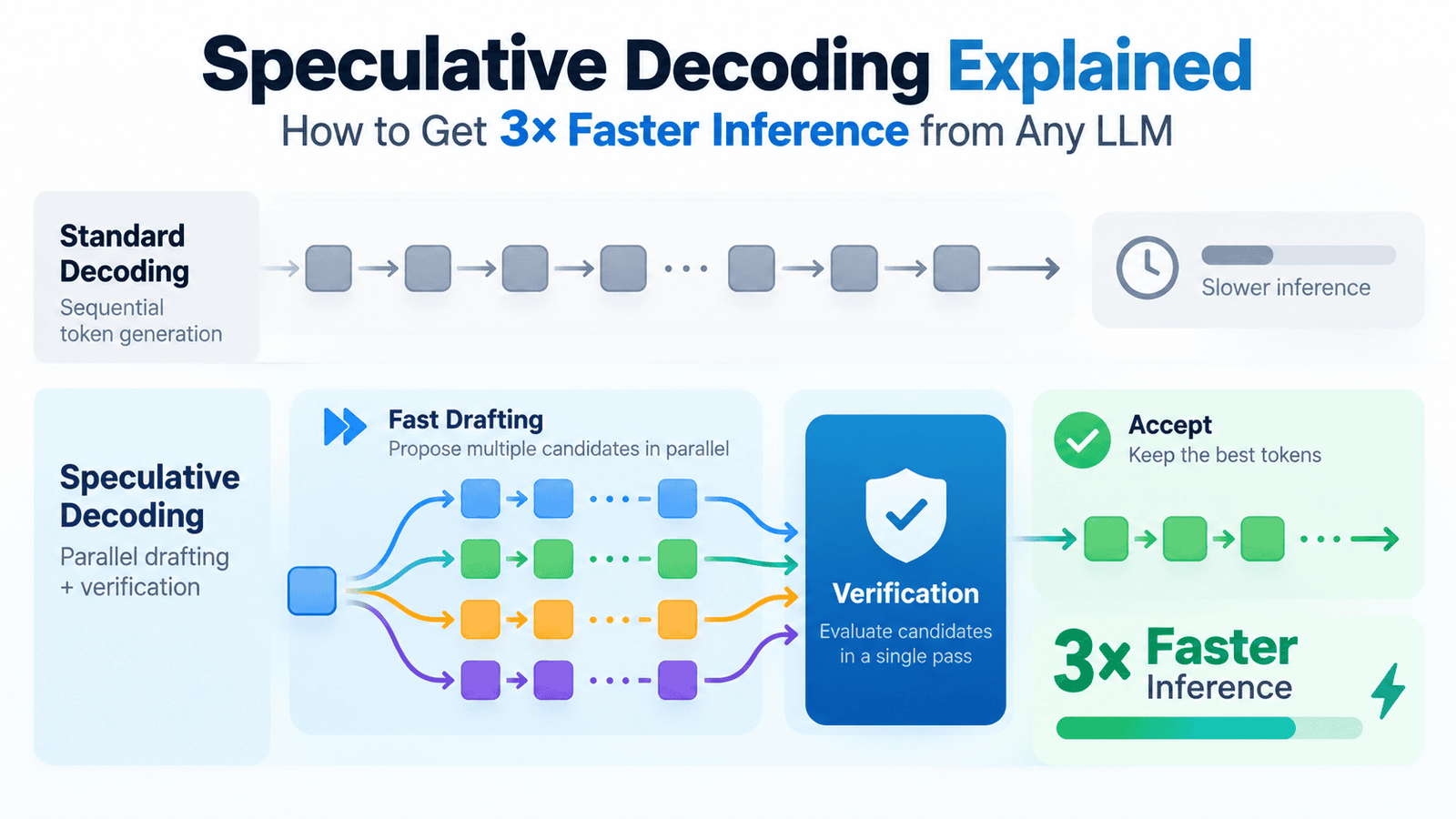
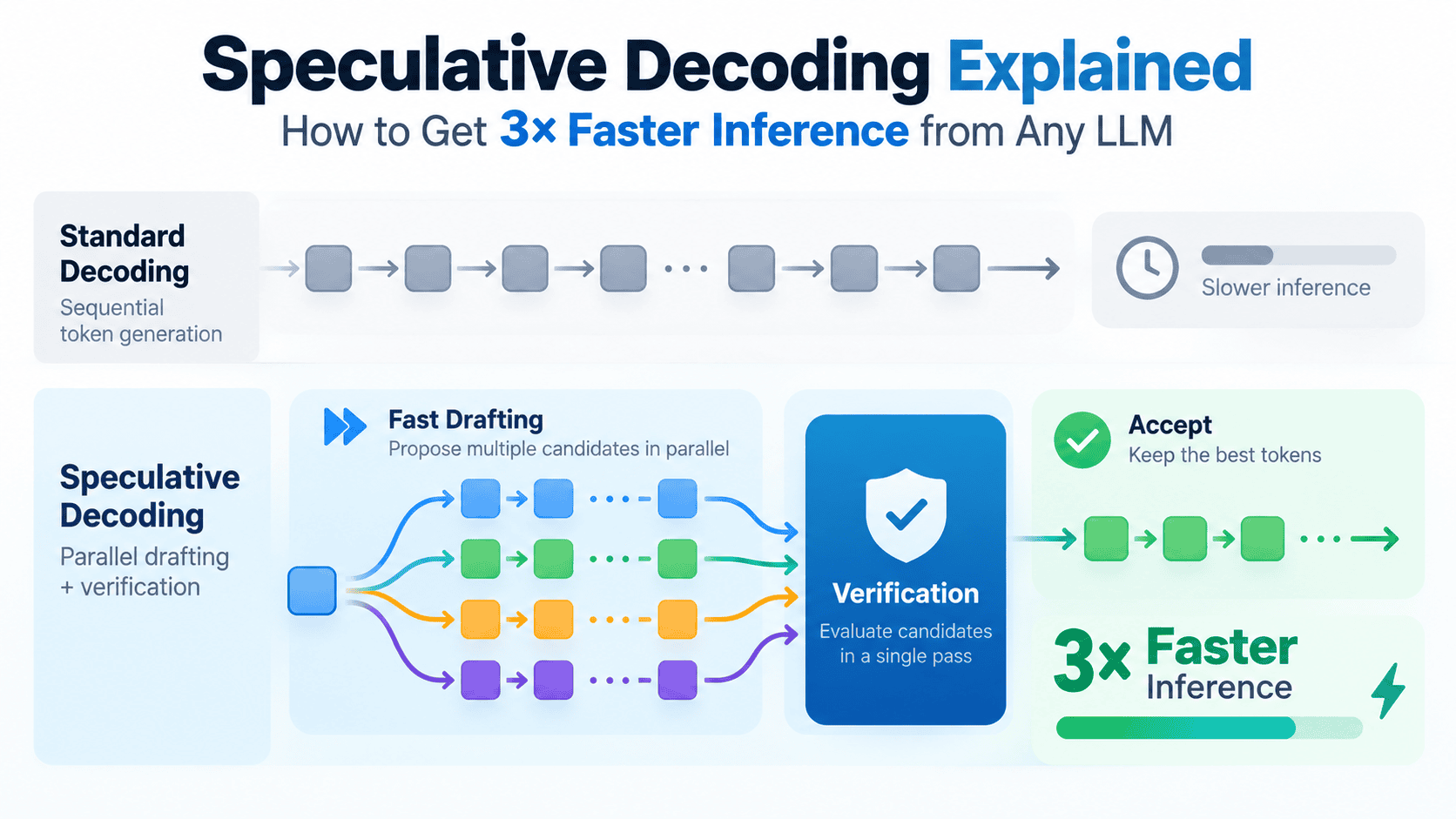
The central concept is easy: as an alternative of producing tokens one by one, generate a batch of candidate tokens suddenly and confirm them in parallel.
This works by a two-model system. A small, light-weight mannequin known as the draft mannequin quickly generates a sequence of candidate tokens. These guesses are quick and low cost to supply as a result of the draft mannequin has far fewer parameters than the primary mannequin. It nonetheless generates tokens autoregressively, simply a lot quicker as a result of its smaller dimension.
The big, high-quality mannequin known as the goal mannequin then evaluates all of these candidate tokens in a single ahead go. As a result of fashionable GPUs are constructed for parallel computation, processing a batch of tokens takes solely barely longer than processing one. The goal mannequin checks every candidate and accepts or rejects it based mostly on a probabilistic comparability with its personal predictions.
This course of follows a statistical methodology that gives a mathematical assure: the ultimate output has precisely the identical chance distribution as if the goal mannequin had generated each token by itself. The output high quality isn’t approximated. It’s provably similar.
Strolling By means of the Speculative Loop
The draft mannequin generates a brief sequence, sometimes 4 to eight candidate tokens, in a short time. These symbolize its greatest guess at what the goal mannequin would say subsequent.
The goal mannequin then takes that total sequence and scores it in a single batch operation. Quite than loading its billions of parameters into the processor as soon as per token, the goal mannequin hundreds them as soon as and evaluates the whole candidate sequence collectively.
Ranging from the primary candidate, the goal mannequin compares how doubtless it considers that token versus how doubtless the draft mannequin thought of it. If the goal mannequin is at the very least as assured because the draft mannequin, the token is mechanically accepted. If the draft mannequin was extra assured, the token is accepted with a chance that decreases because the hole grows. When a token is rejected, a corrected token is sampled from an adjusted distribution that accounts for the distinction between the 2 fashions’ predictions. This adjustment is exactly what ensures the ultimate output matches the goal mannequin’s distribution precisely, and the loop begins once more from there.
In one of the best case, all candidate tokens are accepted, plus the goal mannequin produces one extra token on the finish. This implies the system generated 5 to 9 tokens for roughly the price of one goal mannequin go. Within the worst case, the primary draft token is rejected and changed, which really provides slight overhead in comparison with commonplace decoding for the reason that draft mannequin’s era time nonetheless will get paid. Output high quality stays intact both method, however practitioners must be conscious that the draw back of a poorly matched mannequin pair is a small slowdown, not only a impartial outcome.
Why This Interprets to Actual Velocity Positive aspects
In commonplace era, loading the goal mannequin’s weights from reminiscence dominates the time finances. Every token triggers one other costly reminiscence learn, leaving compute models ready.
With speculative decoding, the goal mannequin’s weights are loaded as soon as per speculative step after which utilized throughout a number of accepted tokens. The GPU’s parallel compute capability will get to do significant work on the whole candidate sequence directly, somewhat than sitting idle between particular person token reads.
The precise speedup relies upon totally on the acceptance charge, which means how usually the draft mannequin’s candidates go the goal mannequin’s verification. When acceptance charges sit round 70 to 80 %, which is typical for well-matched mannequin pairs on frequent duties, the real-world speedup lands between 2x and 3x. Duties involving predictable or repetitive textual content have a tendency to supply even increased acceptance charges and bigger features.
Fashionable Approaches: Past the Two-Mannequin Setup
The unique formulation requires sustaining a separate draft mannequin alongside the goal mannequin, which provides reminiscence and engineering overhead. A number of newer strategies protect the core concept whereas eradicating the necessity for a standalone draft mannequin. Value noting: a few of these approaches commerce the strict distributional assure of the unique methodology for easier implementation or increased throughput, although the sensible influence on output high quality is mostly negligible.
Medusa modifies the goal mannequin itself by attaching a number of extra prediction heads on to its last layer. Every head independently predicts a distinct future token place, so the goal mannequin successfully drafts its personal candidate sequences with none exterior mannequin.
Eagle (Extrapolation Algorithm for Higher Language-model Effectivity) predicts future tokens based mostly on the goal mannequin’s inside hidden states somewhat than its last output tokens. Hidden states carry richer contextual info, which tends to supply increased acceptance charges on advanced or domain-specific textual content.
Immediate Lookup Decoding requires no secondary mannequin in any respect. It scans the present immediate and dialog historical past for phrases prone to recur within the response and makes use of these straight as draft candidates. This method works particularly nicely for code enhancing and doc summarization, the place the output incessantly echoes vocabulary and construction from the enter.
What This Means for Practitioners
Speculative decoding is on the market as a built-in choice in inference frameworks like Hugging Face’s text-generation-inference, vLLM, and llama.cpp. For many practitioners, enabling it’s a configuration change somewhat than a analysis undertaking.
The method is most helpful when producing longer outputs, when the mannequin is serving one request at a time somewhat than massive batches, and when the immediate and response share vocabulary or construction. Query answering, doc summarization, and code completion are likely to see the biggest features. Excessive-throughput batch serving is a distinct story: in closely batched settings, speculative decoding can really harm throughput as a result of the draft tokens eat reminiscence and compute that would in any other case serve extra requests. Hold that trade-off in thoughts when selecting whether or not to allow it in manufacturing.
Conclusion
Speculative decoding reframes what has lengthy been handled as an unavoidable constraint in language mannequin inference. The one-token-at-a-time course of isn’t a set requirement however a consequence of how commonplace era works, and speculative decoding breaks it by pairing a quick drafting stage with a parallel verification go that preserves the goal mannequin’s output precisely.
The result’s quicker inference with no change to mannequin weights, no discount in output high quality, and no modification to the prompting workflow. Because the method turns into extra tightly built-in into commonplace inference tooling, it’s shortly changing into a default a part of how massive language fashions are deployed.