
Prospects more and more self-host massive language fashions (LLMs) on GPUs for management over price, accuracy, and latency. Nevertheless, self-hosting typically means paying for redundant GPU work as a result of small, remoted caches on every server can’t maintain or share the rising context AI brokers and chat functions resend. Take into account a authorized AI assistant that may accumulate lots of of 1000’s of tokens of case historical past in every dialog. When a lawyer returns to a thread after lunch, responses from the LLM can take minutes. The GPU server that picks up the request has none of that historical past in its reminiscence. So, the GPU recomputes the key-value (KV) consideration states for all of these tokens, a step referred to as prefill, earlier than it writes a phrase. The identical sample slows down resumed coding brokers, agentic AI assistants, and doc Q&A assistants. Distributed KV caching with Amazon ElastiCache can lower self-hosted LLM inference prices by as much as 40% and time to first token (TTFT) by as much as 80%. Distributed KV caching extends GPU-local caches with a shared tier beside your GPU fleet so any server can reuse KV state for days throughout classes, routing shifts, and server failures. “Asserting distributed KV caching for self-hosted LLMs with Amazon ElastiCache” dives into the technical particulars and the efficiency benchmarks.
This put up particulars the distributed KV caching ability within the Agent Toolkit for AWS. With this ability, you possibly can consider and arrange distributed KV caching from inside your coding agent in just a few prompts. The ability guides the agent by checking whether or not your workload advantages from distributed KV caching, establishing a cache cluster for testing or manufacturing workload, and troubleshooting your LLM inference caching. The ability works with Kiro, Claude Code, OpenAI Codex, and different coding brokers that help Agent Abilities. We stroll by how the ability works with 4 conversations: diagnosing a sluggish first token, sizing and pricing the cache, setting it up, and fixing a failed switch.
Why a ability for KV caching and what can it do?
The advantages on your workload rely on traits similar to LLM fashions used, consumer visitors patterns, and immediate routing selections, and will be complicated to estimate. We created the KVTrace instrument to get shut estimates of the advantages on your workload, from your individual mannequin and visitors earlier than you deploy any infrastructure, at no extra cost. The ability simplifies this analysis and the setup, and guides your coding agent by the next greatest practices earlier than altering something:
- A match test earlier than any spend. The agent reads your GPU fleet with a read-only
describe-instancesname and counts Elastic Material Adapter (EFA) interfaces. It asks just for what it might probably’t see: engine, mannequin, tensor-parallel (TP) measurement, KV information sort, server worth, and the way typically prompts repeat. It stops and explains when one thing doesn’t match. - Numbers out of your workload. For brief prompts, loading KV state can take longer than computing it once more. Above a sure immediate size (the cutover level), the learn wins. That cutover and the way typically your prompts repeat determine whether or not the cache is price its worth. The agent estimates financial savings from your individual visitors with KVTrace, at no extra cost, and stops in the event that they don’t cowl the cache’s price. Each quantity says the place it got here from.
- Handle configuration throughout inference servers with the stack you already run. The agent provides the LMCache connector to your present vLLM or SGLang engine, together with vLLM staff beneath serving frameworks similar to llm-d and Ray Serve. It retains your routing and the engine’s settings and units the servers in your inference fleet to at least one KV ID mechanism (hash and seed) and an express KV information sort. Matching settings keep away from key mismatches, the place every server writes KV state the others can’t discover.
- Implements greatest practices. Earlier than manufacturing visitors, the agent empties the native tiers and checks that two cache-loaded runs give the identical output, as a result of a structure mismatch can produce wholesome hit counters and unsuitable solutions. The ability guides the agent to hunt express approval for high-impact operations similar to creating, altering, or deleting sources.
Conditions
These flows, from estimating advantages to setup, require the next:
- A coding agent that helps Agent Abilities, similar to Kiro or Claude Code.
- GPU situations that help EFA RDMA write, similar to p5.
- LMCache 0.5.8rc1 or later and vLLM 0.11.1 or later (SGLang 0.5.13 or later).
- ElastiCache for Valkey 9.1 or later, on cache.i8ge.48xlarge nodes (if establishing the cache).
Circulation 1: Can distributed KV caching assist?
We gave the agent this immediate: “My vLLM fleet serves a authorized assistant with 64K-token contexts on p5 situations. Returning conversations take 13 seconds for the primary token as a result of the GPU recomputes the complete dialog historical past each flip. How do I repair this?”
The agent matches the request to the ability and, in Kiro, asks for approval earlier than loading it. The reply identifies that the latency was attributable to chilly prefill, and three issues within the reply matter for an actual deployment. First, it checks for fixes that want no new infrastructure. For those who turned off prefix caching, turning it again on can pace up back-to-back turns. If the GPU prefix cache hit fee is already above 90% with session affinity, you may not want a shared KV cache. Second, it identifies constraints particular to the authorized AI assistant. A shared KV cache can let one tenant inform from response occasions whether or not one other tenant despatched the identical textual content. Instances that should keep remoted get separate caches, and tenants that share a cache add their very own ID to the KV hash. Third, it doesn’t guess the scale. It asks for the mannequin and TP measurement, KV information sort, reproduction rely and routing, and the way lengthy customers wait between turns.
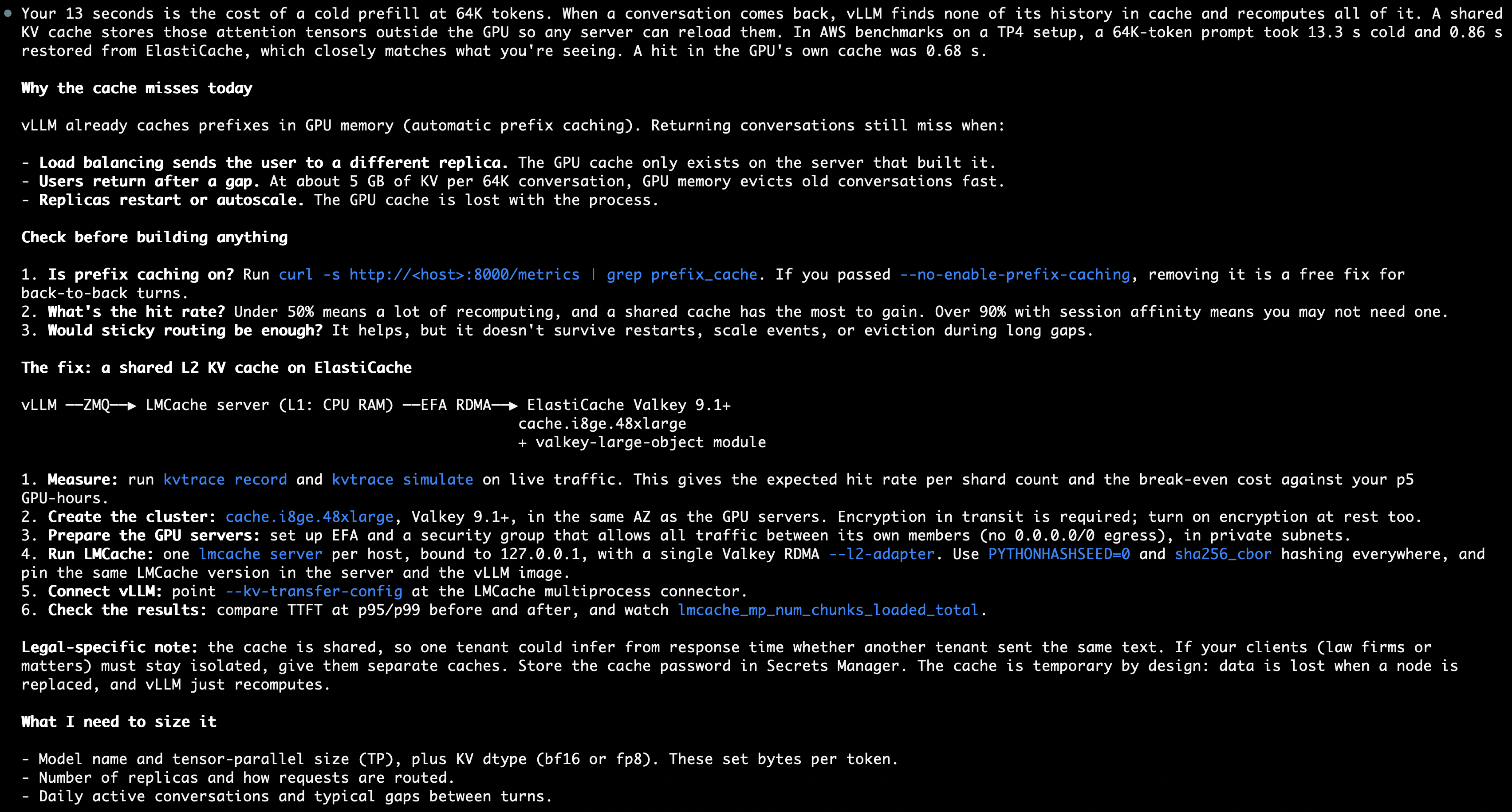
Determine 1: The prognosis and proposed structure for the authorized assistant
Circulation 2: Estimating financial savings
To measurement the financial savings, we gave the agent an instance fleet of 8 p5 situations that serve 64,000-token prompts for a multi-turn retrieval-augmented era (RAG) assistant. The agent appeared up the GPU and cache node costs and derived the prefill fee and KV measurement from benchmarks. Lastly, the agent really useful two cache.i8ge.48xlarge nodes for distributed KV caching. The next determine reveals the agent’s abstract and the inputs it used.
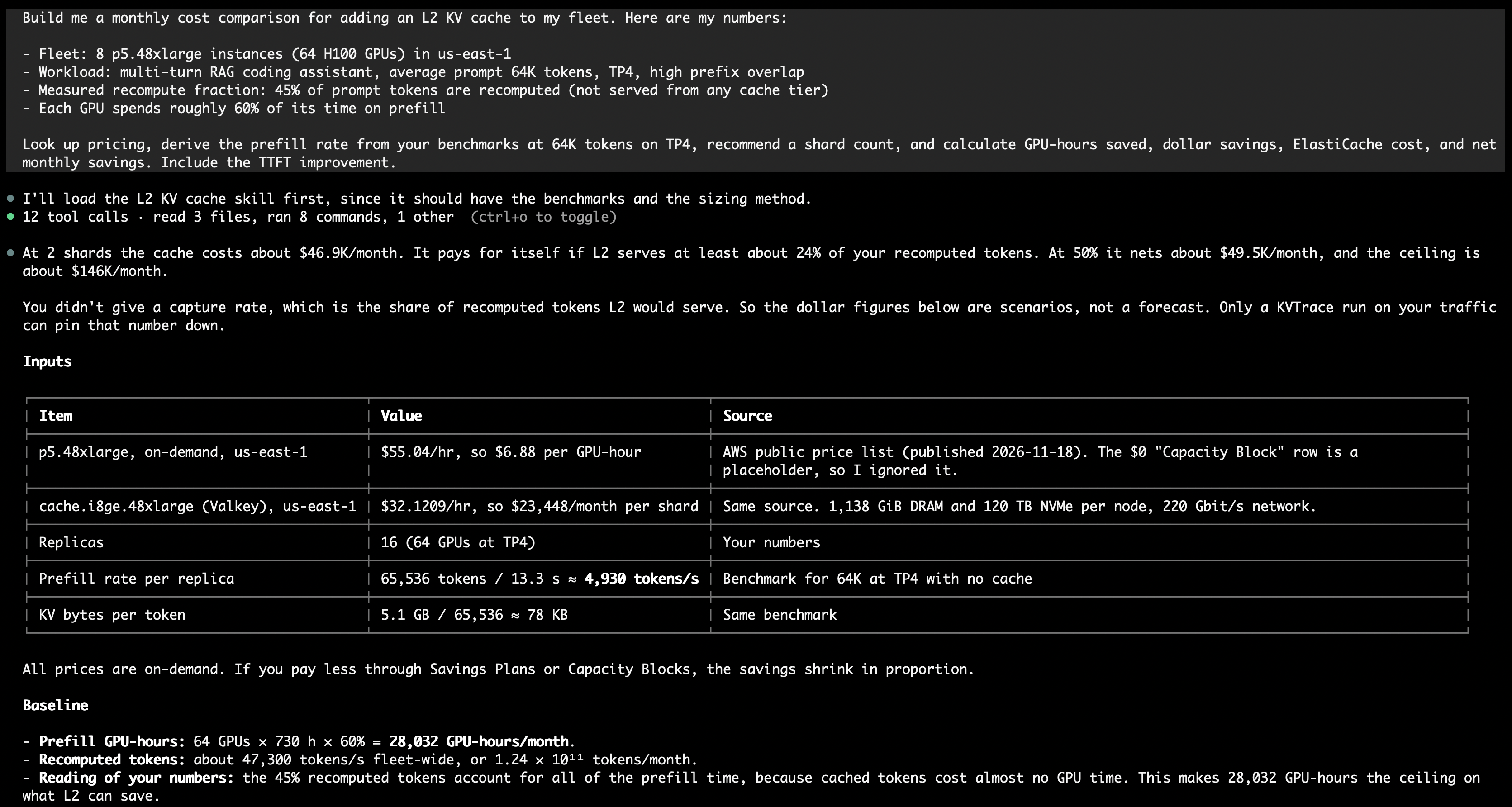
Determine 2: The agent’s abstract and inputs. It appeared up each costs within the AWS worth checklist and explains the way it arrived on the recompute determine
We didn’t present a cache hit fee, which is the share of recomputed tokens the cache would serve. The agent due to this fact presents eventualities and recommends a KVTrace run to determine the cache hit fee. KVTrace data the KV cache occasions from vLLM or SGLang. It then replays them offline towards a shared KV cache of every candidate measurement. The recorder by no means writes token IDs or immediate textual content. Traces maintain block hashes and token counts. Block hashes come from token content material, so cross --anonymize-key-file when your prompts are delicate. The ability data on each GPU server for a consultant window, similar to a full enterprise day. The agent additionally notes that freed GPU time turns into {dollars} provided that you run fewer servers or serve extra visitors on the identical ones.
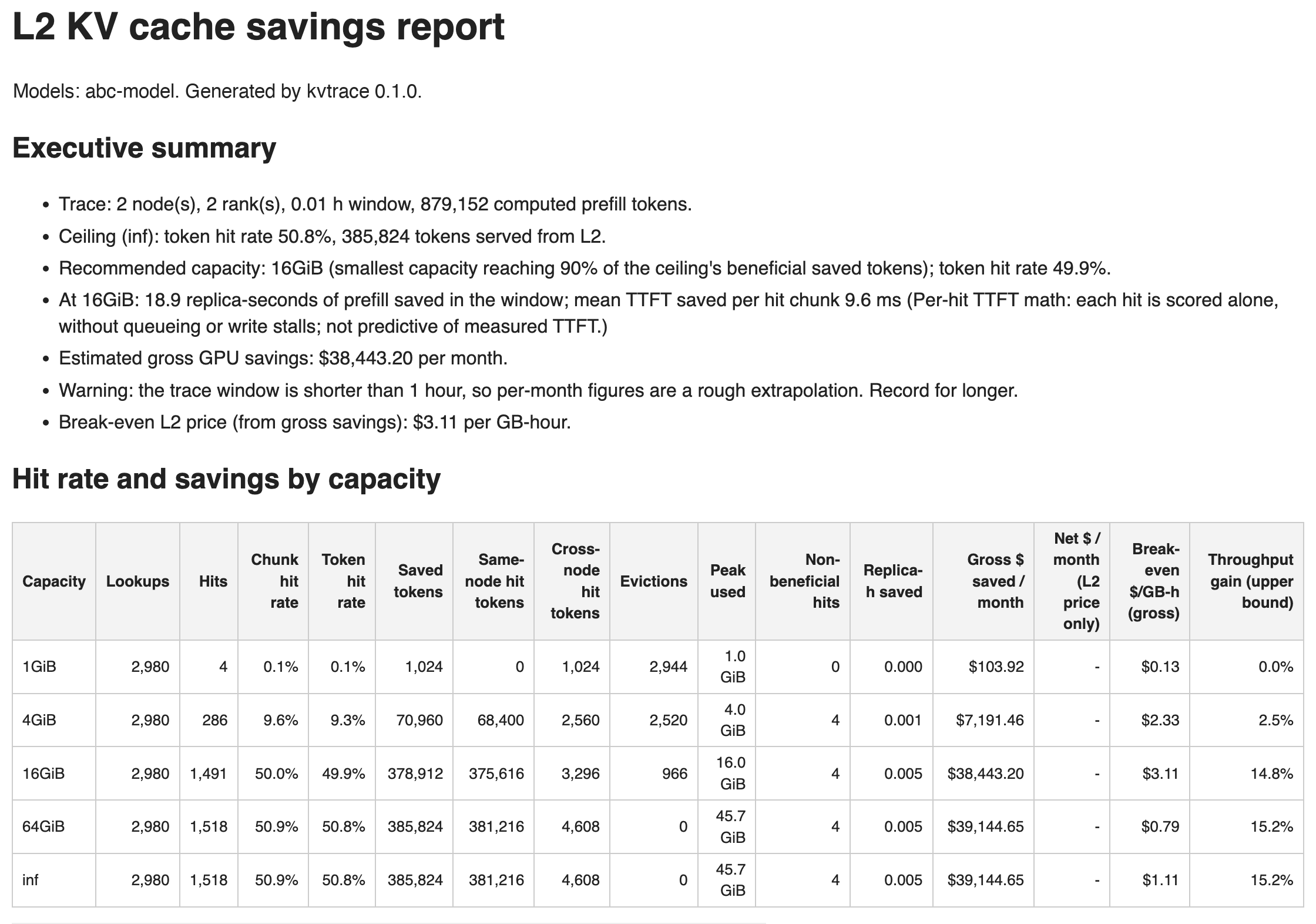
Determine 3: The highest of a KVTrace report from artificial demo visitors. It recommends the smallest capability that reaches 90% of the financial savings ceiling.
Circulation 3: Organising a distributed KV cache
We prompted the agent with: “Arrange a shared L2 KV cache for LLM inference, ranging from scratch.” Earlier than it creates something, the agent requests your affirmation to arrange the urged cache node rely in your Availability Zone, on the estimated worth. As soon as confirmed, it creates the fitting safety group with EFA permissions, and a Valkey 9.1 cluster that makes use of a customized parameter group with caching eviction insurance policies. LMCache will get its personal cache consumer, with the password in AWS Secrets and techniques Supervisor. The agent prepares the GPU servers and begins one LMCache server per GPU server. Then it checks the cluster with a small check object and confirms that repeated prompts load their KV state from the cache over Distant Direct Reminiscence Entry (RDMA). On a GPU fleet, the ability checks the measured L2 share towards the KVTrace prediction. For the complete setup with each command, see Getting began with distributed KV caching within the Amazon ElastiCache documentation.
Circulation 4: Troubleshooting
Immediate: “My LMCache server connects to the ElastiCache cluster and BLOB.RDMA_HELLO succeeds, however precise information transfers are failing. INFO largeobj reveals rdma_write_errors climbing. What’s unsuitable?”
Following the ability’s troubleshooting information, the agent causes from the symptom sample and identifies the seemingly trigger as a safety group that blocks EFA visitors between its personal members. It offers you instructions to test and repair the rule.
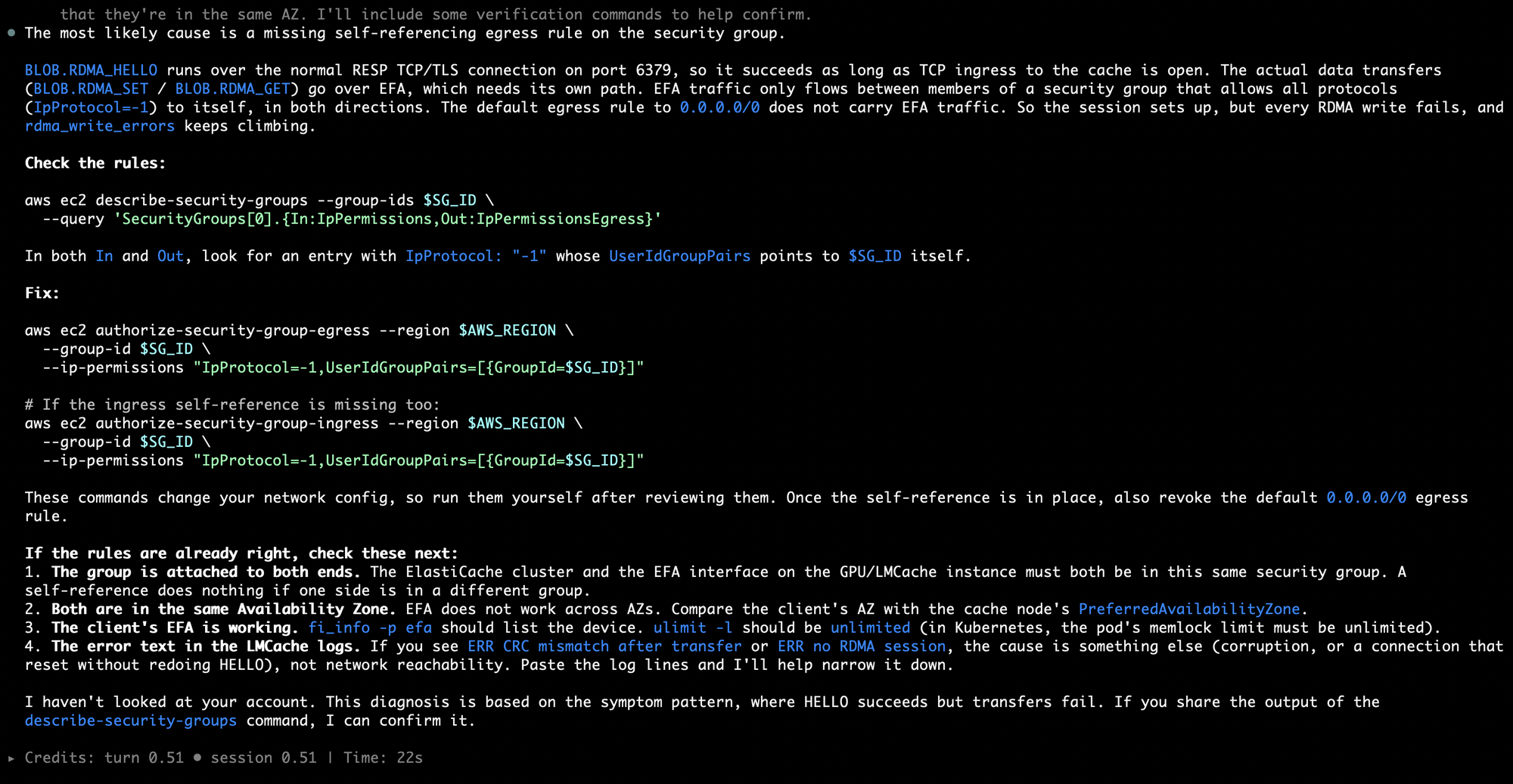
Determine 4: The agent explains the symptom, then offers instructions to test and repair the safety group
Get began
You may get the distributed KV caching ability or the AWS MCP Server from the Agent Toolkit for AWS. Then describe your downside or ask your AI agent to chop prices and latency in your GPU fleet to get began. To study extra about distributed KV caching with ElastiCache and the efficiency benchmarks see the AWS weblog. You possibly can see getting began with the AWS Command Line Interface (AWS CLI) at Amazon ElastiCache documentation and study extra about KVTrace on the GitHub repo.
In regards to the authors