
GPU sharing isn’t new: Multi-Occasion GPU (MIG), time-slicing, and Multi-Course of Service (MPS) deal with completely different isolation and utilization wants. NVIDIA Run:ai GPU Fractioning builds on MPS with Kubernetes-integrated scheduling, per-Pod reminiscence contracts, enforcement, and metrics.
Validated end result: Two Pods shared one NVIDIA A10G Tensor Core GPU. Every Pod efficiently allotted 6 GiB inside an 8 GiB restrict, whereas an allocation above the restrict failed as anticipated.
NVIDIA Run:ai is AI workload orchestration software program for Kubernetes. Its GPU Fractioning Operator will help a number of groups share one or two GPUs on Amazon Elastic Kubernetes Service (Amazon EKS). Notebooks, mannequin evaluations, and small inference providers can depart groups ready even when GPU reminiscence stays obtainable. On this walkthrough’s baseline, the NVIDIA system plugin exposes the one GPU as one nvidia.com/gpu useful resource, with GPU sharing disabled. Two Pods every requesting nvidia.com/gpu: 1 can’t run concurrently on that node, even when their mixed GPU-memory demand matches.
NVIDIA Run:ai GPU Fractioning provides Kubernetes scheduling integration, enforced GPU-memory limits, and per-Pod metrics to software-based sharing. The strategy applies to NVIDIA GPUs that meet the GPU Fractioning Operator’s {hardware} and software program necessities, together with GPUs with out MIG. We use one Amazon Elastic Compute Cloud (Amazon EC2) g5.xlarge occasion with an NVIDIA A10G Tensor Core GPU because the validated instance. Different configurations require compatibility checks and validation.
NVIDIA introduced the open supply launch of NVIDIA Run:ai on October 13, 2026. This instance makes use of two of its 4 modular elements: KAI Scheduler and GPU Fractioning Operator. KAI Useful resource Administration and Workload Map deal with organizational governance and extra workload varieties, exterior this walkthrough’s scope.
On this publish, we present how one can construct a customized Amazon Linux 2023 (AL2023) picture and configure GPU-memory sharing on Amazon EKS. Within the validated G5/A10G instance, you determine a whole-GPU baseline, give every Pod an 8 GiB reminiscence contract, and confirm 6 GiB allocations. You then examine per-Pod metrics, take a look at rejection of a 9 GiB allocation, and clear up the disposable atmosphere.
Select a GPU sharing strategy
MIG offers {hardware} partitions on supported GPUs. System-plugin time-slicing shares a GPU with out duplicate reminiscence or fault isolation. MPS permits concurrent CUDA processes. Fault containment depends upon configuration. NVIDIA Run:ai GPU Fractioning provides enforced per-container reminiscence limits and helps time-slicing (default) or sm-sharing compute modes. NVIDIA paperwork separate workload error domains for its default mode and a shared error area for sm-sharing. These will not be safety ensures. This walkthrough assessments reminiscence limits, not fault containment or compute efficiency. A reminiscence restrict doesn’t reserve proportional compute.
Amazon EKS paperwork a number of GPU sharing choices: MIG, time-slicing with the NVIDIA system plugin, and time-slicing with the NVIDIA DRA driver and Karpenter. For steering on selecting amongst them, see the GPU sharing steering within the Amazon EKS Finest Practices Information. Select GPU fractioning once you want enforced per-Pod GPU-memory limits on GPUs with out MIG and may run fixed-size GPU node teams.
Dynamic Useful resource Allocation (DRA) offers Kubernetes APIs for requesting and allocating gadgets. GPU sharing and isolation depend upon the system driver’s implementation and enabled options. KAI Scheduler and GPU Operator assist DRA. This walkthrough makes use of NvFractions annotations, not DRA.
GPU fractioning will help interactive notebooks with idle intervals, quick analysis jobs, GPU compatibility assessments, and small inference providers. Select every GPU-memory request from measured peak utilization plus overhead, then take a look at latency below concurrent load. The demonstrated density enchancment doesn’t set up a throughput acquire or a common value discount.
Answer overview
The next diagram reveals the validated single-GPU atmosphere within the US East (Ohio) Area (us-east-2). You utilize the AWS Command Line Interface (AWS CLI), eksctl, Helm, and Packer to construct and function it. The Amazon EKS management airplane runs Kubernetes model 1.36 in an AWS managed Amazon Digital Personal Cloud (Amazon VPC), separate from the shopper VPC. It connects to EC2 staff in non-public subnets of the shopper VPC.
An m7i.massive system node hosts the operator controllers and KAI Scheduler. KAI Scheduler locations each Pods on a tainted g5.xlarge with one A10G containing 23,028 MiB of GPU reminiscence.
Every Pod has an 8 GiB GPU-memory restrict and allocates 6 GiB of GPU reminiscence. The GPU employee makes use of customized AL2023 with the NVIDIA R615 driver department, NVIDIA Container Toolkit, and containerd. It runs fractiond with Node Useful resource Interface (NRI) integration and MPS for sharing. The metricsd daemon exports per-Pod GPU-memory metrics.
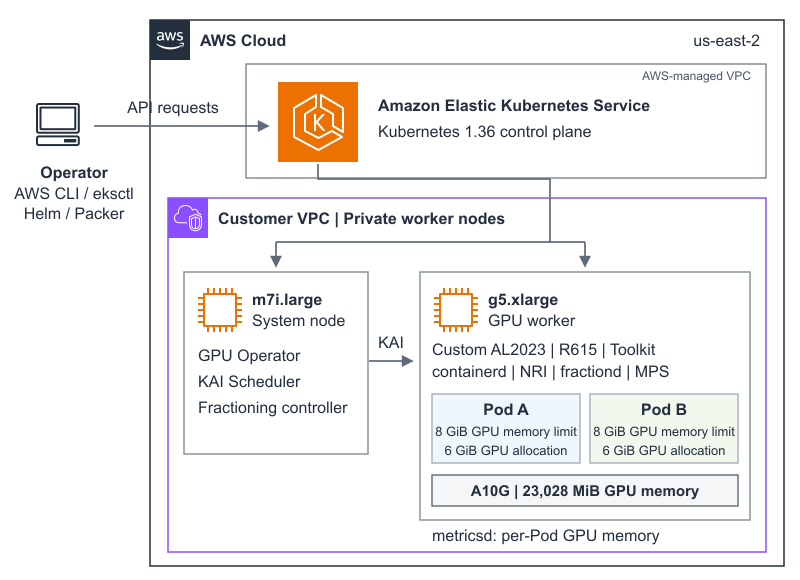
Determine 1: Validated instance of two GPU-memory contracts on one A10G in Amazon EKS
Implementation walkthrough
The walkthrough makes use of the AWS Samples repository. Affirm the stipulations and validated element variations, then full Steps 1 via 10.
Conditions
Use an AWS account with permissions for Amazon EKS, AWS CloudFormation, Amazon VPC, Amazon EC2, Amazon Elastic Block Retailer (Amazon EBS), AWS Identification and Entry Administration (IAM), and AWS Methods Supervisor for Amazon Machine Picture (AMI) discovery. Affirm quota and capability for g5.xlarge, the system node, and a brief m5.xlarge picture builder. Set up AWS CLI v2, eksctl, kubectl, Helm, Packer, Git, jq, and curl.
Use your regular AWS credential supplier: a named profile, AWS IAM Identification Heart, an assumed position, or access-key atmosphere variables. Want non permanent credentials. AWS_SESSION_TOKEN is required when utilizing non permanent entry keys. The examples use us-east-2. One other Area should assist the chosen Amazon EKS model and occasion varieties.
Earlier than selecting one other GPU, verify NVIDIA’s GPU Operator {hardware} listing, the chosen driver’s {hardware} assist, and the GPU Fractioning Operator stipulations. {Hardware} assist alone doesn’t set up fractioning compatibility. This walkthrough validates the G5/A10G configuration solely. The AMI construct targets x86_64. Examine CUDA compatibility and reminiscence headroom: The 2 8 GiB contracts require room for each contracts and runtime overhead. Smaller gadgets want smaller contracts and adjusted probes.
The walkthrough creates billable assets, together with an Amazon EKS management airplane, a NAT gateway, cases, volumes, and an AMI snapshot. Use a disposable atmosphere and full cleanup when validation finishes.
Use the validated AL2023 stack
On the time of validation, the EKS-optimized AL2023 NVIDIA picture supplied R580 and R595 driver branches. GPU Fractioning Operator v0.1.7 requires R615 or newer. R615 is short-lived and isn’t the GPU Operator default. This instance builds a customized normal Amazon EKS 1.36 AL2023 picture with AMI-owned driver and toolkit. It doesn’t use an operator-managed driver container on one other OS. The desk information lab validation, not vendor assist certification.
| Element | Validated model |
| Amazon EKS | 1.36 |
| GPU | NVIDIA A10G, 23,028 MiB |
| NVIDIA driver / Container Toolkit | 615.71.10 / 1.20.1-1 |
| containerd | 2.3.5 with NRI |
| GPU Operator / system plugin | 26.7.1 / 0.20.1 |
| KAI Scheduler / Fractioning Operator | 0.18.5 / 0.1.7 |
We validated this walkthrough on October 22, 2026, utilizing NVIDIA driver 615.71.10. On November 18, 2026, after updating the GPU node taint, we repeated each step besides the Step 3 picture construct, utilizing a picture with the identical driver. The outcomes matched. The desk lists the examined element variations, not a everlasting assist matrix. Recheck the Amazon EKS AMI documentation and NVIDIA stipulations earlier than altering any element.
Step 1: Clone and configure
Clone the repository, then create an area configuration file from the supplied instance and prohibit its permissions:
After cloning, use walkthrough.env for configuration and run.sh for every stage. Generated recordsdata and kubeconfig keep within the ignored .state listing. GPU_INSTANCE_TYPE selects the occasion sort. Altering it alone doesn’t set up compatibility.
Defaults and optionally available authentication settings in walkthrough.env
By no means commit credentials. The native configuration file is ignored by Git. Affirm the lively identification earlier than provisioning:
Run phases individually to examine outcomes, or use ./run.sh walkthrough to run via the memory-limit take a look at. Cleanup is all the time a separate motion.
Step 2: Create the disposable cluster
Run the next command to create the disposable Amazon EKS cluster and its system node:
The command provisions an Amazon EKS cluster working Kubernetes model 1.36, a devoted VPC with one NAT gateway, OpenID Join (OIDC) integration, and a personal m7i.massive managed node.
Chosen fields from config/eksctl-cluster.yaml.tpl
Step 3: Construct the customized AL2023 picture
Run the next command to construct the customized AL2023 picture with the R615 driver department:
The script discovers a public builder subnet and the advisable normal Amazon EKS AMI for Kubernetes 1.36 on AL2023. Packer installs the present patch launch from the R615 driver department and the toolkit, configures the NVIDIA runtime, checks package deal state, and creates an encrypted picture. The Area-specific AMI ID is saved in .state/ami-id.
NVIDIA_DRIVER_VERSION selects the R615 department. It isn’t a precise patch pin. The workflow information the found driver model with the AMI ID and makes use of that model in AMI and node-group tags. Learn .state/installed-driver-version for the model noticed in your construct. For manufacturing, pin precise packages and the bottom picture in your individual construct and validate a supported driver-branch improve.
You want this step solely as a result of the EKS-optimized AL2023 NVIDIA AMI didn’t embody the R615 driver department on the time of validation. Want an EKS-optimized NVIDIA AMI as soon as the driving force that it selects in your GPU and the remaining host stipulations meet the GPU Fractioning Operator necessities. Examine the driving force variations within the Amazon EKS AMI releases on GitHub. The pattern’s scripts at present require the R615 driver and metadata from the picture construct, so utilizing a inventory AMI additionally requires script adjustments.
Related Packer settings from ami/eks-al2023-r615.pkr.hcl
SOURCE_AMI_ID and PACKER_SUBNET_ID are optionally available overrides for an accredited base picture or builder subnet. Rebuild and take a look at photos when the working system or GPU stack adjustments.
Step 4: Add the GPU employee
Run the next command so as to add a GPU managed node group that makes use of the customized picture:
By default, the managed node group makes use of the customized picture and stays at one On-Demand g5.xlarge, the validated GPU employee. A GPU taint excludes bizarre workloads. The script disables eksctl’s NVIDIA device-plugin set up as a result of GPU Operator manages that element.
Chosen fields from config/eksctl-gpu-nodegroup.yaml.tpl
Step 5: Set up GPU Operator and examine the host
Run the next command to put in GPU Operator and examine the GPU employee’s host configuration:
GPU Operator 26.7.1 provides the system plugin and Kubernetes integrations. Its configuration preserves the image-owned driver and toolkit:
The identical command runs a brief privileged inspection Pod on the GPU employee, prints the host configuration, and removes the Pod. The validated node stories:
Noticed host configuration
On this AL2023 node, /var/run is a symbolic hyperlink to /run. Each paths establish the identical socket. Restrict privileged inspection to the disposable atmosphere and ensure the Pod is eliminated.
Step 6: Set up the whole-GPU baseline
Run the next command to check whole-GPU scheduling earlier than fractioning is put in:
Every baseline Pod requests and limits nvidia.com/gpu to 1. The take a look at assumes one obtainable bodily GPU with sharing disabled: One Pod runs and the opposite stays Pending. This demonstrates the whole-device scheduling constraint earlier than fractioning is put in. On multi-GPU nodes, adapt this baseline and confirm that each fractional workloads use the identical GPU.
Measured baseline end result
The script checks this state and removes each baseline Pods.
Step 7: Set up KAI Scheduler and GPU Fractioning Operator
Run the next command to put in KAI Scheduler, which incorporates GPU Fractioning Operator:
The pinned KAI Scheduler 0.18.5 chart contains GPU Fractioning Operator 0.1.7. The values activate NvFractions and per-Pod metrics whereas retaining GPU-stack model checks. The optionally available nvidia.com/container. annotation selects compute mode. These workloads depart the default unchanged.
Related fields from helm/kai-values.yaml
Within the validation, FractiondReady, MpsdReady, and Prepared are True. DriverUpgradeInProgress is False with motive NoDriverUpgrade, in step with the AMI retaining driver possession.
Step 8: Run the constructive sharing take a look at
Run the next command to deploy two Pods with 8 GiB GPU-memory contracts:
Every Pod requests and limits reminiscence to eight GiB and selects kai-scheduler. Neither requests an entire nvidia.com/gpu useful resource. The repository applies these scheduling fields and runs a CUDA probe that allocates 6 GiB:
Important fields from kubernetes/fraction-8gi-pods.yaml
Measured constructive end result
The script verifies matching node names and GPU UUIDs. Within the validation, each Pods see 8,192 MiB and report allocation_succeeded_mib=6144. These checks set up placement on one bodily GPU, the bounded system view, and profitable allocations inside every contract.
Measured allocation output from every Pod
Observe reminiscence whereas each Pods stay lively
The gpu_fractioning_gpu_memory_used_bytes metric attributes reminiscence by Pod and GPU UUID. The noticed 6,394 MiB (about 6.24 GiB) per Pod exceeds the probe’s 6,144 MiB allocation by 250 MiB. Metrics can embody CUDA context and runtime overhead. This experiment doesn’t measure that breakdown. Retain workload identification and request, restrict, and utilization values collectively when monitoring the shared system.
Measured per-Pod metric collection
Step 9: Confirm rejection above the restrict
Run the next command to check an allocation that exceeds the 8 GiB contract:
This command removes the positive-test Pods and creates one Pod with an 8 GiB contract that makes an attempt a 9 GiB allocation. The probe stories:
Measured over-limit end result
Measured negative-test Pod standing
Right here, cudaMalloc returns an out-of-memory error, which the probe handles earlier than exiting with code 0. Accomplished is anticipated, not OOMKilled. This demonstrates allocation rejection, not container termination or common fault isolation.
Step 10: Clear up
Seize the VPC ID earlier than deleting the cluster. The impartial checks that observe use the default cluster identify and Area. Substitute your configured values if you happen to modified them.
Seize the VPC ID
Take away the disposable atmosphere
Customary cleanup removes the take a look at namespace, Helm releases, and disposable cluster whereas preserving the customized AMI and its Amazon EBS snapshot.
Confirm useful resource deletion
Anticipate express resource-not-found responses for deleted assets. Authentication or permission errors don’t set up deletion. Additionally examine remaining node teams and cluster-tagged cases. If cleanup fails, examine CloudFormation occasions and resolve owned dependencies earlier than retrying. An absent Amazon EKS endpoint doesn’t show that its VPC is gone.
Use ./run.sh cleanup-all solely when the customized AMI and its Amazon EBS snapshot are now not wanted. If picture deletion is refused, verify the AMI ID and pattern possession tag. Don’t bypass the safeguard.
Manufacturing concerns
Deal with this as a conduct validation. Use trusted workloads and apply least-privilege IAM, namespace controls, accredited photos, and admission guidelines for fraction requests. Select entire GPUs or MIG on supported {hardware} when stronger isolation is required.
The pinned fractioning daemons use privileged containers, host PID entry, and NRI/MPS host mounts. Limit their deployment and configuration to trusted directors.
Enable headroom for CUDA contexts, caches, batching, and runtime overhead. Measure latency and throughput below concurrent load. Monitor allocation failures, MPS well being, NRI connectivity, and GPU errors. Pin the bottom AMI, driver, toolkit, system plugin, operator, scheduler, and workload photos as one examined mixture. Rebuild photos and take a look at rollback earlier than rollout.
This walkthrough requires pre-provisioned GPU capability. It doesn’t configure or validate GPU-fraction-aware autoscaling. The fractional Pods choose kai-scheduler, request no nvidia.com/gpu useful resource, and use a nodeSelector that targets a node group mounted at one node. Karpenter assist for secondary schedulers is an open characteristic request (challenge #742 on GitHub). The customized picture can’t run on Amazon EKS Auto Mode-managed nodes, as a result of Auto Mode selects and manages their AMI. A cluster can combine Auto Mode-managed nodes with managed node teams, however we didn’t validate this walkthrough in such a cluster.
Groups that use Karpenter can reference the identical customized AMI by ID in an EC2NodeClass. The autoscaling restrict nonetheless applies. We didn’t validate this path.
KAI Scheduler is a second scheduler. It handles queueing and placement for Pods that choose it. In case you already use Kueue, determine which element owns queueing for GPU workloads earlier than you undertake KAI Scheduler.
We suggest working the Amazon EKS node monitoring agent on GPU nodes. In a November 18, 2026 regression run, the agent ran on the customized R615 picture with MPS sharing lively and reported wholesome GPU circumstances all through the sharing and restrict assessments. That run didn’t take a look at fault detection. As a result of GPU Operator already runs a Knowledge Heart GPU Supervisor (DCGM) host engine, configure the agent to use that host engine as an alternative of its bundled one.
Conclusion
On this publish, we confirmed how one can configure GPU-memory fractioning on Amazon EKS with a customized AL2023 picture, utilizing G5/A10G because the validated instance. The strategy extends to appropriate NVIDIA GPUs after checking stipulations and validating the chosen configuration. You established the whole-GPU baseline, ran two bounded workloads on the identical GPU, inspected per-Pod reminiscence utilization, and verified rejection of an allocation above the restrict. Fractioning can enhance entry to current capability when workload reminiscence matches. Manufacturing adoption additionally requires isolation controls and efficiency testing.
To repeat the experiment, clone the AWS Samples repository and examine your outcomes with its validated proof. Discover the GPU Fractioning Operator documentation and the Amazon EKS accelerated AMI steering earlier than adapting the instance to your workloads.
The content material and opinions on this publish are these of the third-party writer and AWS isn’t accountable for the content material or accuracy of this publish.
Concerning the authors