
Price administration for generative AI is a shared accountability between the groups that construct purposes and the groups accountable for cloud spend. Many groups begin by evaluating per-model token charges and asking utility groups to shorten prompts. These steps assist, however they don’t reply the questions that finance and engineering leaders ask as utilization scales: which group spent this, on which workload, and was that spend inside an accepted finances?
Agentic workloads make these questions extra urgent. A conversational assistant sometimes points one mannequin invocation per consumer flip. An agentic workflow, comparable to an AI coding assistant that plans a change, reads recordsdata, calls instruments, and iterates, points many invocations per job and carries a bigger context on every one. Token consumption due to this fact scales with the diploma of autonomy you grant the workflow and the scale of the context it carries, somewhat than with the variety of consumer interactions. As a result of consumption is a perform of how a workload is designed and operated, price administration for generative AI is an architectural and operational self-discipline. Revealed averages are a poor substitute in your personal numbers: use the AWS Pricing Calculator and the Amazon Bedrock pricing web page to mannequin charges, and use Step 2 of this publish to measure what your workloads really eat.
The repair isn’t a less expensive mannequin or a smaller immediate. It’s an working mannequin: a repeatable loop that attributes each greenback to an proprietor, makes each request observable, alerts on and enforces budgets earlier than overspend compounds, optimizes the platform defaults that drive most waste, and opinions the entire system on a cadence.
On this publish, you discover ways to handle Amazon Bedrock price in 5 steps. You attribute each greenback to an proprietor, make each request observable, management spend with budgets and enforcement, optimize the platform defaults that drive most avoidable spend, and function a evaluate cadence that turns knowledge into selections. This method is constructed from AWS constructing blocks, and you may customise it and apply it to your personal atmosphere. The publish is written for 2 audiences: FinOps practitioners who personal attribution, chargeback, budgets, and anomaly evaluate, and platform engineering groups who personal logging, request metadata, enforcement, and routing defaults.
The working mannequin in a single view
5 phases, run as a loop. Attribute: each Amazon Bedrock greenback lands on an identification, group, and utility within the billing pipeline. Observe: each request is logged with sufficient metadata to elucidate what generated the spend. Implement: budgets have tooth, with alerts at minimal and onerous blocks the place the chance calls for them. Optimize: the platform defaults (mannequin routing, caching, token limits) take away waste centrally as a substitute of asking each group to watch out. Function: a small scorecard and a evaluate cadence flip the information into selections. FinOps leads phases one and 5. Platform engineering leads two by 4. The evaluate is joint. The phases are sequenced intentionally. Every one is determined by those earlier than it, and groups that leap straight to optimization with out attribution and observability are guessing.
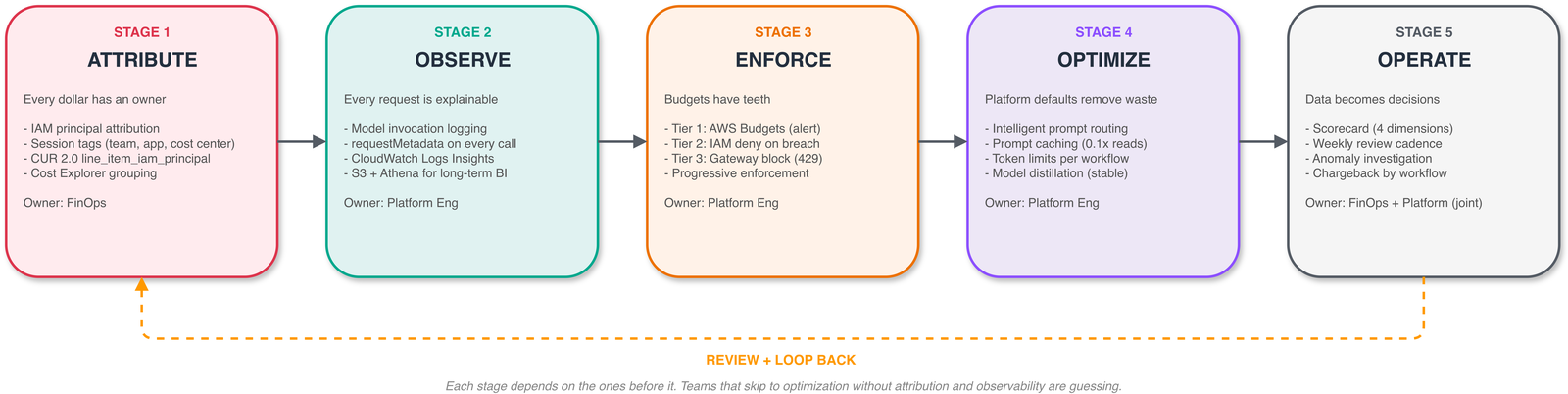
Determine 1: The five-stage working mannequin, run as a steady loop
Stage 1: Attribute each greenback
You may’t handle what you’ll be able to’t attribute, and all the things downstream (chargeback, budgets, enforcement, anomaly detection) is determined by this stage. The inspiration is the granular price attribution of Amazon Bedrock (see Introducing granular price attribution for Amazon Bedrock): Amazon Bedrock robotically attributes inference prices to the AWS Identification and Entry Administration (IAM) principal that made the decision, throughout all fashions, with no sources to handle. The caller’s ARN lands within the line_item_iam_principal column of the AWS Price and Utilization Report (CUR) 2.0, and protection spans IAM customers, roles, federated identities, and API keys.
Setup is 4 steps:
- Activate IAM principal knowledge in your CUR 2.0 knowledge export.
- Tag your IAM principals with enterprise dimensions comparable to group, utility, and price middle. For federated entry, configure your identification supplier to move session names and tags by OIDC or SAML claims.
- Activate these tags as price allocation tags in AWS Billing (console or the
UpdateCostAllocationTagsStatusAPI). - Analyze the tags: they floor in CUR 2.0 with an
iamPrincipal/prefix (for instance,iamPrincipal/group) and seem in AWS Price Explorer beneath the IAM class inside 24–48 hours of activation, prepared for filtering and grouping by group, utility, or price middle.
That is invoice-grade, per-identity attribution with no customized infrastructure.
The shared-role drawback
The sample that deserves essentially the most consideration is the shared-role drawback, as a result of it’s the place most platforms silently lose attribution. A big language mannequin (LLM) gateway that calls Amazon Bedrock by a single IAM position attributes each greenback to that one position, eliminating per-user visibility fully. The repair is per-user session administration. The gateway assumes the Amazon Bedrock invocation position as soon as per consumer, passing the consumer’s identification because the position session title and their attributes as session tags, then caches these credentials for as much as an hour (one AWS Safety Token Service (AWS STS) name per consumer per hour, not per request).
This wants two roles: a gateway execution position holding sts:AssumeRole and sts:TagSession permissions, and the Amazon Bedrock invocation position it assumes. The result’s line_item_iam_principal entries like assumed-role/BedrockRuntimeRole/gw-alex, every carrying its consumer’s tags: per-user and per-tenant attribution restored behind a shared gateway.
A notice on utility inference profiles and Initiatives
Amazon Bedrock gives two extra attribution mechanisms, every suited to a special sample. Software inference profiles are pre-created, per-application sources on the bedrock-runtime endpoint that carry price allocation tags. You create one profile per utility per mannequin per AWS Area, and callers reference the profile ARN, which inserts groups with a small and steady set of purposes and fashions. Initiatives and workspaces serve the bedrock-mantle endpoint (Responses API, Chat Completions API). A venture isn’t tied to a particular mannequin, so a single venture ID spans many fashions, which inserts groups whose mannequin utilization modifications often. You move the venture ID at consumer initialization, and its tags circulation to CUR 2.0 and Price Explorer (see Handle AI prices with Amazon Bedrock Initiatives). Initiatives are the attribution path for OpenAI-compatible workloads on Amazon Bedrock.
For bedrock-runtime workloads, we advocate IAM principal attribution by session tags as the first mechanism. It scales together with your identification system, requires no pre-created sources, and covers each mannequin and API operation. Software inference profiles work nicely when a small, steady set of enterprise items wants invoice-grade billing separation with out modifications to identification design. Use tasks for bedrock-mantle workloads that use the Responses API or Chat Completions API.
Stage 2: Make each request observable
CUR tells you who spent. Invocation logs let you know what occurred. Amazon Bedrock helps mannequin invocation logging of request knowledge, response knowledge, and metadata to Amazon CloudWatch Logs, Amazon Easy Storage Service (Amazon S3), or each. Use Amazon CloudWatch for quick operational queries and S3 plus Amazon Athena for long-term enterprise intelligence (BI) entry. Deal with logging as infrastructure, not a handbook toggle: provision the log group or bucket by code, outline retention and encryption insurance policies, and validate supply throughout atmosphere setup. If logging exists solely in growth or solely in a single Area, your price program turns into fragmentary the second utilization grows.
Logging additionally closes the latency hole: CUR attribution lags roughly 24 hours, however CloudWatch plus OpenTelemetry can energy near-real-time dashboards displaying per-developer spend inside minutes (Analyzing Claude Code utilization with CloudWatch and OpenTelemetry demonstrates this finish to finish).
Request metadata for workload-level attribution
Uncooked logs reply identity-level questions. To reply workload-level questions (which function, workflow, or tenant generated the tokens), stamp request metadata on each name. Amazon Bedrock captures this metadata within the invocation logs for later evaluation:
The next instance makes use of Anthropic Claude Sonnet 5.5 on Amazon Bedrock by the US cross-Area inference profile. For the complete record of fashions, see Supported basis fashions in Amazon Bedrock. For availability by Area, see Mannequin assist by AWS Area in Amazon Bedrock.
Amazon Bedrock doesn’t implement request metadata, and groups drift into inconsistent schemas rapidly when each utility does its personal factor. The platform group ought to inject obligatory metadata centrally in a shared SDK wrapper or gateway, normalize the important thing set, and deal with metadata protection as a platform well being metric.
Diagnostic queries
With logs and metadata in place, CloudWatch Logs Insights solutions the standing questions. Who consumes essentially the most tokens:
The identical question grouped by requestMetadata.utility and requestMetadata.workflow as a substitute of caller produces the workload-level leaderboard: the view product and engineering groups will ask FinOps for the second chargeback conversations begin.
Word: Area paths proven within the previous question are illustrative. Confirm towards your invocation log schema, which can range by mannequin, API operation, and logging configuration.
Stage 3: Implement budgets
With attribution and observability in place, enforcement turns into an structure selection somewhat than a want. There are three viable tiers. The appropriate one is determined by your spend velocity, your threat tolerance for overspend, and the way your instruments connect with Amazon Bedrock.
Tier 1: Monitor and alert (no blocking)
Amazon Bedrock writes principal identification into the billing pipeline robotically. You place AWS Budgets on prime for threshold alerts, with the OpenTelemetry dashboards from Stage 2 closing the 24-hour CUR hole for day-to-day visibility. Nothing to deploy, native AWS billing, and no added latency on inference calls. It really works with instruments that decision Amazon Bedrock straight. Nothing can hard-stop spend, so that you see the issue after it occurs. Proper for early adoption, the place alerting plus human intervention is enough. Two builder guides stroll by it: Limiting Bedrock utilization and controlling prices, and Deep dive on managing Bedrock in Claude Code with AWS Budgets and Tags.
Tier 2: IAM tag enforcement (deny on breach)
An aggregator AWS Lambda perform tallies per-user token and greenback counters in Amazon DynamoDB from invocation log knowledge. When a consumer breaches their threshold, the perform provides their identification to a shared IAM deny coverage (denying bedrock:*) till a month-to-month reset or admin override. This enforcement runs fully on IAM and Amazon Bedrock logging, with no third-party part within the inference path, and it really works with instruments that decision Amazon Bedrock straight. The Steering for Claude Code with Amazon Bedrock within the AWS Options Library gives a deployable variant. It checks every consumer’s utilization towards per-user and per-team limits when it points credentials, and withholds credentials as soon as a consumer exceeds their restrict. As a result of that examine makes use of utilization telemetry emitted by the consumer, its figures can differ from CUR. In both type, enforcement is asynchronous. A block takes impact seconds to minutes after the breaching name for an IAM coverage replace, or on the subsequent credential refresh for the credential examine. Your platform group owns the pipeline. This tier is correct for groups that want actual enforcement, can tolerate that lag, and wish to maintain third-party software program out of the information path.
Tier 3: Gateway enforcement (synchronous block)
A gateway sits within the inference knowledge path and enforces budgets synchronously, returning HTTP 429 the second a consumer or group exceeds their restrict. You get sub-second blocking, per-user mannequin allowlists, token fee limits, and centrally enforced routing guidelines. The trade-off: a part within the knowledge path that have to be deployed, scaled, and security-reviewed. Shoppers have to be configured to ship their requests by the gateway.
For Claude Code and Claude Desktop fleets, the Claude apps gateway for AWS is the official suggestion. It ships contained in the CLI binary and runs as a single stateless container backed by PostgreSQL. It gives OIDC identification, centrally managed coverage, OpenTelemetry telemetry, multi-Area Amazon Bedrock routing, and per-user/group/org spend caps out of the field. For mixed-model workloads spanning a number of suppliers, general-purpose gateways stay the suitable selection: LiteLLM by the Amazon Elastic Container Service (Amazon ECS) on AWS Fargate reference structure, or a serverless various described in Construct a proactive AI price administration system for Amazon Bedrock, Half 2.
Selecting a tier
Two components dominate.
Connectivity: If builders name Amazon Bedrock straight with no proxy, solely Tiers 1 and a pair of are viable.
Spend velocity: If spend is already within the tens of millions per thirty days, construct enforcement now. If alerts can maintain the road for one more quarter, spend money on Phases 1 and a pair of first and add enforcement when the information calls for it.
Most organizations ought to section it: observe at Tier 1, then step up. Deal with all three as bridges, not locations: the Nicely-Architected Agentic AI Lens already codifies agent price governance as a first-class architectural concern, and the attribution basis from Stage 1 is what any managed enforcement will sit on.
Stage 4: Optimize the defaults
Most Amazon Bedrock waste will not be particular person carelessness. It’s platform defaults no one set. The 2 highest-impact levers are each platform-controlled.
Mannequin routing
Not each job wants a frontier mannequin. Routine completions (boilerplate, linting strategies, small refactors) can run on smaller, cheaper fashions with high quality reserved for advanced reasoning, by clever immediate routing inside a mannequin household or routing guidelines on the gateway (see Cut back prices and latency with Amazon Bedrock Clever Immediate Routing and immediate caching for the complete walkthrough). Which workflows can downshift is an empirical query: pull the workload leaderboard from Stage 2, run a high quality analysis on the cheaper mannequin for the highest entries, and route what passes. For agentic coding fleets, the place boilerplate dominates name quantity, greater than half of calls touchdown on cheaper fashions is an achievable goal.
Immediate caching
Immediate caching rewards steady repeated prefixes. As of October 2026, the printed Amazon Bedrock pricing for Anthropic Claude fashions in US East (N. Virginia) payments a cache write at 1.25x the bottom enter fee with the 5-minute time-to-live (TTL) (2x with the 1-hour TTL). A cache learn is billed at 0.1x the bottom enter fee on Claude Sonnet 4.6 and Claude Haiku 4.5, and at 0.05x on Claude Sonnet 5.5 and Claude Opus 5.5. Examine the pricing web page in your mannequin and Area, as a result of these multipliers range by mannequin and may change. The break-even math is friendlier than groups assume. With the 5-minute TTL, a single reuse already pays for the write, and ten calls towards a steady prefix price roughly a fifth of the uncached worth (about 22 % at a 0.1x learn fee, 17 % at 0.05x). The one dropping case is writes which are by no means re-read, which price 25 % further with the 5-minute TTL and double with the 1-hour TTL. So the platform dashboard ought to observe cache-read quantity towards cache-write quantity per workflow. A low learn ratio means the prefix will not be really steady (often a timestamp or session ID embedded earlier than the cache level).
Candidates floor straight from the invocation logs:
Word: Area paths proven within the previous question are illustrative. Confirm towards your invocation log schema, which can range by mannequin, API operation, and logging configuration.
Software-level optimization
A 3rd class of financial savings (just-in-time retrieval as a substitute of stuffed context, compaction of lengthy conversations, distilling steady high-volume workflows onto smaller fashions) belongs to utility groups somewhat than the platform. The platform’s job is to make these financial savings seen: publish the per-workflow token leaderboard, set token limits per mannequin and workflow, and let the groups that personal costly workflows see precisely the place they stand.
Stage 5: Function the loop
The primary 4 phases produce knowledge. This one turns it into selections. The platform group runs a standing well being dashboard with 4 alerts:
- Mannequin combine: Which fashions are referred to as and the way typically, the direct measure of routing self-discipline.
- Failed request charges: Errors, throttles, and timeouts. Every retry provides latency, and a client-side timeout on a request that also completes on the service aspect will be billed twice, as soon as for the deserted name and as soon as for the retry.
- Cache effectiveness: The read-versus-write ratio from Stage 4.
- Metadata protection: The proportion of manufacturing calls with full metadata. Each uncovered name is an attribution blind spot that quietly degrades each different quantity.
When a sign drifts, the remediation is a coverage change (routing guidelines, token limits, metadata enforcement), not an e mail asking groups to watch out.
The cash loop
FinOps runs the cash loop on the identical knowledge. When attribution is clear, anomaly detection turns into an investigation stream somewhat than a panicked all-hands: a spike in a tagged group or utility triggers a lookup within the Stage 2 leaderboard, not a battle room. Chargeback runs from CUR groupings by group and utility.
Scorecard
The next thresholds are beginning factors, not prescriptions. Calibrate them towards your personal fleet knowledge and pricing tier earlier than adopting them as coverage.
| Dimension | Metric | Inexperienced | Yellow | Pink |
| Unit economics | Price per profitable end result | ≤ finances | 1–1.5x finances | >1.5x finances |
| Per-dev price | Day by day spend per developer | <$100 | $100–$300 | >$300 |
| Mannequin routing | % of calls to cost-efficient-models | >50% | 30–50% | <30% |
| Cache effectivity | Cache-read hit ratio | >60% | 30–60% | <30% |
Inexperienced means the workload operates inside its financial envelope. Yellow means routing or caching self-discipline is slipping. Pink means spend is concentrating in premium fashions or uncached context, and the Stage 3 and 4 controls are the remediation path. Evaluation this scorecard on a daily cadence (weekly for high-velocity fleets, biweekly in any other case) and deal with it because the joint FinOps-plus-platform determination floor.
Conclusion
On this publish, you discovered find out how to construct a five-stage working mannequin that takes Amazon Bedrock spend from uncontrolled to totally ruled:
- Attribute each greenback to an proprietor utilizing IAM principal tags, session tags, and CUR 2.0.
- Observe each request by mannequin invocation logging and stamped request metadata.
- Implement budgets on the tier that matches your threat: monitor-only, IAM deny on breach, or synchronous gateway blocking.
- Optimize platform defaults with clever immediate routing and immediate caching to take away waste centrally.
- Function a scorecard and evaluate cadence that turns telemetry into coverage selections.
Discover the primary row of that scorecard: price per profitable end result, not price per name. That distinction is the place this playbook arms off. Every little thing right here makes Amazon Bedrock spend seen, attributable, capped, and environment friendly, however a workflow will be completely environment friendly and nonetheless not be value operating. Deciding that requires measuring the agent towards the human course of it changed, which is a product and analytics self-discipline somewhat than a FinOps one. What the fee platform contributes is the inspiration: clear attribution and per-workflow price knowledge are precisely the inputs that end result measurement joins towards.
Construct the 5 phases and you may reply, finish to finish: who spent it, why, and whether or not it was managed. That’s what it means to handle Amazon Bedrock price, and it’s the distinction between a month-to-month invoice evaluate and an working mannequin.
To get began, deploy the Steering for Claude Code with Amazon Bedrock reference structure for Phases 1–3, then use the price attribution finest practices documentation to configure your tagging technique.
In regards to the authors