
To scale intent-driven UI testing throughout its product groups, Epsilon, an information, expertise, and marketing-services firm and a part of Publicis Groupe, turned to Amazon Nova Act. With a whole lot of thousands and thousands of shopper profiles and hundreds of brand name relationships, Epsilon wanted UI testing that would hold tempo with speedy software adjustments. The answer couldn’t create upkeep overhead for each product group.
Inside Epsilon, the Agentic Platform group (50 engineers) builds shared infrastructure so different product groups can construct, deploy, govern, and run AI brokers safely. With this shared platform, groups get a skills-based agent builder. In addition they get federated identification and pre-flight authorization, Mannequin Context Protocol (MCP) integration, and cross-account provisioning. When a product group desires to undertake AI tooling, they get capabilities with out further configuration and with out re-solving identification, safety, browser infrastructure, or mannequin integration on their very own.
A type of managed capabilities is UI testing. With Amazon Nova Act and Amazon Bedrock AgentCore Browser (a functionality of Amazon Bedrock AgentCore), Epsilon’s platform group might ship resilient, intent-driven testing as a service to groups on the platform.
On this submit, we stroll via Epsilon’s structure for delivering UI testing as a managed platform service, present the core Nova Act and Amazon Bedrock AgentCore Browser Device integration code, spotlight a concrete 18-step take a look at workflow, and share finest practices and measured outcomes.
The problem: Enhancing protection, not changing what works
Epsilon’s current UI testing apply was not damaged. The group maintained a Playwright-based regression suite that validated performance throughout their net functions, and it labored nicely. Playwright stays their regression spine in the present day.
The chance Epsilon recognized was additive, not corrective:
- Scripted Playwright checks are efficient for deterministic regression checks. Nevertheless, they’re tightly coupled to selectors and web page construction. Beauty UI adjustments can break them even when the underlying performance is sound.
- A number of product groups wanted full testing protection towards their very own functions. Standing up browser infrastructure, managing dependencies, and integrating with identification programs per group created duplicative effort.
- The platform group needed UI testing to be a managed functionality that match their current agent mannequin, not a customized CLI that each onboarded group needed to function.
The objective: layer intent-based testing on high of the present Playwright regression suite. Ship it as a multi-tenant platform service so that every Epsilon product group might eat via the identical API floor they used for each different agent functionality.
Epsilon evaluated choices towards two necessities: natural-language take a look at authoring (to enhance selector-based Playwright checks) and managed browser infrastructure (to suit their multi-tenant platform mannequin). With Amazon Nova Act mixed with Amazon Bedrock AgentCore Browser Device, Epsilon might handle each.
- Pure-language steps. Take a look at steps are plain-English directions executed by Nova Act. They’re resilient to beauty UI adjustments and readable by non-engineers. A step like “Verify the rewards steadiness is seen” ages much better than a brittle CSS selector.
- AWS managed, ephemeral browser periods. With Amazon Bedrock AgentCore Browser Device, groups get remoted browser cases with no binaries to ship and no show server to keep up. Amazon Bedrock AgentCore Browser Device additionally presents stay view for human commentary or takeover (helpful for CAPTCHAs or multi-factor authentication), session recording to Amazon Easy Storage Service (Amazon S3), and AWS CloudTrail audit, all with out further configuration.
- AWS Id and Entry Administration (AWS IAM)-based authentication. With Nova Act, you may authenticate via the usual AWS credential chain (the duty function). This matches Epsilon’s current safety mannequin with out distributing separate API keys.
- Cross-account pleasant. With Nova Act and Amazon Bedrock AgentCore Browser Device, you may slot into your current AWS Safety Token Service (AWS STS) AssumeRole provisioning. Every onboarded group can run checks inside their very own AWS account underneath a scoped function. This maintains isolation and auditability.
Epsilon selected Amazon Bedrock AgentCore Browser Device particularly as a result of it eliminates the operational burden of managing browser binaries, show servers, and session lifecycle. The Agentic Platform group had little interest in proudly owning that infrastructure.
The answer: Structure and implementation
Epsilon’s resolution has three essential parts: a platform API for creating workflows, a background process runner for executing them, and the Nova Act and Amazon Bedrock AgentCore Browser Device integration that drives the browser.
Platform structure
Epsilon’s UI testing functionality follows a transparent pipeline:
- A person creates a workflow via the platform API, specifying a
target_urland a listing of natural-language steps. - On create, the platform registers a Nova Act workflow definition on AWS.
- On execute, a background process runner (Celery, a Python framework for asynchronous job processing) opens an Amazon Bedrock AgentCore Browser Device browser session. It runs every step via Nova Act over a Chrome DevTools Protocol (CDP) WebSocket (the usual interface for programmatically controlling Chromium browsers), together with conditional logic (for instance, “if a tour field seems, skip it”).
- The system captures a screenshot per step, tracks go/fail per step, computes an total go fee, and shops every thing (outcomes JSON, screenshots in Amazon S3, session ID).
- A completion hook fires so the result’s recorded again into the platform.
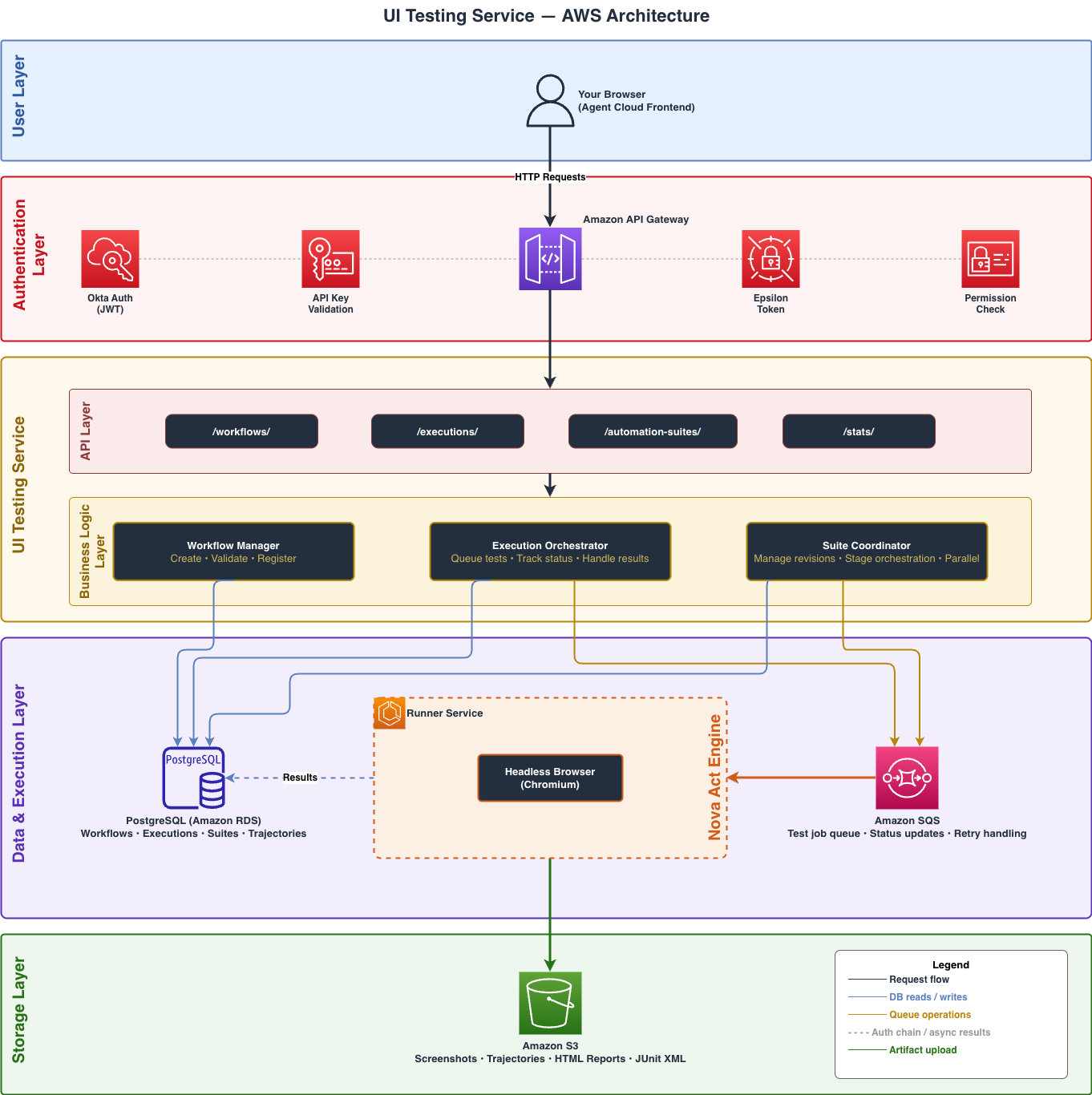
Determine 1: Epsilon’s UI Testing Service structure
Determine 1 reveals the layered structure of Epsilon’s UI Testing Service. Consumer requests movement from the Agent Cloud Frontend via an API Gateway with authentication and permission checks. The API layer (Django REST) exposes endpoints for workflows, executions, automation suites, and stats. The enterprise logic layer features a Workflow Supervisor, Execution Orchestrator, and Suite Coordinator. Take a look at jobs are queued in Amazon Easy Queue Service (Amazon SQS) and picked up by the Runner Service working on Amazon Elastic Container Service (Amazon ECS), which incorporates the Nova Act engine and a headless Chromium browser. Outcomes, screenshots, trajectories, and HTML studies are saved in Amazon S3.
The potential is uncovered as a regular agent (ui-test-agent) with two expertise:
- ui-test-recorder: Discover a state of affairs interactively and file natural-language steps.
- ui-test-executor: Run recorded steps and return structured outcomes.
Onboarded groups eat UI testing the identical method they eat another platform agent. No further infrastructure to handle. The onboarding course of is simple. The platform group provisions a cross-account IAM function for the brand new group, registers their goal software URLs, and grants entry to the ui-test-agent via the present platform API. From that time, groups create workflows, set off executions, and retrieve outcomes via the identical interface they already use for different platform capabilities.
The core integration
The Nova Act + Amazon Bedrock AgentCore Browser Device integration is concise:
This sample (open a managed browser session, join via the CDP WebSocket, and drive actions with pure language) is the muse. Epsilon wraps it with their platform’s multi-tenant orchestration, outcome seize, and observability layers.
Instance: Automating the ‘Create an agent’ movement
For instance intent-based testing, here’s a consultant workflow from Epsilon’s platform. It workout routines login, kind entry, conditional dealing with, scrolling, and verification. The next steps spotlight the differentiating patterns of Nova Act:
| Step | Instruction |
| 1 | Kind the username and select Subsequent |
| 2 | Enter the password and select Confirm |
| 3 | Navigate to Create Agent and choose the Design a brand new specification card |
| 4 | If an onboarding tour field seems, select Skip Tour, then confirm the right web page loaded |
| 5 | Fill within the agent title and outline fields |
| 6 | Scroll down till the Objective Assertion subject is seen, then fill it in |
| 7 | If the talents search field will not be seen, scroll till it seems. Then seek for and add a ability |
| 8 | Select Save, affirm the success immediate, navigate again, and confirm the brand new agent seems within the checklist |
Steps 4 and seven show conditional logic: “if a component seems, deal with it” and “if a goal isn’t seen, scroll till it’s.” These patterns would require specific branching in a standard framework. Nova Act handles them naturally via language understanding.
Runtime isolation
Epsilon runs UI checks in a devoted runner service (a FastAPI sidecar) that pins nova-act 3.x with Workflow and IAM authentication assist, plus the Amazon Bedrock AgentCore Browser Device shopper. This retains dependencies separate from the primary backend in order that they don’t collide with the Strands agent stack. The employee falls again to in-process execution if the runner is disabled, offering resilience throughout deployments.
Greatest practices
Based mostly on their expertise constructing UI testing as a platform functionality, the Epsilon group recommends:
1. Write steps as intent, not mechanics
Intent-based steps survive UI redesigns. Product managers and high quality assurance (QA) leads who may not write code can assessment them straight.
2. Isolate the Nova Act runtime
Pin Nova Act and Amazon Bedrock AgentCore Browser Device dependencies in a devoted service or container. Epsilon discovered that the signing endpoint for Nova Act targets us-east-1 whatever the browser session’s area. Operating it in a separate service with its personal dependency lockfile prevents hard-to-debug conflicts.
3. Reuse recorded trajectories to chop price
Epsilon makes use of trajectory retries in draft state, saves the profitable trajectory, and replays it in energetic state. Repeat runs skip redundant massive language mannequin (LLM) “considering,” decreasing each latency and value for regression-style repeated executions.
4. Design for multi-tenancy from day one
Use cross-account AssumeRole with scoped IAM insurance policies. Every tenant’s checks run underneath their very own function in their very own account. This offers isolation, auditability, and failure scope containment with out customized infrastructure per group.
5. Lean on managed observability
With Amazon Bedrock AgentCore Browser Device, groups get stay view, session recording, and AWS CloudTrail integration. Epsilon makes use of these built-in capabilities as an alternative of constructing customized observability, decreasing upkeep and giving compliance groups acquainted audit surfaces.
6. Account for Amazon Bedrock AgentCore Browser Device viewport habits
When prompting Nova Act steps, account for the browser viewport defaults of Amazon Bedrock AgentCore Browser Device. Steps that reference scrolling (for instance, “scroll down till the Objective Assertion textbox is seen”) confirm that Nova Act handles content material within the decrease portion of the web page accurately.
Outcomes and influence
Epsilon’s UI testing functionality is operational throughout a number of groups, with the multi-tenant structure confirmed in manufacturing.
| Dimension | Amazon Nova Act | Playwright (equal) |
| Strains authored | 18 natural-language steps | ~80-150 strains of code |
| Selector/DOM inspection | None | Required per interactive step |
| Authoring time (per workflow) | ~5-10 minutes | ~30-90 minutes |
| Effort ratio | Baseline | 4-6x extra effort |
Listed here are the measured outcomes:
- 4-6x sooner take a look at authoring (based mostly on Epsilon’s inside benchmarks). A consultant 18-step workflow took 5–10 minutes to creator with Nova Act, in comparison with 30–90 minutes for the equal Playwright script (80–150 strains of code). Every interactive step within the Playwright script requires inspecting the DOM, selecting a secure selector, and coding specific waits, assertions, and branching for conditional circumstances. Nova Act replaces that per-step overhead with 18 natural-language directions and 0 selector or DOM inspection, with conditional logic (such because the tour-box and scroll-until-visible steps) expressed in plain English.
- one hundred pc go fee on trajectory replay (based mostly on Epsilon’s inside benchmarks). After a workflow passes the preliminary discover part (sometimes 4–5 immediate iterations), Epsilon saves the profitable trajectory and replays it deterministically. Saved trajectories obtain a one hundred pc go fee throughout repeated runs.
- Decrease barrier to check authoring. Steps learn like plain English. Workforce members past core take a look at engineers can learn, assessment, and suggest checks, broadening possession of high quality.
- Constructed-in audit path. AWS CloudTrail integration and Amazon Bedrock AgentCore Browser Device session recording made debugging and compliance conversations simpler. This was a profit the group didn’t initially got down to obtain.
- Zero per-team infrastructure overhead. Onboarded groups get UI testing via the identical API floor as each different platform agent. No browser binaries, no Selenium grid, no show servers to handle.
- Go/fail visibility per step. Screenshot seize at every step offers granular debugging context, decreasing imply time to diagnose failures.
“Nova Act allow us to flip UI testing from a brittle, selector-chasing chore right into a managed platform functionality. Our checks now describe intent in plain English, run on AWS managed browsers, and each product group we onboard will get dependable testing with out further configuration.”
— Epsilon Agentic Platform Workforce
Study extra
Epsilon’s Agentic Platform group demonstrated ship resilient, intent-driven UI testing as a managed service utilizing Amazon Nova Act and Amazon Bedrock AgentCore Browser Device. You may apply the identical sample to your personal multi-tenant platform to remove browser infrastructure overhead and make take a look at authoring accessible to non-engineers.
If you wish to construct related intent-driven UI testing capabilities with Amazon Nova Act and Amazon Bedrock AgentCore Browser Device, listed here are assets to get began:
To be taught extra about how your group can use intent-based browser automation for testing, go to the Amazon Nova Act product web page.
Epsilon is a Publicis Groupe firm. Study extra at epsilon.com.
In regards to the authors