

Over the previous yr, as we constructed Amazon Fast, our brokers went from answering inquiries to taking actions: scheduling conferences, working analysis, producing reviews. Because the system developed, one downside saved resurfacing: there was no shared definition of the primitives that agentic work is constructed from. The identical few concepts saved getting rebuilt below completely different names: an actor that does the work, a sign that begins it, a packaged process, and a reminiscence that carries classes ahead. This repetition leaked into product design and onto the person.
Take the person who says “monitor my Slack channel and ship me a every day digest”. Is {that a} new agent, a scheduled instruction to an current one, a workflow, or a talent? These are completely different questions, however with out a shared vocabulary they collapse into one complicated alternative.
This publish shares the taxonomy we converged on: one set of primitives discovered by decomposing agentic work into 4 plain questions: When?, What?, Who?, and How? Many of the framework stays invisible to finish customers by design, however a shared vocabulary makes the system simpler to purpose about for anybody constructing beneath it.
The framework at a look
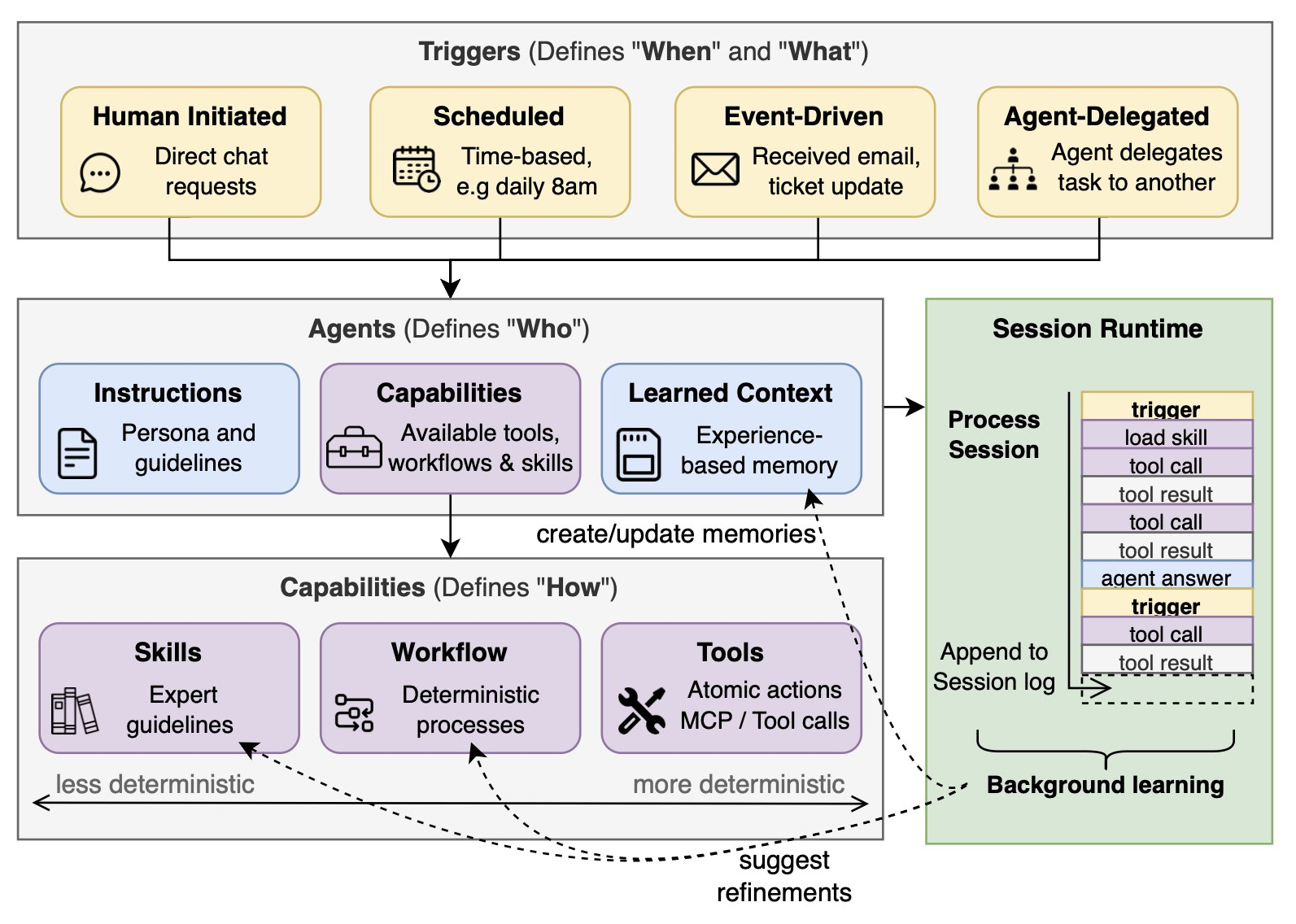
Determine 1: How triggers, brokers, and capabilities relate, with studying feeding again from the session runtime
A set off begins the work and carries the duty (When and What), an agent takes it on (Who) and makes use of its capabilities (instruments, expertise, and workflows) to carry out the duty (How). This publish describes these primitives and the way they relate to at least one one other. It’s the primary publish in a collection, and upcoming posts cowl our agentic working system, background studying, proactive feeds, and way more.
Triggers: What causes work to start
Triggers are the activation mechanism for getting work performed, however in addition they carry directions: a human message is each the second of activation and the outline of what to do. They’re each the When? and the What? of a job.
- Human-initiated: An individual opens a dialog and asks the agent to do one thing. Interactive, synchronous, conversational.
- Agent-delegated: One agent, mid-task, invokes one other to deal with a sub-problem. Programmatic, composable, doubtlessly recursive.
- Scheduled: Time-based activation, like “run monetary analysis each Monday at 9am.” Deterministic, with the identical standing directions utilized throughout runs.
- Occasion-driven: A sign from an exterior system, equivalent to a brand new electronic mail, a Slack point out, a file change, or a webhook.
The kind of set off situations the execution: a scheduled background job may keep conservative (for instance, do nothing if unsure), whereas a human-initiated one can be responsive (for instance, ask relatively than cease).
Brokers
We outline an agent as a persistent, studying actor. It’s the Who? in any execution, and the anchor towards which studying accrues. Two brokers given similar enter can differ, as a result of they carry completely different directions, capabilities, and histories. The agent isn’t the directions it follows. It’s the entity that interprets them. It consists of three issues:
- Directions: Standing steerage defining persona, position, context information, and working ideas. A Finance Agent behaves otherwise from a normal assistant primarily due to this.
- Capabilities: The instruments, expertise, workflows, and sub-agents obtainable to be used, up to date dynamically. A charting library could be added in a single session and eliminated the subsequent.
- Discovered context: Reminiscence that accumulates by means of use: the queries that work for a device, the formatting customers desire, the sting circumstances they care about. That is how the tenth execution beats the primary with out anybody altering the directions.
Every thing else is extrinsic: the massive language mannequin (LLM) underlying the agent is a swappable mannequin parameter, dialog historical past is per-session state, and triggers belong to the platform.
A consequence of this definition is {that a} person request “I would like an agent that screens my Slack and sends a digest each morning” is normally a set off added to an current agent, not a brand new agent or workflow. With this framing, we will merge chat, scheduled, and “autonomous” brokers into one actor you could converse with, schedule, and that may orchestrate and examine its personal previous work.
Capabilities
Capabilities are How an agent acts, spanning a spectrum from totally agentic to completely deterministic. That axis is mostly a confidence contract: how a lot latitude the agent retains versus how a lot the person fixes prematurely.
Instruments are atomic operations with a typed schema: ship an electronic mail, question a database, learn a file. Whether or not a neighborhood perform, a Mannequin Context Protocol (MCP) server, or one other agent behind a protocol boundary, the caller sees the identical interface: identify, description, parameters, consequence.
Abilities are structured steerage with room for judgment: directions bundled with assets (templates, scripts, examples) that describe an strategy relatively than a inflexible sequence. They load by means of progressive disclosure, so the agent sees solely names and quick descriptions till one turns into related, then reads the total directions in. A talent can due to this fact bundle arbitrary depth of experience with out a fixed price.
Workflows are deterministic coordination: declared steps, management circulate, branching, and error dealing with that execute in fastened order, with resolution logic in code relatively than mannequin inference. Consider a purchase-approval route: funds examine, supervisor sign-off, then finance, every recorded. The route is fastened, however the judgment inside a step continues to be the agent’s.
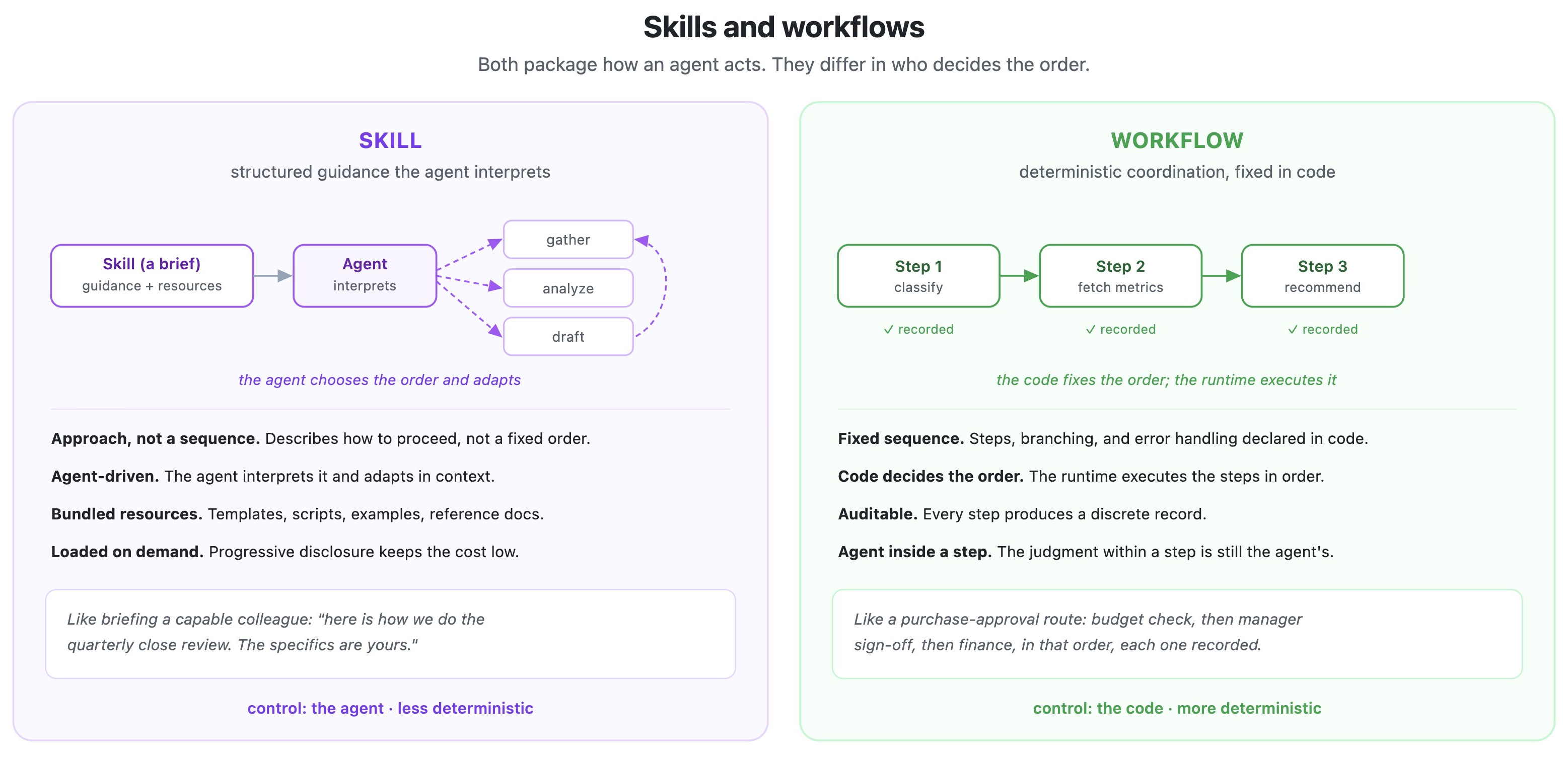
Determine 2: Abilities versus workflows, which differ in whether or not the agent or the code decides the step order
Why expertise and workflows outlast mannequin enhancements
A pure query arises: if fashions preserve bettering, gained’t expertise and workflows develop into pointless? We don’t assume so, as a result of every holds worth unbiased of mannequin functionality. Abilities are the unit for capturing, versioning, and sharing institutional experience, whereas workflows ship auditability, step-wise visibility, and deterministic multi-service coordination. Nor are they fastened: a well-understood talent can tighten right into a workflow (crystallization), a workflow that retains hitting edge circumstances can loosen again right into a talent (dissolution). That is performed in Fast by means of our steady studying framework, which we are going to describe in a future publish.
What this implies in apply
Return to “monitor my Slack channel and ship me a every day digest”. As a result of these primitives compose, the identical request could be met a number of legitimate methods:
- A scheduled job with a one-line instruction, leaving the agent to determine the remainder.
- The identical job backed by a talent with express formatting guidelines and channel priorities.
- The identical job invoking a workflow with deterministic steps and error dealing with.
All three produce a every day digest on a schedule. What differs is the arrogance contract. A person who trusts the agent desires the primary, one burned by inconsistency the second, one working a compliance-sensitive course of the third.
Studying shifts that trajectory over time. A job that begins as one sentence (“examine my electronic mail for pressing gadgets”) accumulates domain-bound learnings: efficient queries, most popular formatting, and which senders matter. The tenth run is markedly higher, with nobody encoding that by hand. The precise design is the best possibility that meets the person’s confidence requirement, with a path to graduate by means of autonomous studying once they want extra.
Conclusion
The worth of this agentic primitive taxonomy is that 4 plain questions, When, What, Who, and How, are sufficient to put any piece of agentic work, from a one-line chat request to a scheduled, compliance-grade course of. Sharing one vocabulary lets builders purpose concerning the system and lets the product conceal complexity. Better of all, the person by no means has to study any of it. They are saying what they need, and the system assembles the suitable primitives to do their job.
Subsequent within the collection: the agentic working system that builds on these primitives and powers Amazon Fast.
Hold exploring
Concerning the authors