
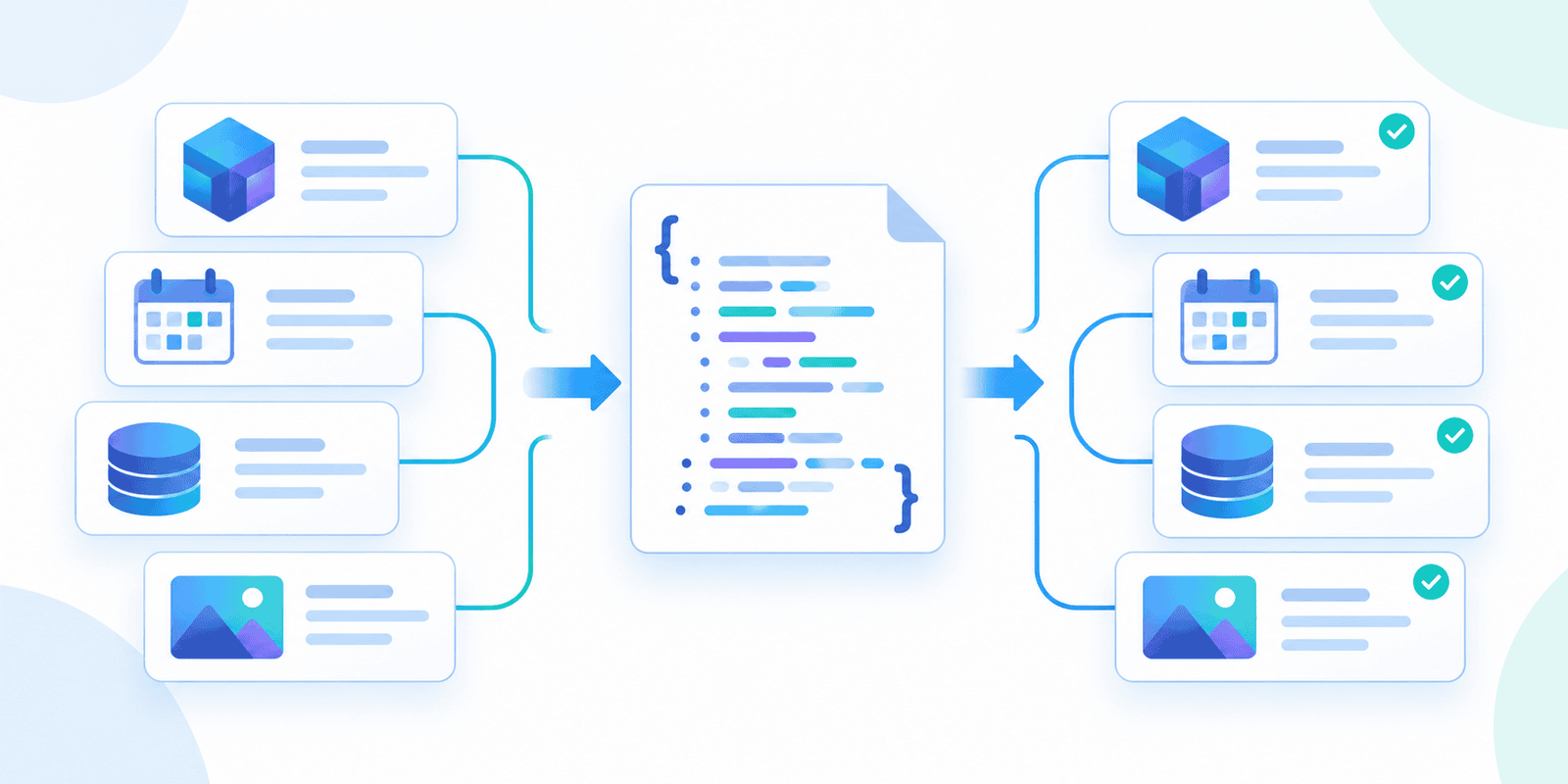
On this article, you’ll discover ways to construct a strong JSON serialization pipeline in Python that handles customized knowledge varieties, swish error restoration, and schema migrations.
Matters we are going to cowl embrace:
- outline a customized JSON encoder to deal with Python varieties like
datetime,set,Path, andEnum. - write a customized decoder operate that reconstructs these unique Python objects from a serialized JSON string, together with swish dealing with of malformed knowledge.
- handle schema adjustments over time utilizing a manufacturing unit operate that applies defaults and migrations throughout deserialization.

Introduction and Motivation
Anybody pretty skilled in setting up machine studying pipelines may need seen at some stage that solely a small proportion of their time is devoted to writing the mannequin structure. What do they spend the remainder of that point on? Knowledge plumbing: the method of cleansing, preprocessing, and remodeling knowledge to make it look completely digestible for downstream fashions.
This text tackles a hidden payoff usually found alongside the machine studying engineering journey: the fixed want to maneuver structured datasets between information, processes, microservices, and APIs. All through these processes, you want an answer to serialize and deserialize knowledge in a dependable and sturdy style.
We are going to discover some sensible methods for serializing customized varieties in a means that permits parsing them again securely, in addition to managing knowledge schema adjustments and coping with malformed knowledge — all with out essentially crashing the entire pipeline!
Earlier than going deep into the three-step answer, let’s take a look at the foundation drawback: JSON limitations when encountering sure knowledge varieties like datetime, set, Path, or Enum. Suppose that is the configuration for a machine studying experiment:
|
1 2 3 4 5 6 7 8 9 10 11 12 13 14 15 16 17 18 19 |
from datetime import datetime from enum import Enum from pathlib import Path import json
class ModelType(Enum): RANDOM_FOREST = “rf” NEURAL_NET = “nn”
experiment_config = { “experiment_id”: 1042, “model_type”: ModelType.NEURAL_NET, “options”: {“age”, “earnings”, “location”}, # A set! “data_path”: Path(“/knowledge/v2/prepare.csv”), “timestamp”: datetime.now(), “nested_meta”: { “retries”: 3 } } |
The second you attempt to serialize this experiment configuration utilizing json.dumps(experiment_config), you’ll instantly come throughout an error like this:
|
TypeError: Object of kind ModelType is not JSON serializable |
These sorts of errors are what we’re about to repair by defining a strong pipeline for encoding and decoding JSON objects with customized varieties.
1. Defining a Customized Encoder
First, we are going to outline a customized encoder class that inherits from json.JSONEncoder. That is essential to have the ability to “customise” the prevailing json.dumps() with the additional logic we are going to implement in our class to deal with customized knowledge varieties that JSON can not deal with by default.
Apart from subclassing json.JSONEncoder, we additionally must override the default() technique. That is the place, one after the other, we are going to outline the customized method to deal with every particular knowledge kind we would must work with, utilizing conditionals within the kind if isinstance(obj, DATA_TYPE):, changing DATA_TYPE with a selected knowledge kind or class identify, as proven beneath:
|
1 2 3 4 5 6 7 8 9 10 11 12 13 14 15 16 17 18 19 20 21 22 23 24 |
class RobustEncoder(json.JSONEncoder): def default(self, obj): # Dealing with Datetimes if isinstance(obj, datetime): return {“__type__”: “datetime”, “worth”: obj.isoformat()}
# Dealing with Units (convert to checklist for JSON) if isinstance(obj, set): return {“__type__”: “set”, “worth”: checklist(obj)}
# Dealing with Paths (convert to string) if isinstance(obj, Path): return {“__type__”: “path”, “worth”: str(obj)}
# Dealing with Enums (extract the underlying worth) if isinstance(obj, Enum): return obj.worth
# Letting the bottom class deal with all the things else (or increase TypeError) return tremendous().default(obj)
# Serializing our config object json_string = json.dumps(experiment_config, cls=RobustEncoder, indent=2) print(json_string) |
Yet another essential element: the additional trick for sturdy serialization within the above code is attaching the __type__ marker to things which may lose their unique typing when they’re become JSON primitives. This happens, for example, when changing Python units into lists.
Discover how we use cls=RobustEncoder on this new name to json.dumps() to make use of our customized encoder.
Outcome:
|
1 2 3 4 5 6 7 8 9 10 11 12 13 14 15 16 17 18 19 20 21 22 23 |
{ “experiment_id”: 1042, “model_type”: “nn”, “options”: { “__type__”: “set”, “worth”: [ “income”, “location”, “age” ] }, “data_path”: { “__type__”: “path”, “worth”: “/knowledge/v2/prepare.csv” }, “timestamp”: { “__type__”: “datetime”, “worth”: “2026-09-28T14:26:10.328310” }, “nested_meta”: { “retries”: 3 } } |
No TypeError anymore!
2. Defining a Customized Decoder
For the inverse course of — acquiring Python objects again from a serialized JSON string — the bottom line is utilizing a unique technique and argument: json.masses() alongside an object_hook parameter.
We don’t must outline a category by way of inheritance this time, however we do create a customized operate named robust_decoder which, when handed to json.masses(), will run on all nested dictionaries within the JSON string throughout parsing. The code consists of the logic to reconstruct unique Python objects, corresponding to Path, as wanted:
|
1 2 3 4 5 6 7 8 9 10 11 12 13 14 15 16 17 18 19 20 21 22 23 24 25 26 27 |
import logging
def robust_decoder(dct): # Checking if this dictionary represents certainly one of our customized varieties if “__type__” in dct and “worth” in dct: type_name = dct[“__type__”] val = dct[“value”]
attempt: if type_name == “datetime”: return datetime.fromisoformat(val) elif type_name == “set”: return set(val) elif type_name == “path”: return Path(val) besides (ValueError, TypeError) as e: # Dealing with Malformed Knowledge: Logging the error with out inflicting a crash. # Return a secure fallback or a specialised error dictionary. logging.warning(f“Malformed {type_name} knowledge detected: {e}. Falling again to uncooked worth.”) return val
return dct
# Deserialize again to Python objects parsed_config = json.masses(json_string, object_hook=robust_decoder) print(kind(parsed_config[“timestamp”])) print(kind(parsed_config[“features”])) |
The operate additionally consists of exception dealing with in case malformed knowledge is encountered.
Outcome (output of the 2 print calls):
|
<class ‘datetime.datetime’> <class ‘set’> |
3. Coping with Schema Adjustments
One additional widespread problem in machine studying tasks is that mannequin metadata schemas (mannequin specs or configuration, in easier phrases) change continually. It’s not uncommon so as to add new hyperparameters, deprecate previous ones, or rename a metric. Loading previous JSON config objects into newer variations of your code subsequently usually requires wrapping the deserialized dictionary in an extra validation layer.
The next manufacturing unit operate can assist obtain this, aided by the sturdy decoder operate we carried out earlier:
|
1 2 3 4 5 6 7 8 9 10 11 12 13 14 15 16 17 18 |
def load_experiment_config(json_data: str) -> dict: # 1. Deserializing with our sturdy hook raw_dict = json.masses(json_data, object_hook=robust_decoder)
# 2. Making use of Schema Migrations / Defaults # Our older configuration did not have ‘learning_rate’, so we offer a secure default. validated_config = { “experiment_id”: raw_dict.get(“experiment_id”, “unknown”), “model_type”: raw_dict.get(“model_type”, “rf”), “options”: raw_dict.get(“options”, set()), “data_path”: raw_dict.get(“data_path”, Path(“./default_data.csv”)), “timestamp”: raw_dict.get(“timestamp”, datetime.now()), “learning_rate”: raw_dict.get(“learning_rate”, 0.001), # New schema hyperparameter “nested_meta”: raw_dict.get(“nested_meta”, {}) }
# 3. Discarding deprecated fields (e.g., if ‘old_metric’ was in raw_dict, optionally drop it right here) return validated_config |
We explicitly added the defaulting mechanism for a "learning_rate" hyperparameter that didn’t exist within the unique schema, however you’ll be able to observe the same method for some other new hyperparameter that must be current in your up to date mannequin specs.
Let’s take a look at how this enhanced technique works by passing the unique JSON string by way of the complete pipeline:
|
print(“Uncooked JSON being loaded:”) print(json_string) print(“n” + “=”*40 + “n”)
# Processing the uncooked, unique JSON object by way of our sturdy loading and validation pipeline final_config = load_experiment_config(json_string)
print(“— Validated Python Configuration —“) for key, worth in final_config.objects(): # Printing the important thing, the reconstructed worth, and its underlying Python kind print(f“{key}: {worth} (Sort: {kind(worth).__name__})”) |
Outcomes:
|
1 2 3 4 5 6 7 8 9 10 11 12 13 14 15 16 17 18 19 20 21 22 23 24 25 26 27 28 29 30 31 32 33 34 35 |
Uncooked JSON being loaded: { “experiment_id”: 1042, “model_type”: “nn”, “options”: { “__type__”: “set”, “worth”: [ “income”, “location”, “age” ] }, “data_path”: { “__type__”: “path”, “worth”: “/knowledge/v2/prepare.csv” }, “timestamp”: { “__type__”: “datetime”, “worth”: “2026-09-28T14:26:10.328310” }, “nested_meta”: { “retries”: 3 } }
========================================
—– Validated Python Configuration —– experiment_id: 1042 (Sort: int) model_type: nn (Sort: str) options: {‘earnings’, ‘location’, ‘age’} (Sort: set) data_path: /knowledge/v2/prepare.csv (Sort: PosixPath) timestamp: 2026–09–28 14:26:10.328310 (Sort: datetime) learning_rate: 0.001 (Sort: float) nested_meta: {‘retries’: 3} (Sort: dict) |
Wrapping Up
Via three sensible steps, we’ve got discovered take full management of Python’s instruments for serializing and deserializing JSON objects. These steps will be mixed to kind a strong serialization pipeline that handles customized knowledge varieties which might in any other case increase errors. Not solely can we deal with nested JSON objects by way of the courses and features we outlined, however they’re additionally designed to fail gracefully when malformed knowledge is encountered. These methods can meaningfully sharpen your knowledge plumbing abilities for machine studying engineering.