
Important cloud exposures pile up sooner than safety groups can shut them. Cloud-native utility safety platforms (CNAPP), cloud suppliers, and posture scanners generate extra findings than any crew can triage, and threat accumulates within the hole between detected and glued. Most findings sit untouched, not as a result of they’re onerous to repair. Somebody should examine context, determine the proprietor, affirm the repair received’t break manufacturing, after which do it at a quantity that outpaces headcount.
On this put up, we share how Tamnoon constructed Tami, an agentic cloud remediation orchestrator on Amazon Bedrock, to shut that hole. Tami autonomously investigates findings ingested from CNAPP and cloud-native sources and assesses whether or not remediation is protected. It then generates and orchestrates the repair with guardrails and governance wherever a change touches a buyer’s cloud. The strategy drove an over 90 p.c discount in crucial cloud publicity in 90 days with zero manufacturing points.
About Tamnoon
Tamnoon is an AI-powered cloud safety remediation platform that works alongside CNAPPs. Its AI assistant, Tami, helps human cloud safety specialists examine, prioritize, and safely remediate misconfigurations and points throughout buyer environments in AWS, Azure, Google Cloud, and different cloud suppliers.
Tamnoon integrates with the CNAPPs and cloud-native instruments groups already use and turns their findings into validated, production-safe fixes. A lot of the work together with investigation, prioritization, and remediation planning occurs earlier than something touches a stay atmosphere, which is what makes automated remediation reliable at scale.
A safety engineer can spend hours investigating a single discovering. Typically, it traces again to the identical root trigger as dozens of different alerts.
- Alert quantity overwhelms headcount: CNAPPs and scanners generate hundreds of findings. Groups can’t triage all of them, so crucial exposures sit unresolved whereas threat compounds for months.
- Investigation is handbook and repetitive: Every discovering requires context gathering on who owns the useful resource, what relies on it, whether or not the repair is protected. This eats hours of senior engineer time, repeated throughout each merchandise within the backlog.
- Worry of manufacturing affect blocks automation: Groups hesitate to automate remediation as a result of they’ll’t threat taking down manufacturing. With out confidence {that a} repair is protected, nothing strikes.
- Reactive prioritization: With no method to cluster associated findings or rating remediation confidence, groups work via alerts linearly quite than addressing root causes that resolve many points without delay.
Tamnoon’s resolution addresses the complete pipeline from discovering ingestion to validated repair. The platform treats these challenges as interconnected quite than remoted issues.
Answer overview
Tamnoon takes you from preliminary discovering to executing the repair. The platform ingests findings from CNAPP, Cloud Safety Posture Administration (CSPM) suppliers, and different safety instruments and normalizes them right into a unified schema. It then enriches them with asset and publicity context and prioritizes them. From there, the agentic layer takes over utilizing a set of specialised AI brokers, every working in an event-driven, serverless structure on AWS, so each stage scales independently and fails safely.
Agentic structure on Amazon Bedrock
The platform delegates work to 4 specialised brokers, every accountable for a definite part of the remediation pipeline:
- An investigation agent attracts on coaching from hundreds of thousands of actual buyer cloud environments to find out context, filters that context via a big language mannequin (LLM)-as-a-judge validation layer. It causes via the remediation aim, operational scope, and cloud-provider-specific verification, producing read-only investigation steps and a whole investigation plan.
- A security-scoring agent builds an proof chain per asset, combining automated verification outcomes with analyst findings. It classifies every discovering’s remediation as SAFE, RISKY, or AWAITING DATA with a intentionally conservative bias. When doubtful, it downgrades.
- A remediation agent prompts just for findings that the security agent has deemed protected. It causes via ordering, dependencies, and situations, then produces a remediation plan during which each step follows a backup, remediate, and confirm construction and contains rollback steerage.
- A code-generation agent turns plan steps into executable remediation, however solely after an enter guardrail screens for relevance and immediate injection. Each artifact passes an automatic generate-and-review loop during which a separate reviewer agent should approve the output.
Why Amazon Bedrock
When the Tamnoon crew got down to construct Tami, the selection of basis mannequin (FM) platform was going to form every part that adopted. Tamnoon’s remediation brokers don’t all do the identical sort of work. Some carry out deep investigative reasoning to know the basis reason behind a safety discovering. Others deal with high-volume validation, checking proposed fixes rapidly and cheaply. Nonetheless others assessment generated code, balancing high quality in opposition to value on each job. Matching every of those jobs to the best mannequin, with out stitching collectively a distinct integration for each, was a core requirement.
That requirement is what made Amazon Bedrock the pure match. By way of a single API, every agent can name the inspiration mannequin greatest suited to its job. Probably the most succesful fashions deal with the toughest reasoning. Extra environment friendly fashions tackle the repetitive, high-throughput work. Evaluation-focused fashions optimize the trade-off between output high quality and value. As a result of it’s one integration quite than many, fashions could be swapped or upgraded because the panorama evolves, with out re-plumbing the structure every time.
Operational overhead at scale was one other issue within the resolution. As request quantity grew, Tamnoon wished to keep away from constructing and sustaining its personal logic to distribute site visitors throughout regional capability. Amazon Bedrock Cross-Area inference handles this robotically. It robotically routes inference requests to the optimum AWS Area inside an outlined geographic boundary, sustaining throughput with out requiring any customized routing code to function.
Safety was the ultimate consideration, and for a cloud safety firm it was non-negotiable. With Bedrock, inference runs inside Tamnoon’s personal AWS atmosphere beneath AWS Identification and Entry Administration (IAM)-scoped permissions. Delicate buyer knowledge by no means leaves the belief boundary. That gave the crew confidence that the platform underpinning Tami met the identical customary Tamnoon holds its personal service to.
How Tamnoon integrates with CNAPPs and cloud safety instruments
Tamnoon sits downstream of the detection instruments safety groups already run. CNAPPs like Wiz, CrowdStrike, Palo Alto Cortex, Upwind, SentinelOne, Orca, and Cyera together with cloud-native providers like AWS Safety Hub and Amazon GuardDuty are the supply of reality for what’s unsuitable within the atmosphere. Tamnoon connects via API-based integrations and normalizes findings into a standard format, so a misconfiguration seems to be the identical whether or not it got here from Wiz or GuardDuty. The detection instruments stay the inspiration. Tamnoon delivers the end-to-end remediation that follows.
For each discovering it really works, Tami assigns a Remediation Confidence Indicator (RCI) of SAFE, RISKY, or AWAITING DATA. That ranking tells groups what could be automated and what wants human assessment first.
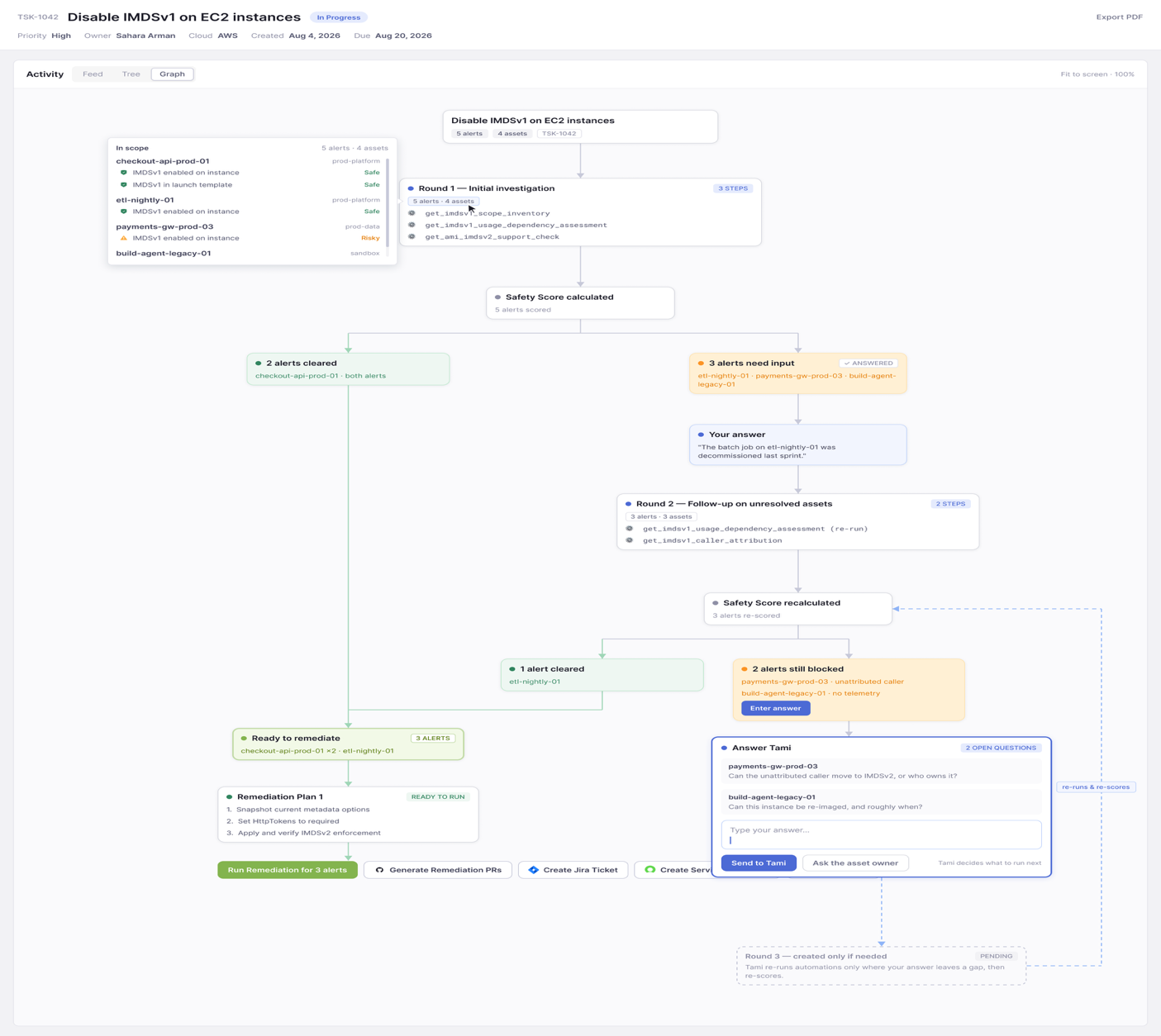
Determine 1: Tamnoon in motion
Tamnoon AWS structure
Tamnoon runs totally inside its personal AWS accounts, remoted per atmosphere. Customers entry the platform via a single safe entry level constructed on Amazon API Gateway, with encryption managed by AWS Certificates Supervisor and sign-in dealt with by Amazon Cognito. The whole lot behind that entry level runs in non-public networks throughout a number of Availability Zones, so the core platform is rarely instantly uncovered to the web.
Inside that atmosphere, Tamnoon combines two sorts of compute. Amazon Elastic Kubernetes Service (Amazon EKS) runs the always-on providers behind the dashboard, whereas AWS Lambda powers the event-driven work of amassing findings, analyzing them, and executing remediations. A set of AWS messaging and workflow providers, together with Amazon EventBridge, Amazon Easy Queue Service (Amazon SQS), and AWS Step Capabilities, coordinate these steps so massive volumes of findings are processed reliably and in parallel, with no single dangerous file stalling the remaining.
The AI layer runs on Amazon Bedrock. Amazon Bedrock AgentCore, a platform to construct, join, and optimize brokers at scale with any framework or mannequin, offers Tamnoon’s brokers a ruled method to take motion as a substitute of open-ended entry. Amazon Bedrock Guardrails then assessment each the request and the generated code earlier than something strikes ahead. Supporting providers deal with the remainder of the platform: managed databases and caching for state, Amazon Easy Storage Service (Amazon S3) for playbooks and artifacts, and AWS Secrets and techniques Supervisor for credentials, so delicate keys by no means stay in utility code.
On the shopper aspect, every part to the left of the AWS Cloud boundary is what prospects join into Tamnoon. They will hyperlink their very own AWS, Azure, and Google Cloud accounts, plug within the safety instruments their findings come from, and join the locations the place they need outcomes delivered, reminiscent of Slack, Jira, ServiceNow, and GitHub.
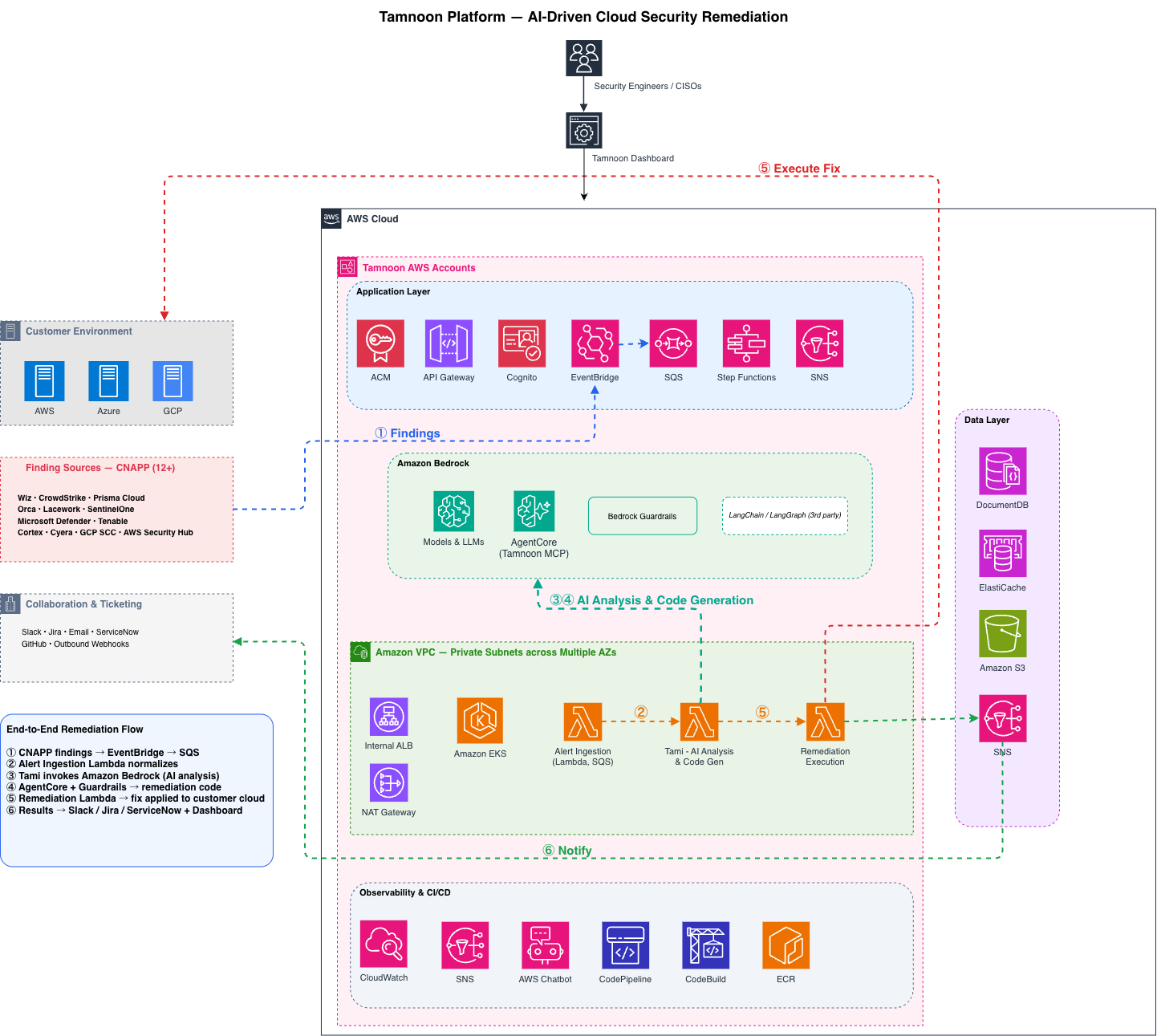
Determine 2: Tamnoon AWS structure
How Tamnoon maintains zero manufacturing points
Zero manufacturing points is a actuality for Tamnoon’s prospects, and it’s no accident. Autonomy at Tamnoon sits inside a defense-in-depth security structure, the place every layer assumes the one earlier than it’d miss one thing.
It begins earlier than any repair is even drafted. No remediation is written till an unbiased security evaluation, targeted on scope and intentionally biased towards warning, concludes that the change is protected to make. From there, the platform attracts a tough line between studying and writing. Investigation steps are validated as strictly read-only, so the work of understanding an issue can by no means alter it. Solely the remediation path is allowed to vary something, and each change it makes carries its personal backup, verification, and rollback steps.
That self-discipline is strengthened by fixed self-critique. Every era step is paired with a mirrored image step that checks the output and feeds its critique again into regeneration, so the system is at all times reviewing its personal work quite than trusting it outright. These suggestions are additionally saved grounded in actuality. Agent output is validated in opposition to automation outcomes, person suggestions, and coaching knowledge drawn from actual mounted alerts, and when the mannequin can’t attain an correct consequence by itself, a human is introduced into the loop.
The ultimate safeguard is in the intervening time of execution. The AI by no means holds cloud credentials. As an alternative, execution is brokered via short-lived, tenant-scoped credentials beneath customer-controlled belief, working in an remoted atmosphere saved separate from the brokers that plan the work. Wrapping all of that is human governance: remediations movement via an approval workflow with a full audit path, and each AI functionality is confirmed internally earlier than it ever reaches a buyer.
Information safety and compliance
Tami causes over delicate buyer knowledge: alert payloads, useful resource identifiers, misconfigurations, and remediation context. That knowledge should keep contained in the AWS belief boundary, run with least privilege, and keep auditable. Standardizing on Amazon Bedrock makes that attainable.
Delicate content material stays inside AWS
Each Tami workload invokes Anthropic Claude on Amazon Bedrock via the ChatBedrockConverse interface, quite than calling a third-party LLM endpoint. That single selection places the complete AI provide chain beneath one AWS native service, which has actual penalties for the way buyer knowledge is dealt with. Inference runs totally inside Tamnoon’s personal AWS account in US industrial Areas, so knowledge by no means leaves AWS. For details about mannequin availability by Area, check with Supported fashions by AWS Area in Amazon Bedrock. As a result of Bedrock doesn’t retain or practice on prompts or completions, buyer knowledge by no means reaches an exterior vendor within the first place.
That boundary holds at the same time as workloads scale. Bedrock Cross-Area inference robotically routes requests to Areas inside the US geographic boundary, rising the throughput accessible to the applying. The compute behind it stays non-public as nicely. Every service runs as an AWS Lambda perform hooked up to a digital non-public cloud (VPC), in non-public subnets with an specific safety group, no public ingress, and tightly managed egress.
Guarding what reaches the mannequin
Payloads can carry delicate element, so Tami applies Amazon Bedrock Guardrails to each request and response. The coverage is enforced on the Bedrock layer, which suggests it covers all three providers uniformly and no particular person perform’s immediate logic can bypass it. That single enforcement level does a number of issues without delay.
First, it protects delicate knowledge. PII and secret-like content material is masked earlier than it’s ever persevered or surfaced, so nothing delicate lingers the place it doesn’t belong. It additionally guards in opposition to immediate injection, which issues as a result of Tami causes over untrusted findings that an unauthorized person might affect. Filtering on the guardrail layer stops a crafted payload from hijacking the mannequin or exfiltrating context. Lastly, denied subjects and content material filters hold the mannequin’s output scoped to safety remediation and nothing else. Each intervention is logged alongside AWS CloudTrail, giving enterprise prospects a transparent path of governance proof.
Least-privilege entry
Entry throughout the platform runs via a devoted per-service IAM execution function, so every perform can attain solely what it wants and nothing extra. That precept is best to see in how Tami touches Amazon Bedrock. Its solely Bedrock permission is bedrock:InvokeModel, scoped to particular inference-profile and foundation-model ARNs. It has no capability to handle, practice, or export fashions.
The identical self-discipline extends to each different dependency. Entry to AWS Secrets and techniques Supervisor is proscribed to the 2 secrets and techniques a perform truly makes use of, SQS entry is confined to its personal enter queue, and Amazon CloudWatch writes are restricted by namespace. There are not any broad, catch-all roles anyplace within the design. Capabilities connect solely to the managed AWSLambdaBasicExecutionRole and AWSLambdaVPCAccessExecutionRole insurance policies, and nothing wider than that.
Multi-tenant isolation and governance
Maintaining tenants separated is a foundational requirement, and it’s enforced from the very first name. Service-to-service calls use OAuth2 shopper credentials via Cognito, scoped per utility, and work is processed one SQS message at a time with its tenant context hooked up. In consequence, a single invocation solely ever touches one tenant’s knowledge.
A lot of this assurance comes from treating all the platform as code. IAM insurance policies, community placement, mannequin IDs, and alarms all stay in versioned AWS CloudFormation and SAM templates, so each permission and mannequin model is reviewable in supply management with no handbook console adjustments to float out of sync. Mannequin variations specifically are pinned to dated identifiers, for instance claude-sonnet-4-5-20250929, which suggests a mannequin change is at all times an specific, reviewed code change quite than a silent improve.
That transparency carries via to runtime. Each inference name lands in AWS CloudTrail, attributable to the invoking function, and deterministic decoding with temperature set to zero retains scoring and planning constant from one run to the following. Failure dealing with is ruled with the identical rigor. Every service has an enter queue with redrive, an error-handler perform, a dead-letter queue, and CloudWatch alarms on timeouts and DLQ depth wired to on-call. Failures are contained and observable, and by no means silently dropped.
Outcomes and affect
Tami has analyzed greater than 14 million cloud alerts throughout Tamnoon’s buyer base, a quantity tracked in Tamnoon’s 2026 State of Cloud Remediation report. The choices Tami makes replicate patterns discovered from these real-world environments.
For a typical buyer, the outcomes present up quick, often inside 90 days.
| Metric | Earlier than | After |
| Important cloud publicity | Compounds for months as alerts outpace headcount | As much as 90% discount in 90 days (supply) |
| Remediation effectivity | Hundreds of uncooked alerts, no clear prioritization | As much as 100x effectivity via root-cause clustering (supply) |
| Manufacturing points | Groups keep away from automation due to threat | Zero manufacturing points throughout hundreds of thousands of workloads |
| Engineer time | Hours per discovering, repeated throughout backlog | 13,000+ hours saved per week throughout buyer base (supply) |
The compression and zero-issue figures come from Tamnoon’s analysis. The sample is constant, exhibiting fewer open exposures, far much less handbook work, and no downtime from the fixes themselves.
Conclusion
Constructing an agent that may purpose a few cloud discovering is the easy half. Constructing one you’d belief to behave on manufacturing is the onerous half. Amazon Bedrock is a completely managed service that gives entry to high-performing basis fashions together with the tooling to construct agentic purposes: orchestration, software use, and guardrails, via a single API. That mixture issues right here for a selected purpose: performing on manufacturing cloud infrastructure calls for each sturdy reasoning and onerous security boundaries.
4 issues make that attainable:
- Your exposures truly shut: Tamnoon operates on stay cloud infrastructure, not on tickets or workflow automation. The backlog goes down as a substitute of sideways.
- Autonomy scales with out manufacturing threat: Each proposed motion carries a confidence ranking. SAFE actions can auto-execute whereas AWAITING DATA or RISKY actions pull in Tamnoon’s embedded cloud engineers.
- Runs on the stack you already purchased: Tamnoon works on prime of common CNAPPs and cloud safety tooling. Each detection software you already pay for begins paying off as a result of its findings lastly get closed.
- Workforce capability scales with out rising: Quick, protected adoption of frontier AI means extra exposures closed per analyst, with no added headcount.
Subsequent steps
To get began with an analogous structure, take into account the next:
In regards to the authors