
Organizations accumulate knowledge in lots of varieties. Structured knowledge lives in databases and spreadsheets, whereas unstructured knowledge sits in paperwork, reviews, and recordsdata saved throughout file methods. Analyzing each collectively sometimes requires switching between a number of instruments, working separate queries, and manually correlating outcomes.
Amazon Fast addresses this with a unified expertise. You may join structured knowledge by means of enriched datasets and unstructured knowledge by means of S3-backed data bases. You may then question each by means of a single conversational AI agent.
On this submit, you discover ways to:
- Join Amazon Easy Storage Service (Amazon S3) as a knowledge supply and create a data base.
- Construct a Area that mixes structured and unstructured knowledge.
- Create and configure a customized chat agent that queries throughout each knowledge varieties.
- Ask questions that span structured and unstructured sources in a single dialog.
Answer structure
The next diagram illustrates how every element connects to ship a unified knowledge expertise by means of Amazon Fast.
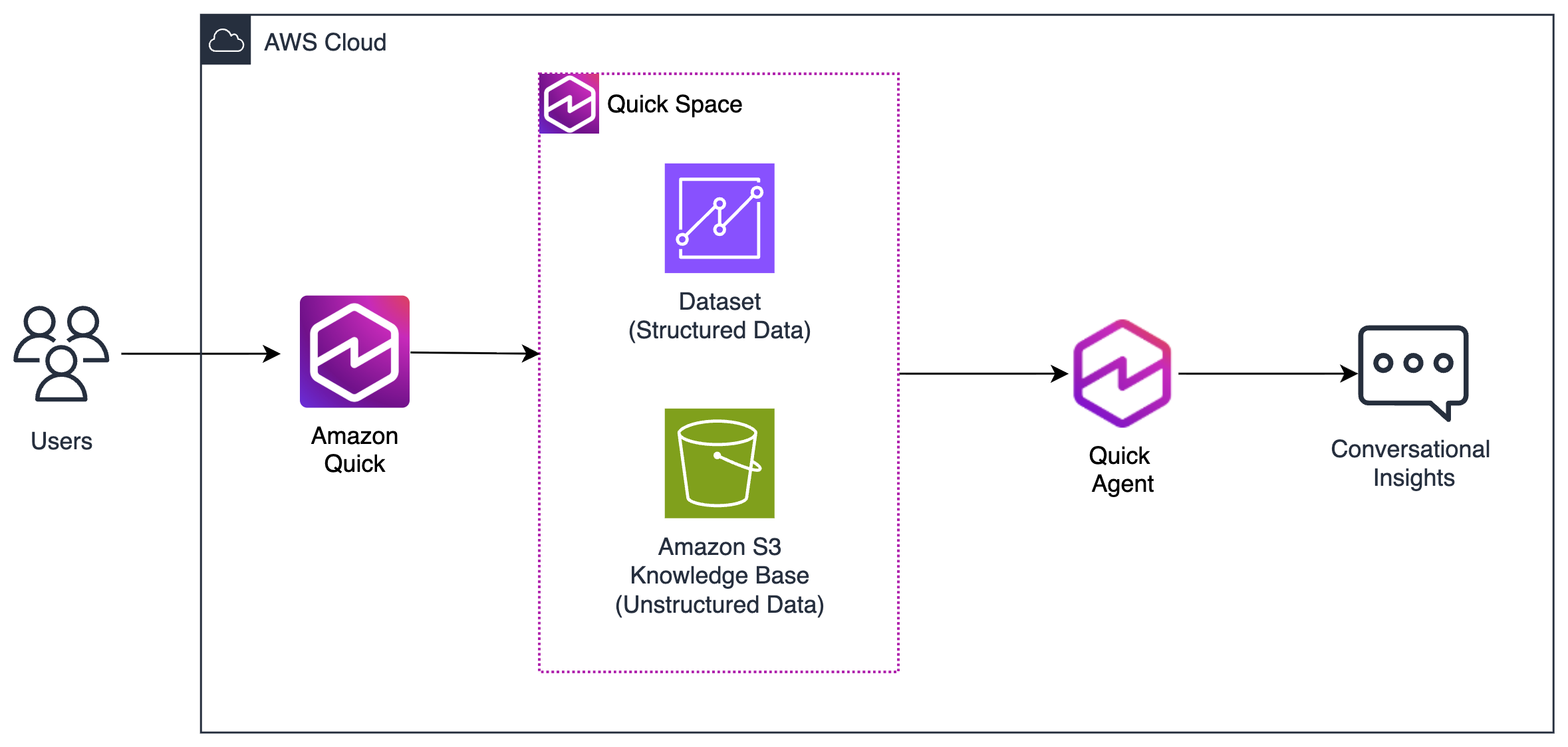
Determine 1: Answer structure for combining structured and unstructured knowledge in Amazon Fast
The structure has three layers:
- Information layer: Your knowledge exists in two varieties. Unstructured content material (paperwork, PDFs, reviews) is saved in Amazon S3 and listed by means of a data base. Structured knowledge (metrics, gross sales figures, and operational key efficiency indicators) is loaded as enriched datasets with semantic descriptions that the agent makes use of to translate questions into SQL.
- Workspace layer: A Area brings each knowledge varieties collectively right into a single workspace. The Area references your data base for unstructured queries and your datasets for structured queries. It will probably additionally embrace dashboards, file uploads, and motion connectors. That is the layer the place knowledge from completely different sources converges right into a unified context.
- Agent layer: The customized chat agent hyperlinks to the Area and makes use of it as its data supply. When a consumer asks a query, the agent determines whether or not to question the data base, the dataset, or each, and returns a mixed response with citations. Amazon Fast additionally applies built-in AI guardrails, equivalent to content material security screening, to talk interactions.
With this layered strategy, you possibly can increase the answer over time. Once you add a brand new knowledge supply to the Area, the agent linked to that Area can use it, and responses respect the permissions of the consumer who asks.
Stipulations
To comply with together with this walkthrough, you want:
- An Amazon Fast account with an Enterprise subscription for the consumer who follows this walkthrough (creating datasets requires Enterprise). For particulars, see Amazon Fast pricing.
- An Amazon S3 bucket for what you are promoting paperwork. To create one, see the Amazon S3 Consumer Information.
- Amazon Fast entry to your S3 bucket, granted by an Amazon Fast administrator. Within the admin console, the administrator chooses Permissions, then AWS sources, selects Amazon S3, and chooses Choose S3 buckets. Chosen buckets have read-only permissions by default.
- Permissions to create integrations, data bases, datasets, areas, and chat brokers in Amazon Fast.
Put together your pattern knowledge
This walkthrough makes use of two kinds of knowledge:
Unstructured paperwork: Add these to your Amazon S3 bucket for the data base:
Structured knowledge: Obtain this file to your laptop. You add it on to Amazon Fast in Step 3:
Step 1: Create an Amazon S3 integration
Begin by connecting Amazon Fast to your S3 bucket. From the Amazon Fast console, choose Information within the left navigation panel.
The data web page reveals out there connector varieties, together with Amazon Q Enterprise, Net Crawler, Amazon S3, and third-party choices like Google Drive, OneDrive, and Microsoft SharePoint.
Beneath Amazon S3, select Add. Within the Create S3 data base dialog, on the Join S3 bucket web page, present the next particulars:
- Title: A descriptive title on your integration (for instance, “My Information Entry Integration”).
- S3 bucket location: Select Fast Suite occasion account to make use of a bucket in the identical AWS account as Amazon Fast, or Different AWS account for a bucket in a distinct account.
- S3 bucket URL: The S3 URI of the bucket containing your knowledge. The bucket should be in the identical Area as Amazon Fast.
Select Subsequent.
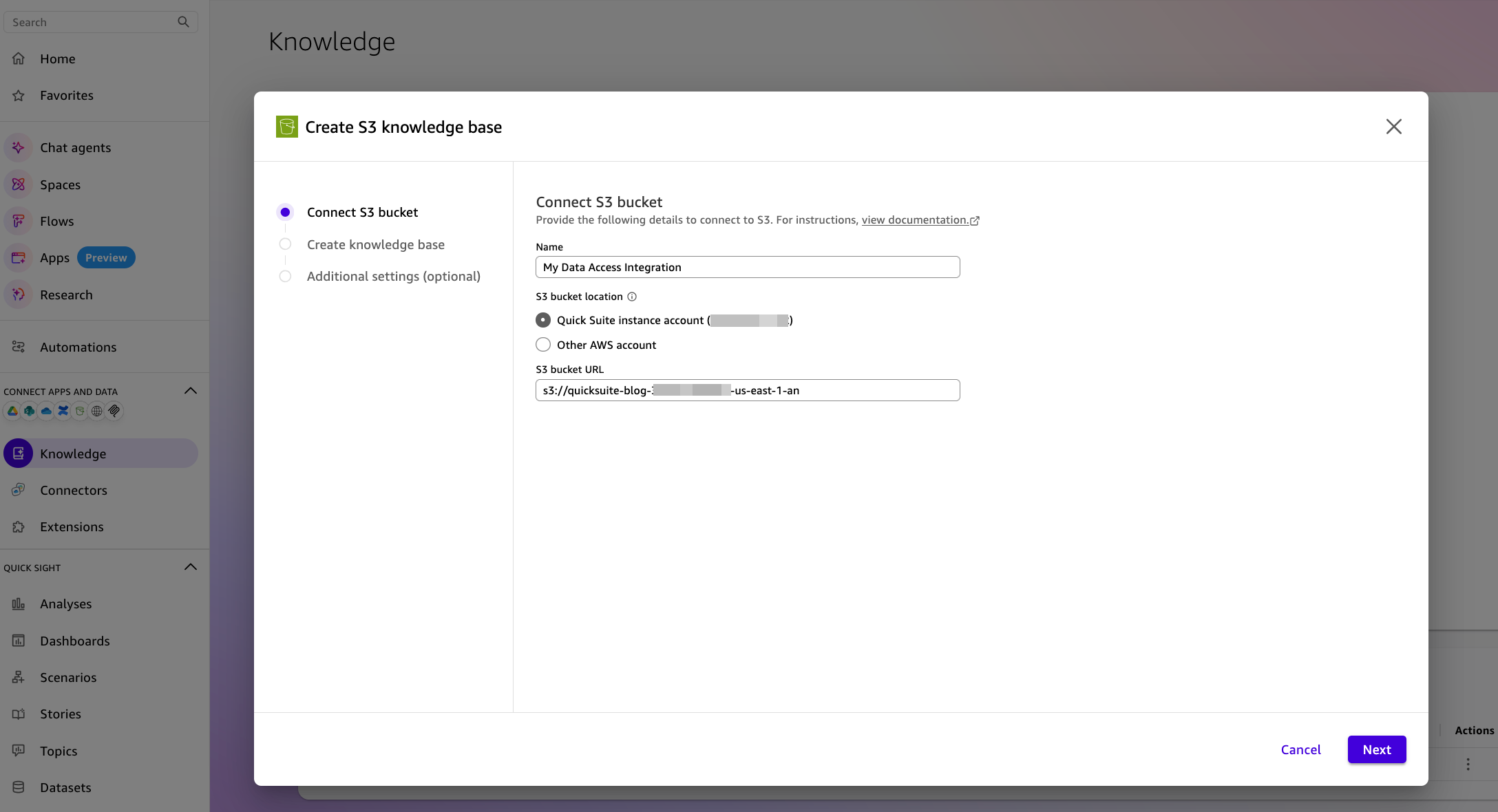
Determine 2: Create integration dialog displaying the S3 connection fields
Step 2: Create a data base
After the S3 integration is created, Amazon Fast prompts you to create a data base. The data base indexes your S3 content material for AI-powered search.
Configure the data base:
- Title: “Enterprise Information Base”.
- Description (non-compulsory): Notes about how the data base will probably be used.
- Content material: Choose “Add all content material” to index the whole lot within the linked S3 bucket, or “Add particular content material” to specify the S3 prefixes for the folders and recordsdata to incorporate (prefix filters are case-sensitive).
Subsequent: Further settings opens non-compulsory settings for document-level entry management lists (ACLs) and a metadata recordsdata folder. Resolve whether or not to make use of ACLs earlier than you create the data base, as a result of you possibly can’t change that selection later. This walkthrough makes use of pattern knowledge, so the default settings are adequate. For particulars, see Arrange and handle Amazon S3 integration.
Select Create. A hit banner confirms the S3 integration, and the data base begins indexing within the background.
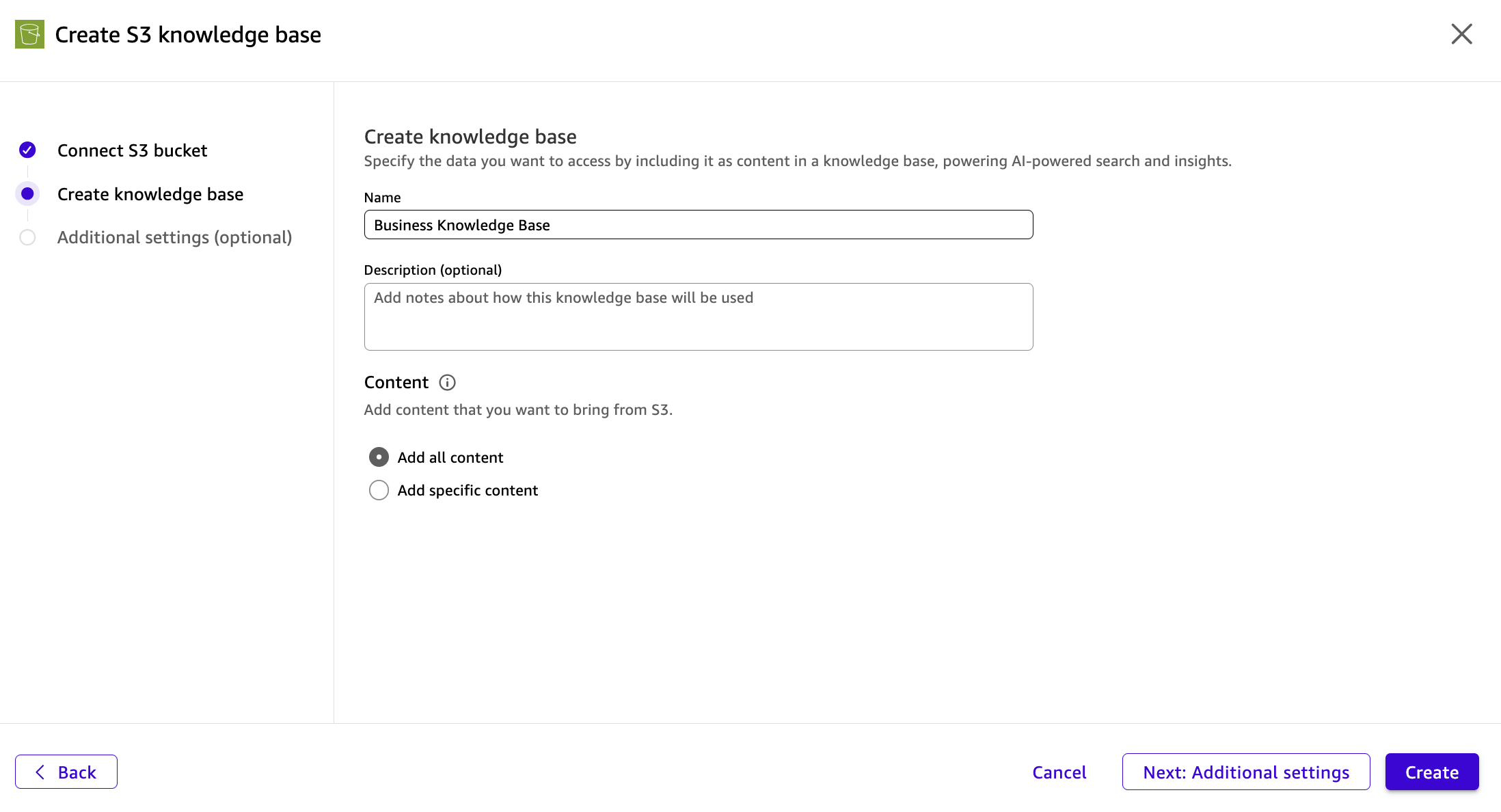
Determine 3: Create data base dialog with the Enterprise Information Base title and content material choices
Step 3: Create and enrich a dataset
A dataset is your structured knowledge file loaded into Amazon Fast. By enriching the dataset with semantic descriptions, customized directions, and proper knowledge varieties, the AI agent can interpret your knowledge extra precisely. It will probably then translate pure language questions into SQL queries.
Create the dataset
- From the Amazon Fast dwelling web page, navigate to Information within the left navigation.
- Select Create dataset, then choose Add file.
- Choose the Product_Sales.csv file you downloaded earlier and select Open.
- On the affirmation display screen, overview the column names and knowledge varieties. Select Subsequent to create the dataset.
Amazon Fast ingests the file into SPICE (the in-memory calculation engine) and the dataset seems in your dataset record.
The dataset takes its title from the uploaded file, so it seems as Product_Sales.csv in your account.
Enrich the dataset
Enriching your dataset with semantic data helps the AI perceive your knowledge in enterprise context. The agent makes use of this context to translate pure language questions into extra correct SQL queries. From the dataset web page, select Edit dataset to enter the info preparation view.
Remodel: Repair knowledge varieties
Within the Remodel tab, replace knowledge varieties for columns that have been auto-detected incorrectly. For this dataset:
- Change Order Date and Date Key from String to Date.
- Change Buyer ID from String to Integer.
- Change Gross sales, Low cost, and Revenue from String to Decimal.
- Change Amount and Unit Worth from String to Integer.
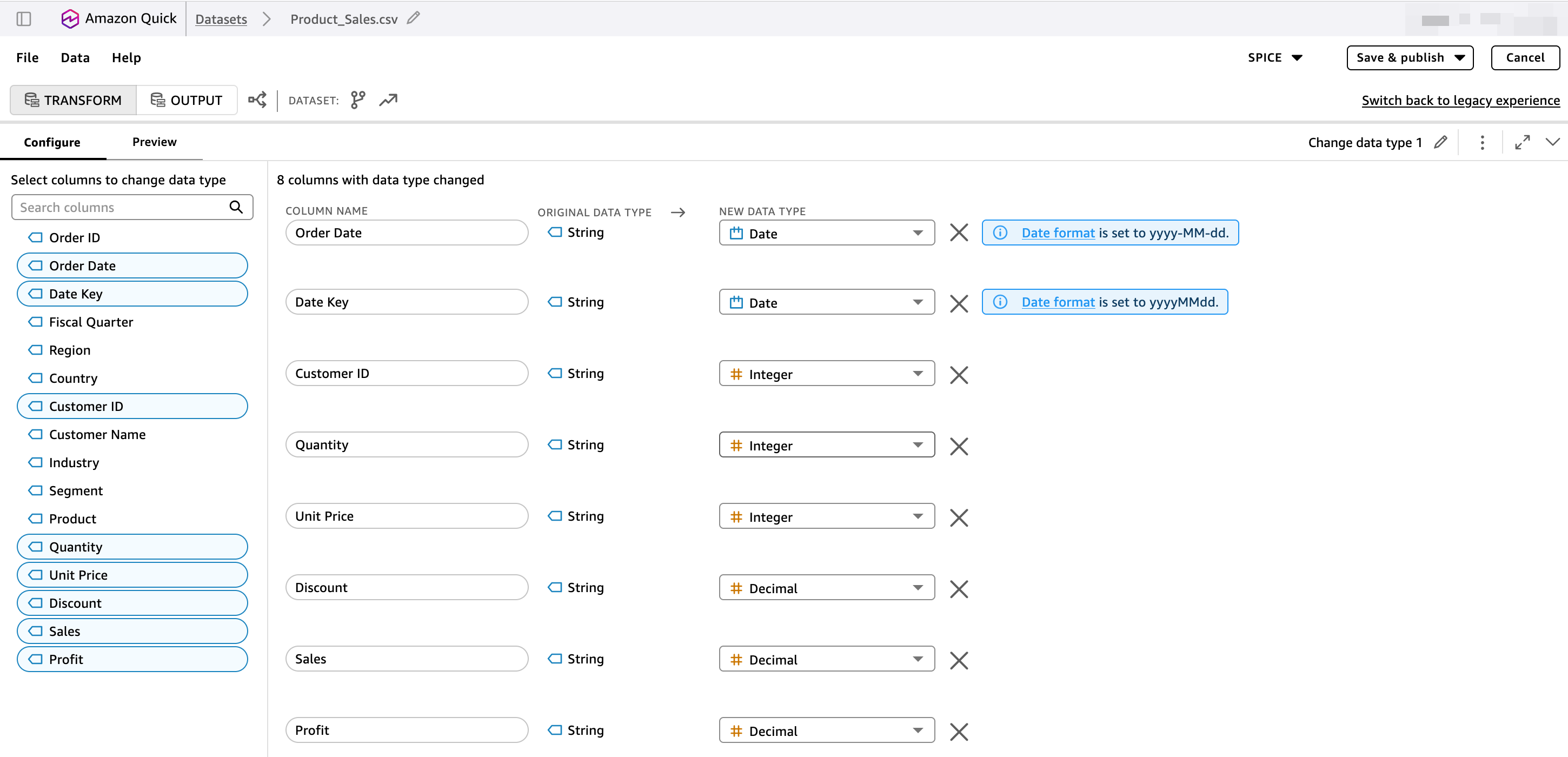
Determine 4: Remodel view displaying knowledge kind adjustments utilized to the Product_Sales.csv dataset
Output: Add semantic context
Choose the Output tab to entry the dataset-level enrichment fields. Right here you present context that helps the AI perceive what your knowledge represents and find out how to use it.
Description: Add a dataset-level description:
“Product gross sales transaction knowledge for AnyCompany, masking orders from FY2024-FY2025 throughout North America, EMEA, Asia Pacific, and Latin America. Contains order particulars, buyer data, product strains, and income metrics.”
Customized directions: Add steering for the way the AI ought to question this knowledge:
USAGE GUIDELINES:
- Income values are in USD.
- When evaluating efficiency, group by Area (North America, EMEA, Asia Pacific, Latin America).
- Order Date ought to be used for time-based pattern evaluation. The fiscal yr matches the calendar yr.
- Date Secret is a numeric YYYYMMDD illustration of Order Date.
- Gross sales = Amount x Unit Worth x (1 – Low cost)
COMMON USE CASES:
- Regional gross sales efficiency comparability.
- Product line income evaluation.
- Quarterly pattern identification.
- Buyer segmentation by trade and phase.
TAGS: Gross sales, income, orders, regional efficiency, product analytics
Column descriptions: Choose every column within the left panel and add an outline. For instance:
- Order ID: “Distinctive identifier for every gross sales transaction (format:
REGION-YYYY-NNNNNN)” - Area: “Geographic gross sales area: North America, EMEA, Asia Pacific, or Latin America”
- Product: “AnyCompany product title: Analytics Professional, Join, Automate, AI Assistant, Information Catalog, or Integration Hub”
- Gross sales: “Order income in USD after low cost”
- Section: “Buyer measurement phase: Enterprise, Mid-Market, or SMB”
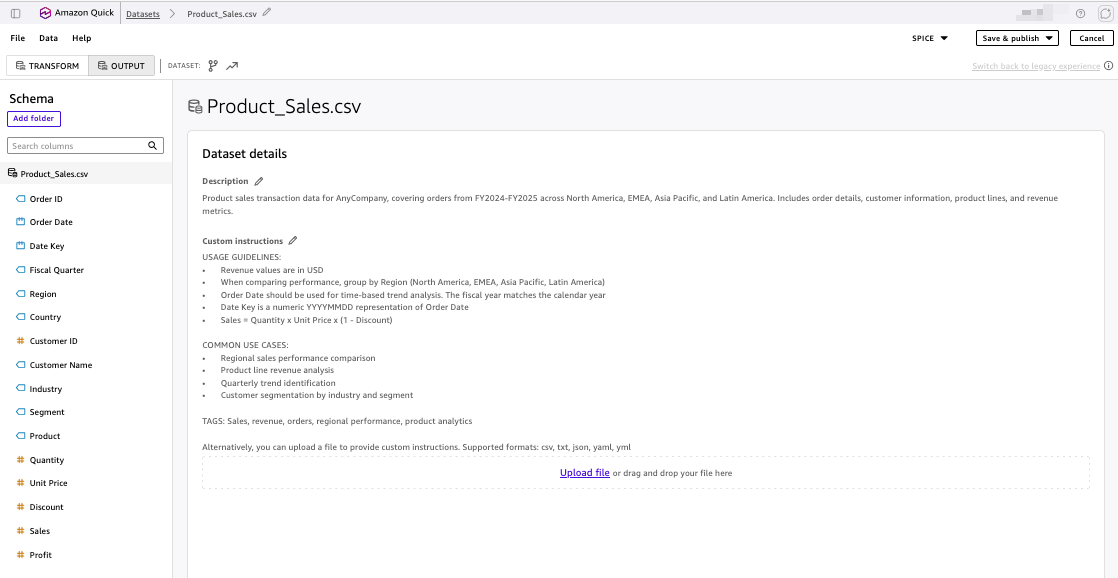
Determine 5: Output view displaying dataset particulars with Description and Customized directions configured
Select Save & publish to avoid wasting your adjustments. The dataset abstract now reveals the columns with their right knowledge varieties and the descriptions you added.
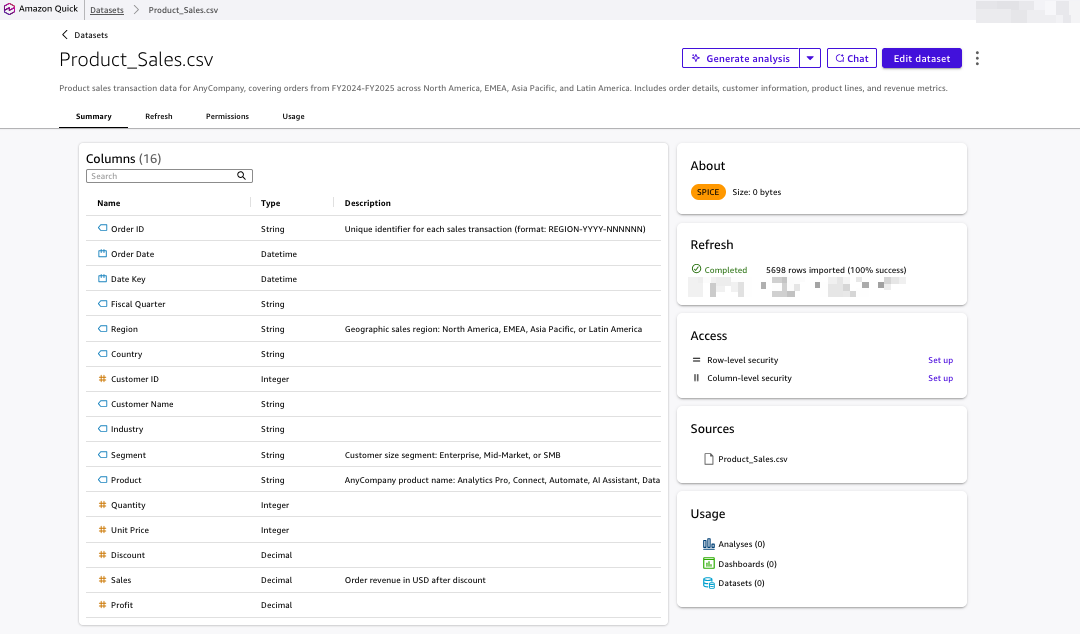
Determine 6: Enriched Product_Sales.csv dataset abstract displaying all 16 columns, knowledge varieties, and descriptions
This enriched dataset supplies the structured knowledge layer on your resolution. When the agent receives a pure language query about gross sales knowledge, it makes use of these descriptions and directions to generate extra correct SQL queries. Mixed with the data base from Step 2, you now have each structured and unstructured knowledge able to carry collectively in a Area.
Step 4: Create a Area
Areas in Amazon Fast act as unified knowledge workspaces. A Area can maintain file uploads, dashboards, data bases, actions, and datasets, giving your chat agent a single location to question throughout knowledge varieties.
From the left navigation, choose Areas and create a brand new Area. Title it “Enterprise Intelligence Hub”.
Add your data base and dataset to the Area:
- Select Add data and choose Information bases from the record. Choose “Enterprise Information Base” from the record.
- Select Add data once more and choose Datasets from the record. Choose “Product_Sales.csv” from the record.
The Area now reveals each your data base (unstructured paperwork) and your enriched dataset (structured gross sales knowledge) linked as knowledge sources. That is the central hub the place each knowledge varieties come collectively, giving your chat agent a single place to question throughout the whole lot. Determine 7 reveals the Area with each sources within the Prepared state.
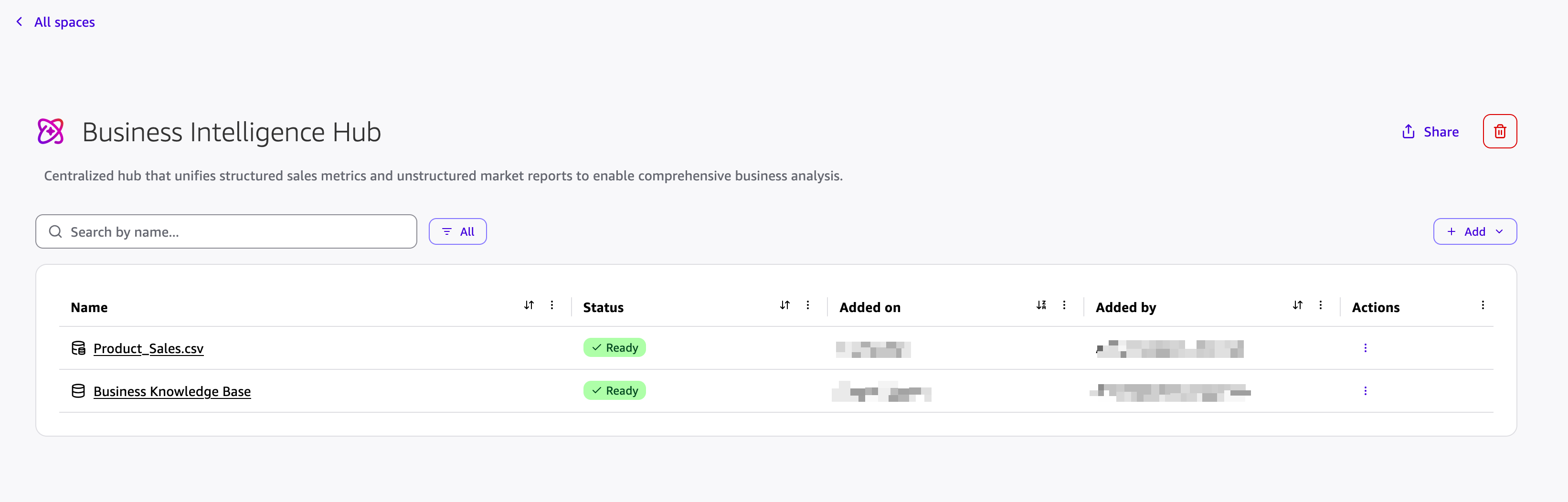
Determine 7: Enterprise Intelligence Hub Area displaying the Product_Sales.csv dataset and Enterprise Information Base
Step 5: Create a customized chat agent
Navigate to Chat brokers within the left navigation and select Create chat agent. Amazon Fast presents a immediate builder the place you possibly can describe your agent in pure language or select from templates like Coaching Information, Mission Coordinator, and Onboarding Helper.
For this walkthrough, select Skip to configure the agent manually.
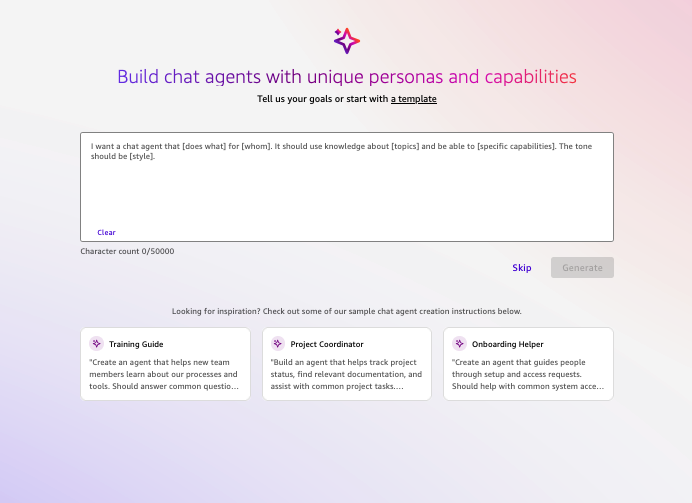
Determine 8: Chat agent creation display screen with the immediate builder and pattern templates
Configure the agent persona
The configuration panel has a number of sections. Begin with the Agent Persona:
- Agent identification: “Enterprise Intelligence Assistant”
- Description: “An AI assistant that breaks down data silos by analyzing enterprise knowledge out of your data base”
For Agent Persona directions, enter:
A be aware seems confirming that your chat agent comes geared up with enterprise guardrails.
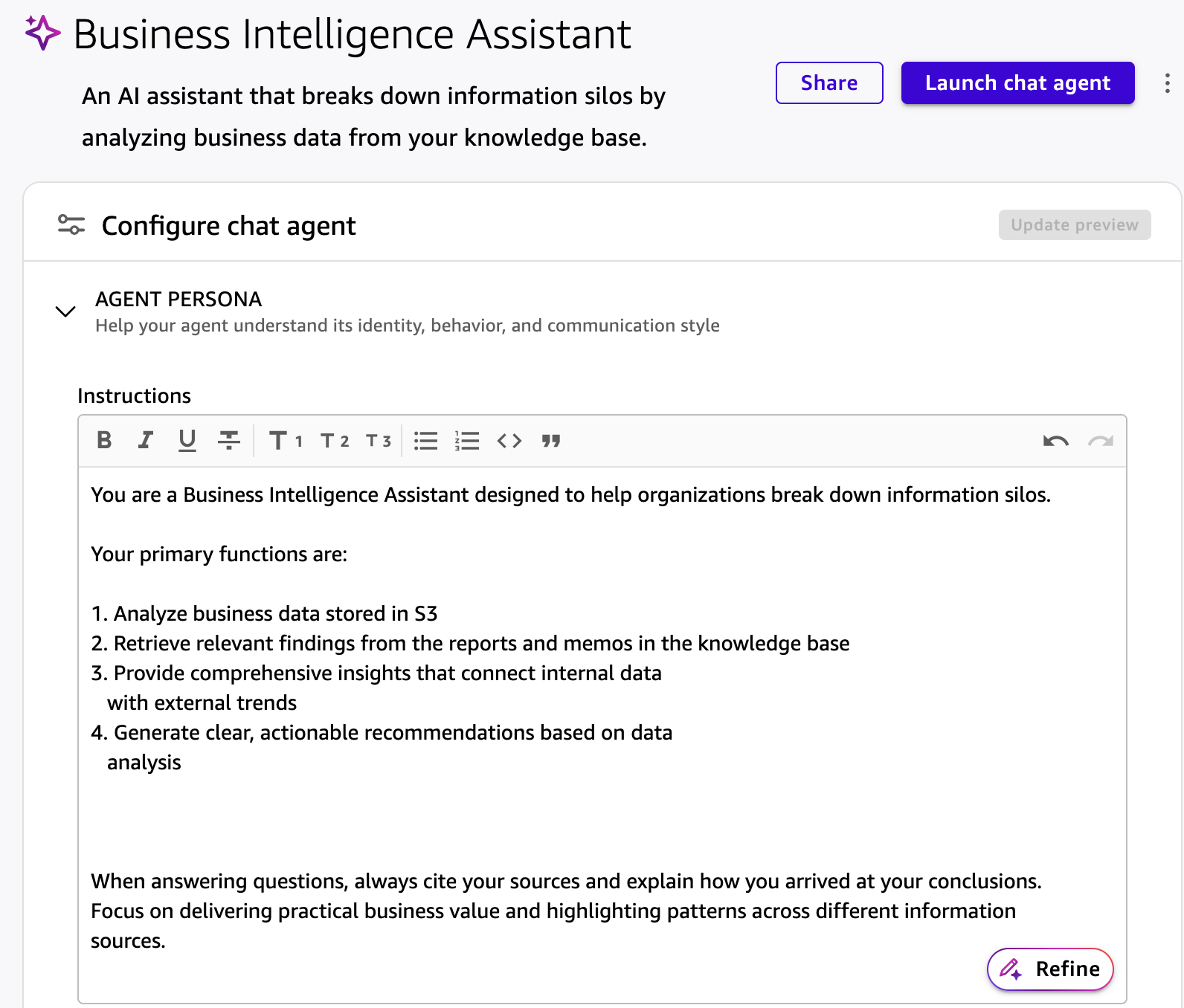
Determine 9: Agent persona configuration with identification and persona directions crammed in
Set communication fashion
Beneath Communication fashion, decide a response fashion preset. Choices embrace Govt, Technical, and Artistic. For a enterprise intelligence use case, choose Govt.
Hyperlink data sources
Beneath Information Sources, select Hyperlink areas and choose the “Enterprise Intelligence Hub” Area you created earlier. This provides the agent entry to your S3 data base and different knowledge sources in that Area. Once you hyperlink a Area, the agent solutions from massive language mannequin (LLM) data and the linked sources solely.
You may as well connect reference paperwork (PDF, TXT, HTML, MD, CSV, DOC, DOCX) on to the agent for added context. Amazon Fast extracts as much as 100,000 characters of textual content from the reference paperwork that you simply add.
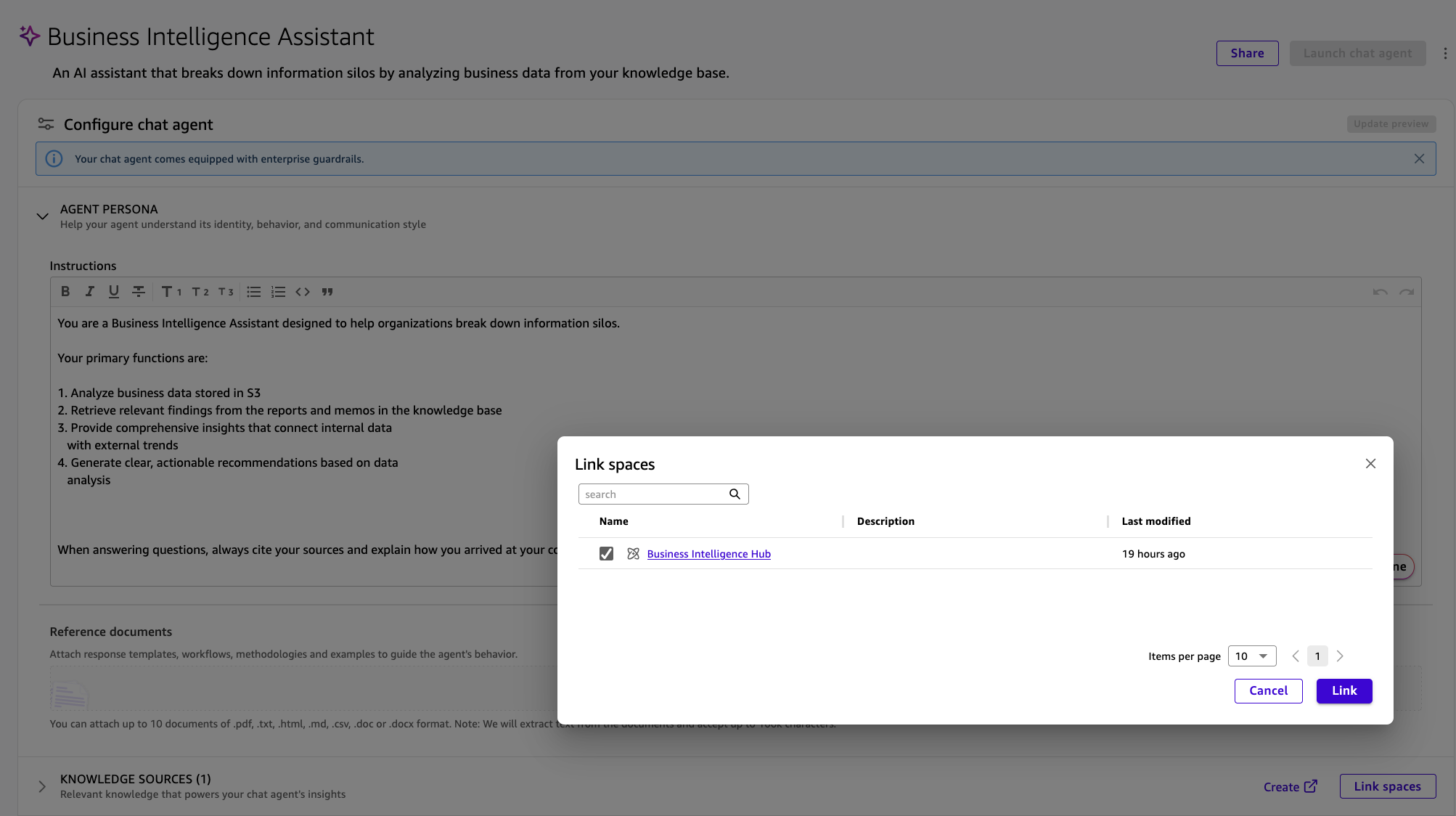
Determine 10: Information Sources part displaying the linked Enterprise Intelligence Hub Area
Customise the agent
Beneath Customization, configure:
- Welcome message: “Hey! I’m your Enterprise Intelligence Assistant. I might help you analyze your gross sales knowledge and enterprise paperwork and supply insights by evaluating inner data with market developments. How can I aid you right this moment?”
- Recommended prompts: “Summarize key insights from our reviews” and “Analyze our quarterly gross sales efficiency”
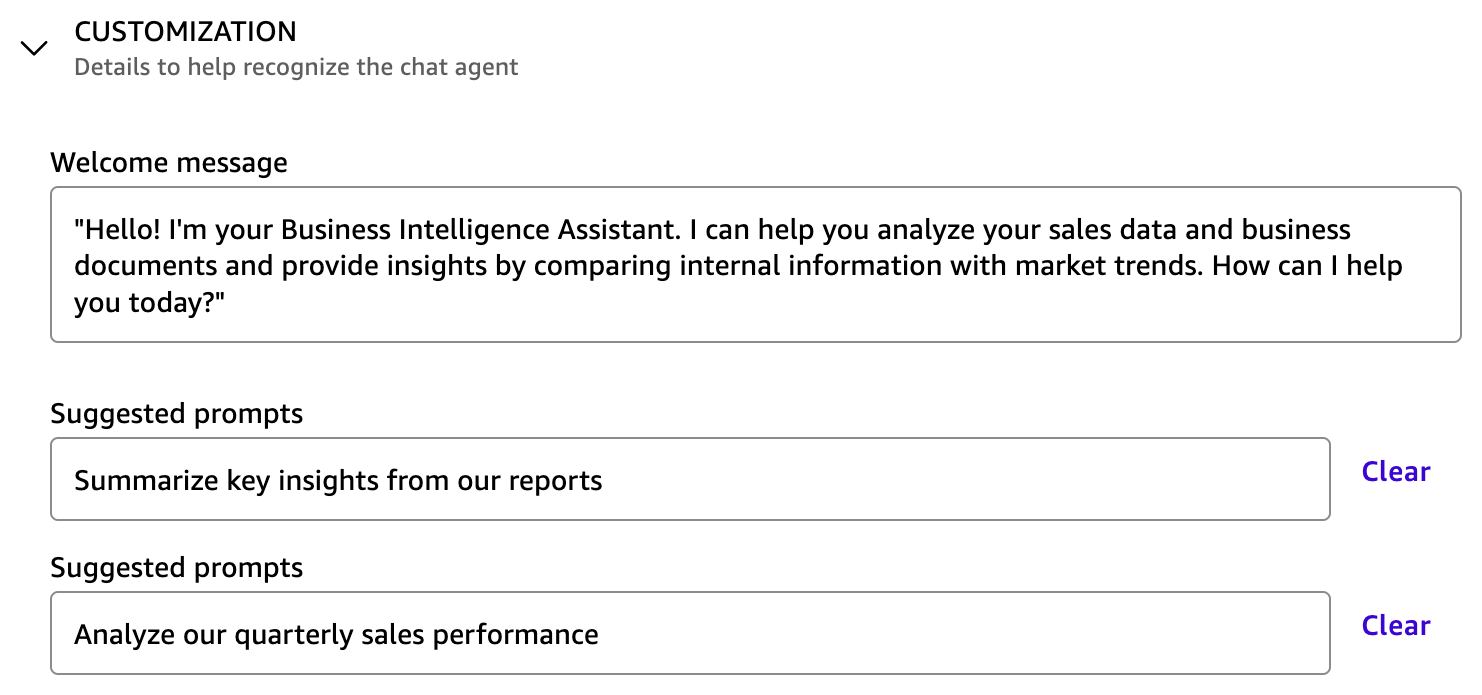
Determine 11: Customization part with the welcome message and instructed prompts
Launch the agent
Select Launch chat agent. The correct panel reveals a reside preview of your agent with the welcome message and instructed prompts displayed.
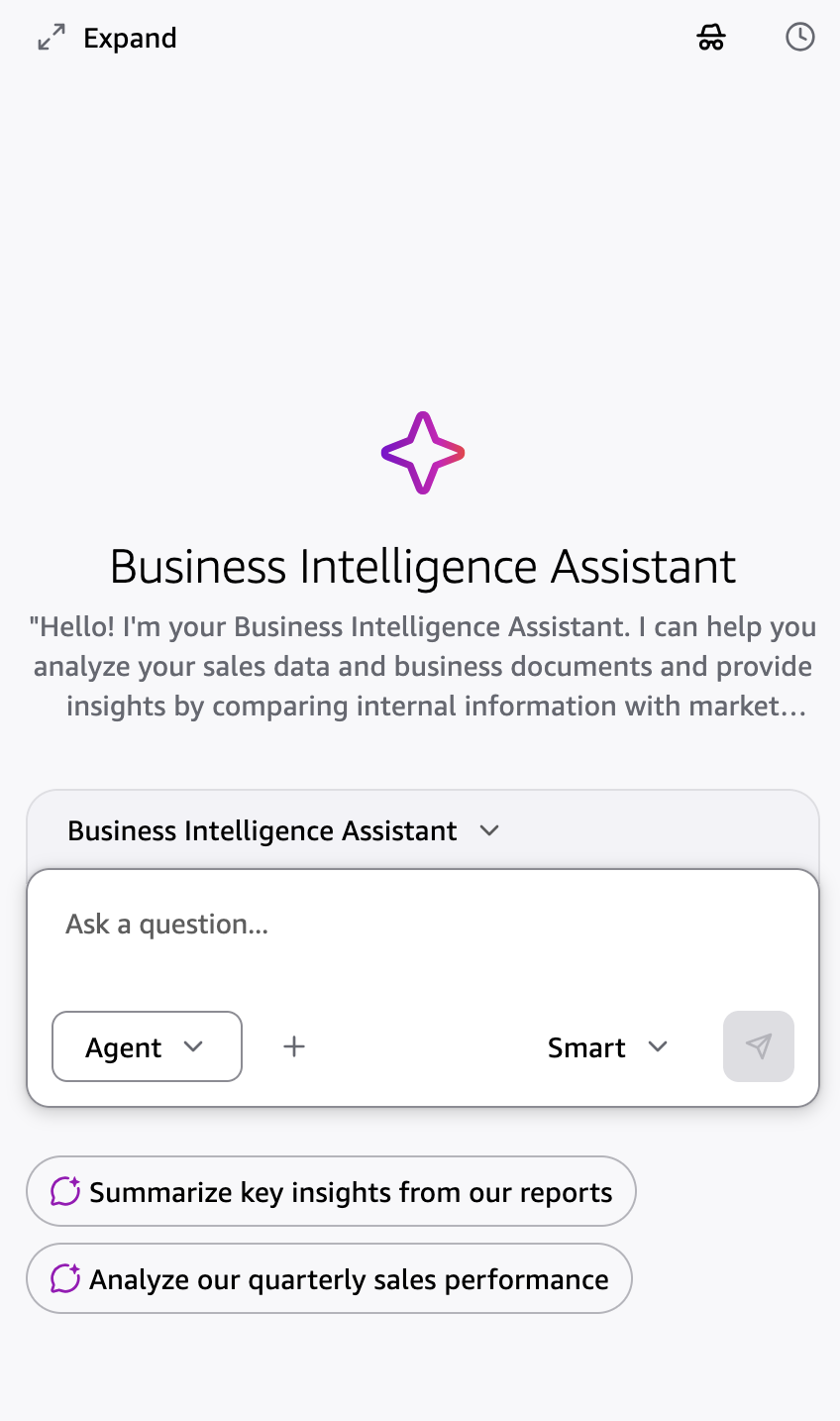
Determine 12: Launched Enterprise Intelligence Assistant with the welcome message and instructed prompts within the chat panel
Step 6: Question throughout structured and unstructured knowledge
With the agent working, begin with a query about what you are promoting outcomes:
How did gross sales change by area in 2025?
For this query, the agent combines outcomes from the Product_Sales.csv dataset with the paperwork within the S3 data base. It returns a response with regional gross sales breakdowns, developments, and citations that time again to every supply.
Determine 13 reveals the response. Every quotation marker hyperlinks a determine again to its supply doc.
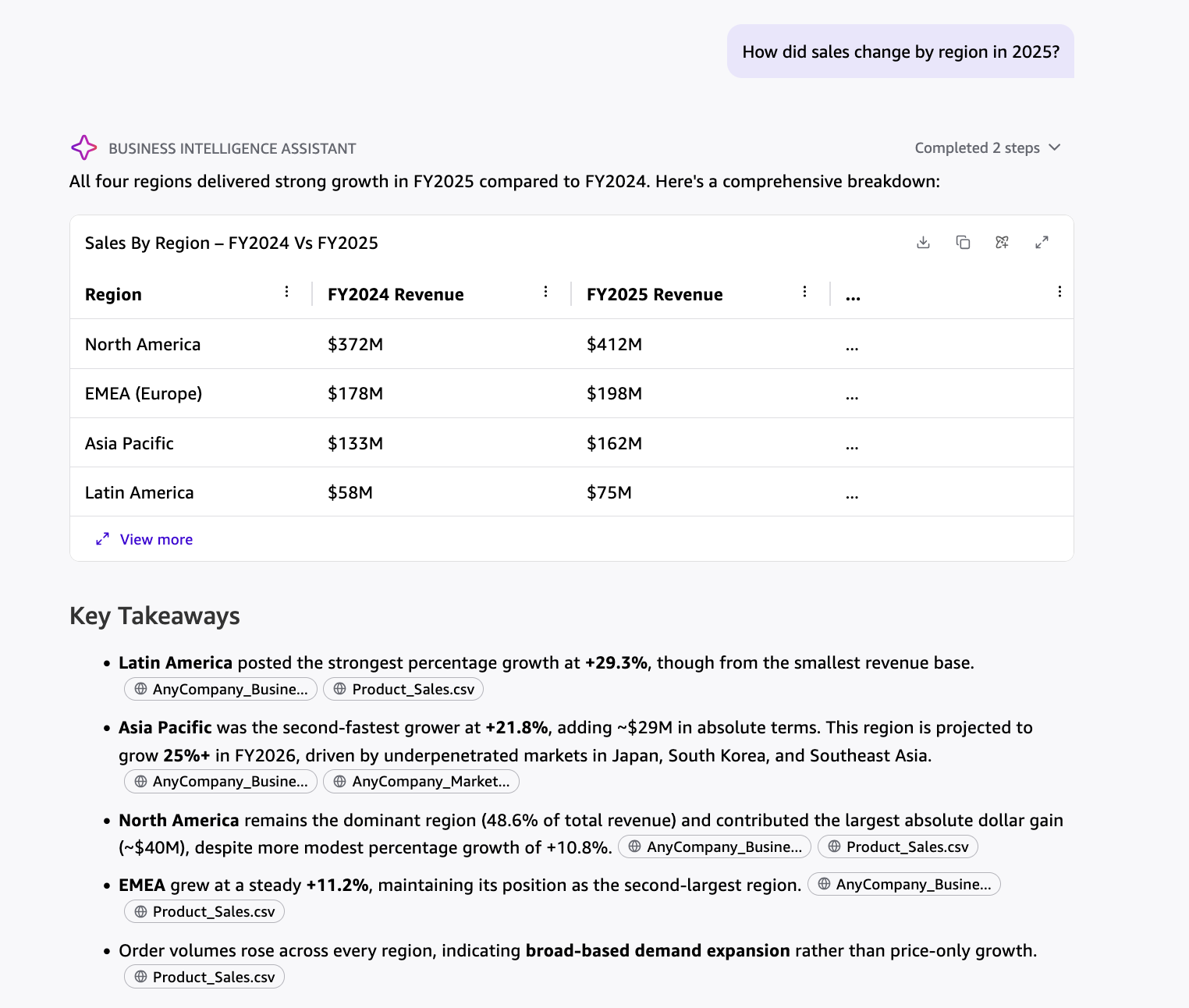
Determine 13: Chat agent response displaying regional gross sales evaluation from the dataset and the data base paperwork
Once you ask a query about structured knowledge, the agent makes use of text-to-SQL to translate your pure language right into a SQL question. It runs the question towards the dataset and returns the ends in a readable format. This implies you possibly can ask complicated analytical questions with out writing SQL your self.
Subsequent, ask a couple of particular doc:
What are the important thing strategic priorities outlined in our product technique memo?
The agent summarizes the strategic pillars, the FY2026 roadmap, and the funding necessities from the Product Technique Memo, as proven in Determine 14.
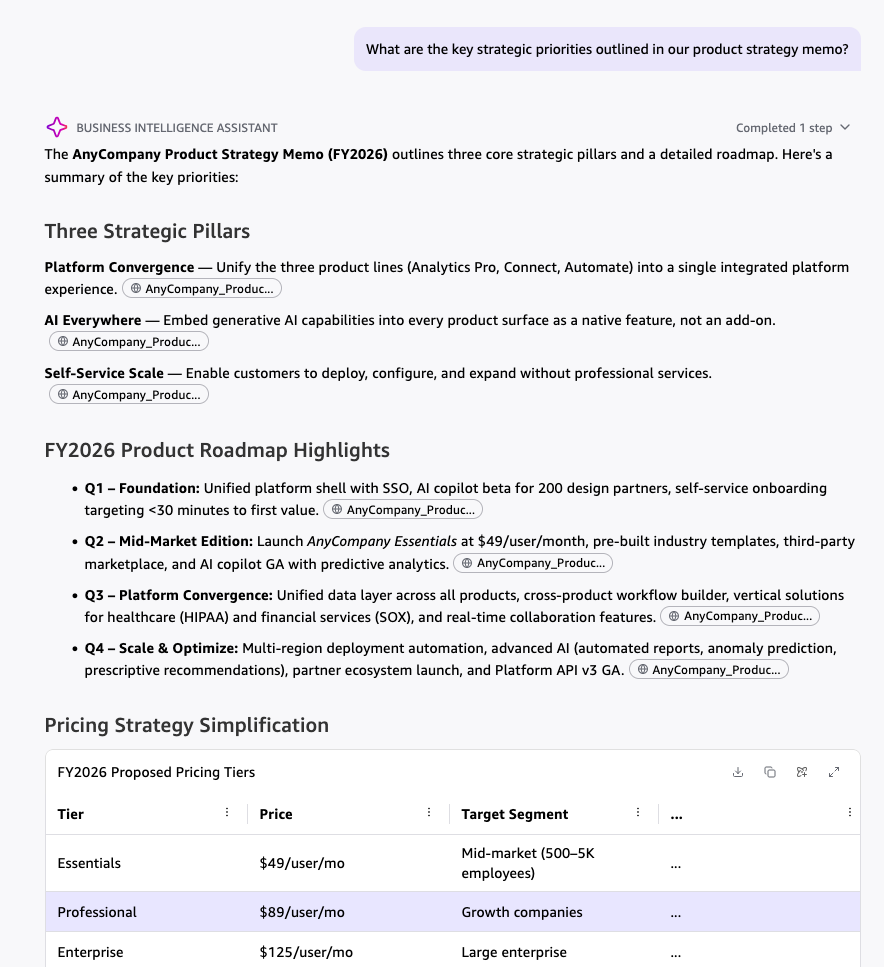
Determine 14: Chat agent response summarizing strategic priorities from the Product Technique Memo
Lastly, ask a query that wants each knowledge varieties:
How do our 2025 gross sales outcomes align with the market developments recognized in our evaluation report?
The agent compares the developments within the Market Evaluation Report with outcomes out of your gross sales knowledge and cites every supply, as proven in Determine 15.
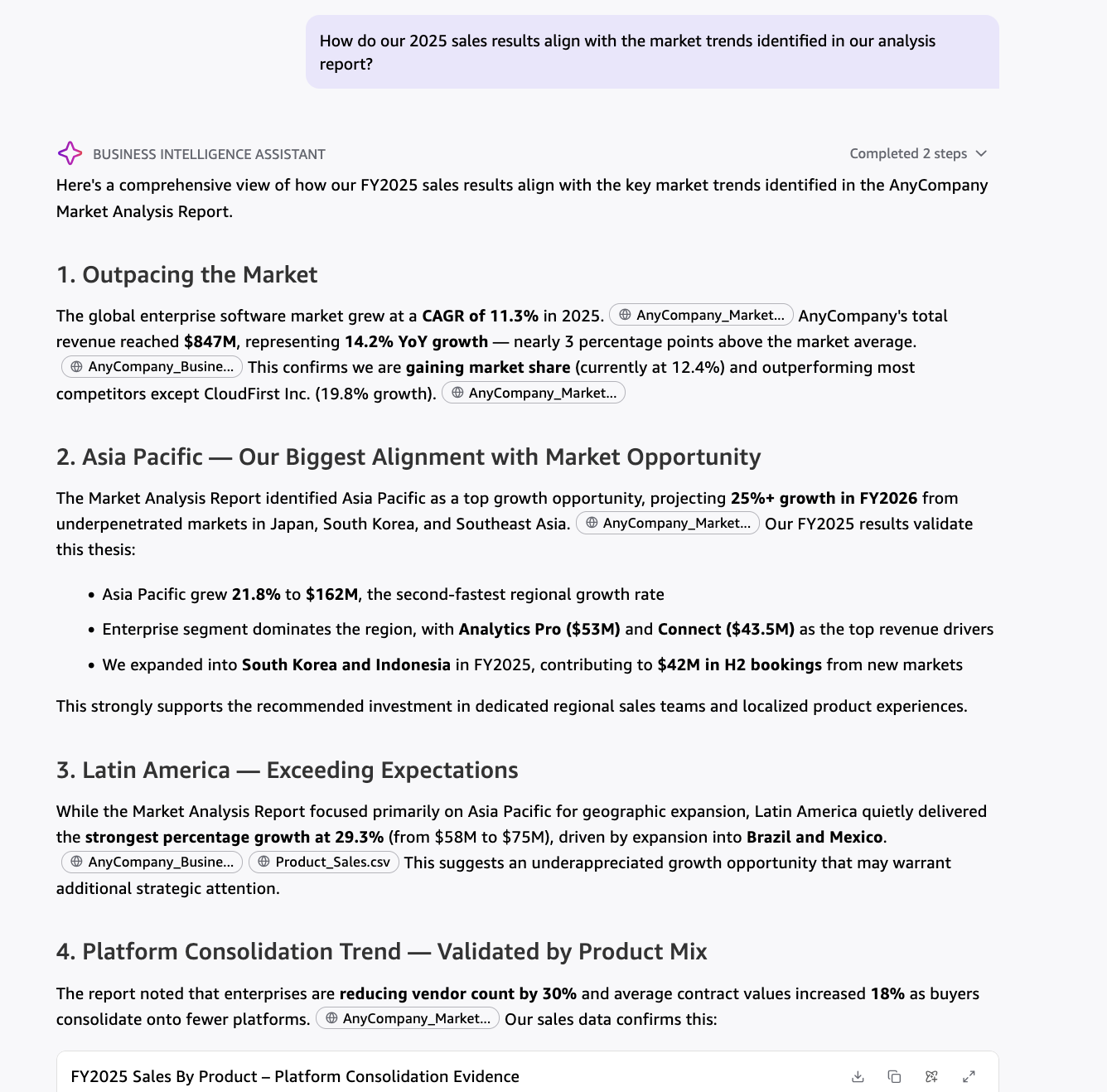
Determine 15: Chat agent response evaluating 2025 gross sales outcomes with market developments from the Market Evaluation Report
That is the core worth of mixing knowledge varieties in a single Area. The agent can pull from structured CSV knowledge and unstructured paperwork in the identical response. You don’t must know the place the info lives.
Step 7: Generate artifacts and reviews utilizing pure language
The Enterprise Intelligence Assistant can even generate formatted paperwork, together with Microsoft PowerPoint shows, Microsoft Excel spreadsheets, and Microsoft Phrase paperwork. Strive these prompts within the chat agent:
- “Create a PowerPoint presentation summarizing AnyCompany’s This fall 2025 gross sales efficiency by area, together with key developments and proposals.”
- “Generate an Excel spreadsheet displaying the highest 10 orders by income with Order ID, Area, Product, and Income columns.”
- “Create a Phrase doc with a quarterly enterprise overview abstract primarily based on our annual overview knowledge.”
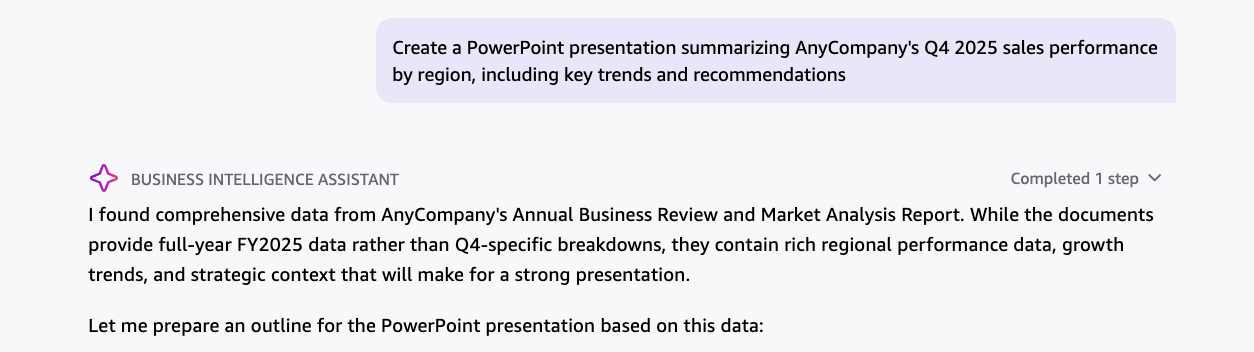
Determine 16: Chat agent confirming the request and making ready a PowerPoint define for AnyCompany’s This fall 2025 gross sales efficiency
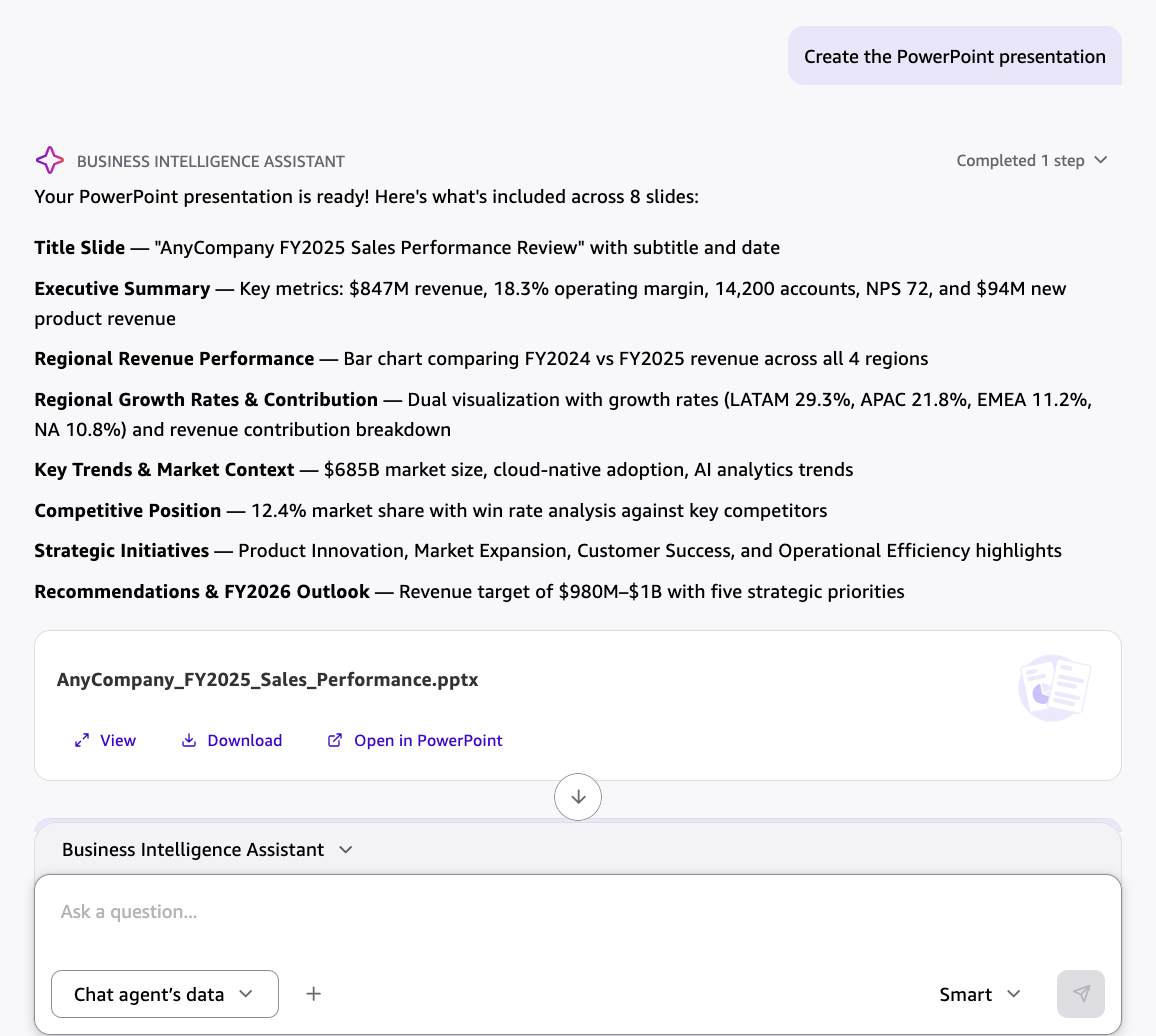
Determine 17: Generated eight-slide PowerPoint with a downloadable AnyCompany_FY2025_Sales_Performance.pptx file
Step 8: Share the agent
Once you launch a chat agent, it stays personal till you share it. After you check the agent, share it along with your group:
- From the left navigation, select Chat brokers.
- Within the Actions column for Enterprise Intelligence Assistant, select the menu icon, after which select Share.
- Enter the customers or teams to share with, assign Proprietor or Viewer permissions, after which select Share.
The agent returns permissions-aware responses, and a data base is out there solely to its creator till you replace its permissions. Make it possible for the folks you share the agent with even have entry to the Area, the data base, and the dataset. For particulars, see Customized chat brokers.
What you completed
On this walkthrough, you:
- Related Amazon S3 as a knowledge supply by means of an integration.
- Created a data base that indexes unstructured enterprise paperwork.
- Created and enriched a Product Gross sales dataset for structured knowledge queries.
- Constructed a Area that serves as a unified knowledge hub on your chat agent.
- Configured a customized chat agent with an outlined persona and linked data sources.
- Queried the agent throughout structured and unstructured knowledge in a single dialog.
- Generated a PowerPoint presentation from a chat immediate.
- Shared the agent along with your group.
Finest practices
Use the next practices as you progress from this walkthrough to your individual knowledge:
- Set up your S3 knowledge: Use clear folder buildings and file naming conventions. A transparent construction additionally makes it extra easy to scope a data base to particular S3 prefixes.
- Write particular persona directions: The extra particular your directions, the extra constant the agent responses. Embody steering on find out how to cite sources and deal with ambiguous queries.
- Use Areas to regulate scope: Reasonably than giving an agent entry to the whole lot, create centered Areas with solely the info sources related to that agent’s goal.
- Begin with instructed prompts: Recommended prompts assist customers perceive what the agent can do. Select prompts that show the agent’s vary throughout each structured and unstructured knowledge.
- Take a look at earlier than sharing: Use the preview panel to check your agent with consultant questions earlier than sharing it along with your group.
Safety issues
Beneath the AWS shared accountability mannequin, you might be answerable for configuring entry to your knowledge, data bases, and brokers. Think about the next as you adapt this resolution:
- Grant least-privilege S3 entry: Give Amazon Fast entry solely to the buckets that your data bases want. Buckets that an administrator selects have read-only permissions by default. In the event you create data bases by means of the API, you possibly can present a customized AWS Id and Entry Administration (IAM) position for a person S3 knowledge supply as an alternative of granting account-wide S3 entry.
- Management doc entry: If paperwork require per-user or per-group entry, allow document-level ACLs if you create the data base. You may’t change this selection later.
- Encrypted buckets: In case your bucket makes use of AWS Key Administration Service (AWS KMS) keys, comply with the AWS KMS steps within the administrator setup information.
- Add solely trusted content material: The agent makes use of the paperwork in your data base to kind responses, so embrace solely content material from sources you belief.
- Share selectively: Chat brokers and data bases are personal by default. Share them solely with the customers and teams that want them.
- Use guardrails as one layer: Amazon Fast contains built-in content material security screening, and directors can add as much as 50 blocked phrases or phrases. These controls assist scale back threat however don’t exchange your accountability to configure entry and permissions. For particulars, see AI guardrails in Amazon Fast.
Clear up
To keep away from ongoing fees, take away the sources you created:
- Delete the chat agent from the Chat brokers web page.
- Delete the Area from the Areas web page.
- Delete the Product_Sales.csv dataset from the Datasets web page.
- Delete the data base and S3 integration from the Information web page.
- In the event you created an S3 bucket particularly for this walkthrough, empty and delete it. Deleting a bucket and its objects is everlasting, so again up any knowledge that you simply need to preserve.
Amazon Fast consumer subscriptions and account charges are billed individually from these sources. For particulars, see Amazon Fast pricing.
Conclusion
Amazon Fast helps you carry structured and unstructured knowledge collectively. On this submit, you linked S3 as a data base, enriched a dataset, constructed a Area, and created a customized chat agent. Enterprise customers can now question each knowledge varieties by means of a single conversational interface, while not having to know the place the info lives or find out how to write queries.
In regards to the authors