

Java groups have established JVM tooling, steady integration and steady supply (CI/CD) pipelines, and operational patterns, but taking AI brokers from prototype to manufacturing is tough: agent frameworks don’t remedy scalability, governance, safety, and operational issues by default. Amazon Bedrock and Spring AI shut these gaps, so Java groups can construct autonomous AI brokers that plan, name instruments and APIs, and preserve context throughout multi-turn conversations. Agentic AI is shifting past prompt-response interactions towards autonomous programs that execute advanced multi-step duties.
Java stays one of many extensively used programming languages in enterprise software program. Groups have current CI/CD pipelines, operational experience, and established patterns constructed across the JVM. Spring AI brings AI capabilities to the JVM by acquainted Spring patterns: auto-configuration, dependency injection, and composable advisors. Builders can construct AI brokers utilizing the identical idioms they use for REST APIs, safety, and knowledge entry.
Amazon Bedrock AgentCore is a platform to construct, join, and optimize brokers at scale, with any framework or mannequin. With AgentCore, you may construct, deploy, and function AI brokers at scale. It’s framework-agnostic and model-agnostic: you convey your most popular agent framework and basis mannequin (FM). With AgentCore, you may entry the manufacturing infrastructure you want: managed runtime, reminiscence, browser automation, code execution, and id administration.
On this put up, we present you how you can construct autonomous AI brokers in Java utilizing Spring AI and Amazon Bedrock with spring-ai-agentcore. We discover the important thing implementation patterns for 2 programs. The primary is a single-agent journey assistant that demonstrates instrument calling and reminiscence. The second is a multi-agent clever doc processing (IDP) system that exhibits how specialist brokers, a guidelines engine, and alerting work collectively.
Conditions
To comply with together with this walkthrough, you want the next:
- Java – JDK 21 (required)
- Spring Boot – 4.1 (with Spring AI 2.0 and spring-ai-agentcore 2.0)
- Maven – 3.9+.
- Node.js – 18+ (for the React frontend)
- Terraform – 1.5+.
- Docker – with Buildx for multi-architecture builds.
- AWS Command Line Interface (AWS CLI) – v2, configured with credentials.
- An AWS account.
What makes a system an agent
A chat completion name can generate textual content, however it will probably’t resolve what to do subsequent, attain into exterior programs, or keep in mind what occurred yesterday. An agent can, as a result of it unites three capabilities:
- Planning – Given a objective, the mannequin breaks it into steps, prioritizes them, and revises the plan as new data arrives.
- Instrument use – Past producing textual content, the mannequin can choose and invoke exterior features similar to APIs, databases, and code interpreters to behave on the earth.
- Reminiscence – Context carries throughout turns (short-term) and throughout periods (long-term), so every choice builds on what got here earlier than.
A Retrieval Augmented Technology (RAG) utility has restricted instrument use (retrieval) however no planning loop. An agent has all three, working in a goal-directed loop till the duty is full or it determines it can’t proceed.
The next diagram exhibits these capabilities in an end-to-end agentic pipeline, from request to grounded reply.
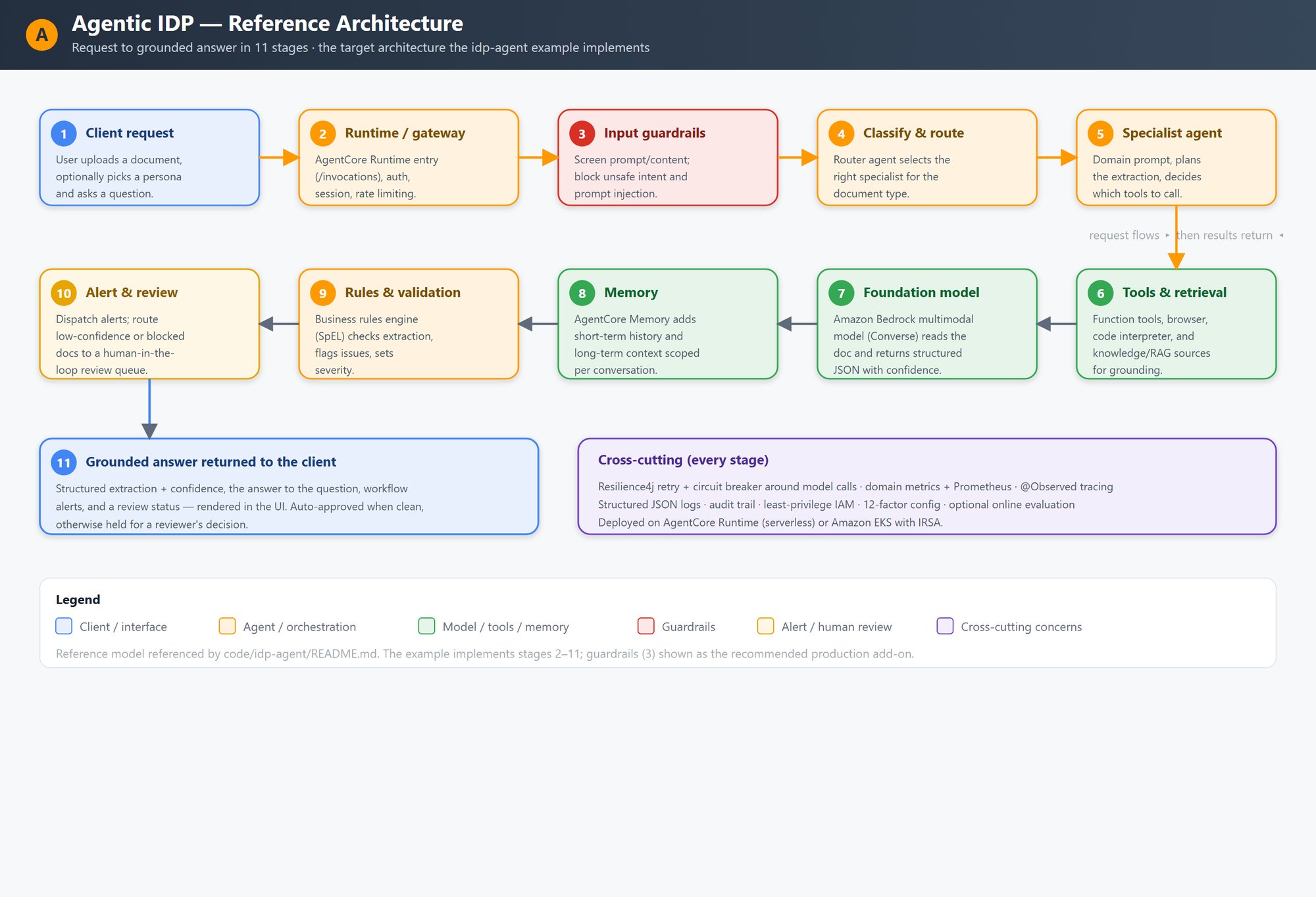
Determine 1: Agentic reference structure. A request flows by the runtime, guardrails, classification, a specialist agent, instruments, the inspiration mannequin, reminiscence, guidelines, and human evaluation to a grounded reply, with resilience and observability as cross-cutting issues
The pipeline has 11 phases. A shopper submits a doc and query. The request passes by a runtime gateway for authentication and price limiting, then enter guardrails display for dangerous content material. A router classifies the doc and routes it to a specialist agent, which plans its workflow and calls instruments, the Amazon Bedrock basis mannequin, reminiscence, and a guidelines engine as wanted. Low-confidence or flagged outcomes go to a human evaluation queue earlier than the grounded reply returns to the shopper. Resilience, observability, logging, and least-privilege AWS Id and Entry Administration (IAM) apply throughout all phases.
Answer overview
The answer consists of two deployable programs that share widespread patterns:
- Journey agent – A single autonomous agent with instrument calling (climate lookups, itinerary search), streaming responses, dialog reminiscence, and resilience patterns. That is the really helpful place to begin.
- IDP multi-agent system – A multi-agent clever doc processing platform with 5 specialist brokers (Lawyer, Mortgage, Insurance coverage, Tax, Normal), guidelines and workflow engine, alerting, and observability. This demonstrates manufacturing patterns at a scale.
Each programs share the next structure:
- Spring Boot utility with Spring AI ChatClient, Spring AI agentcore and Amazon Bedrock Converse API.
- AgentCore runtime, a functionality of Amazon Bedrock AgentCore, defines the contract (POST
/invocations, GET/ping) for managed deployment. - Dialog reminiscence by AgentCore reminiscence, a functionality of Amazon Bedrock AgentCore, for each short-term and long-term context.
- Instrument calling with
@Instrumentannotated strategies. - Structured output mapped to Java information.
- ARM64 container picture optimized for AWS Graviton.
- Modular Terraform for infrastructure provisioning.
The journey assistant is the really helpful place to begin. The next diagram illustrates how a Spring Boot agent interacts with AgentCore runtime, instruments, reminiscence, and fashions accessible on Amazon Bedrock.
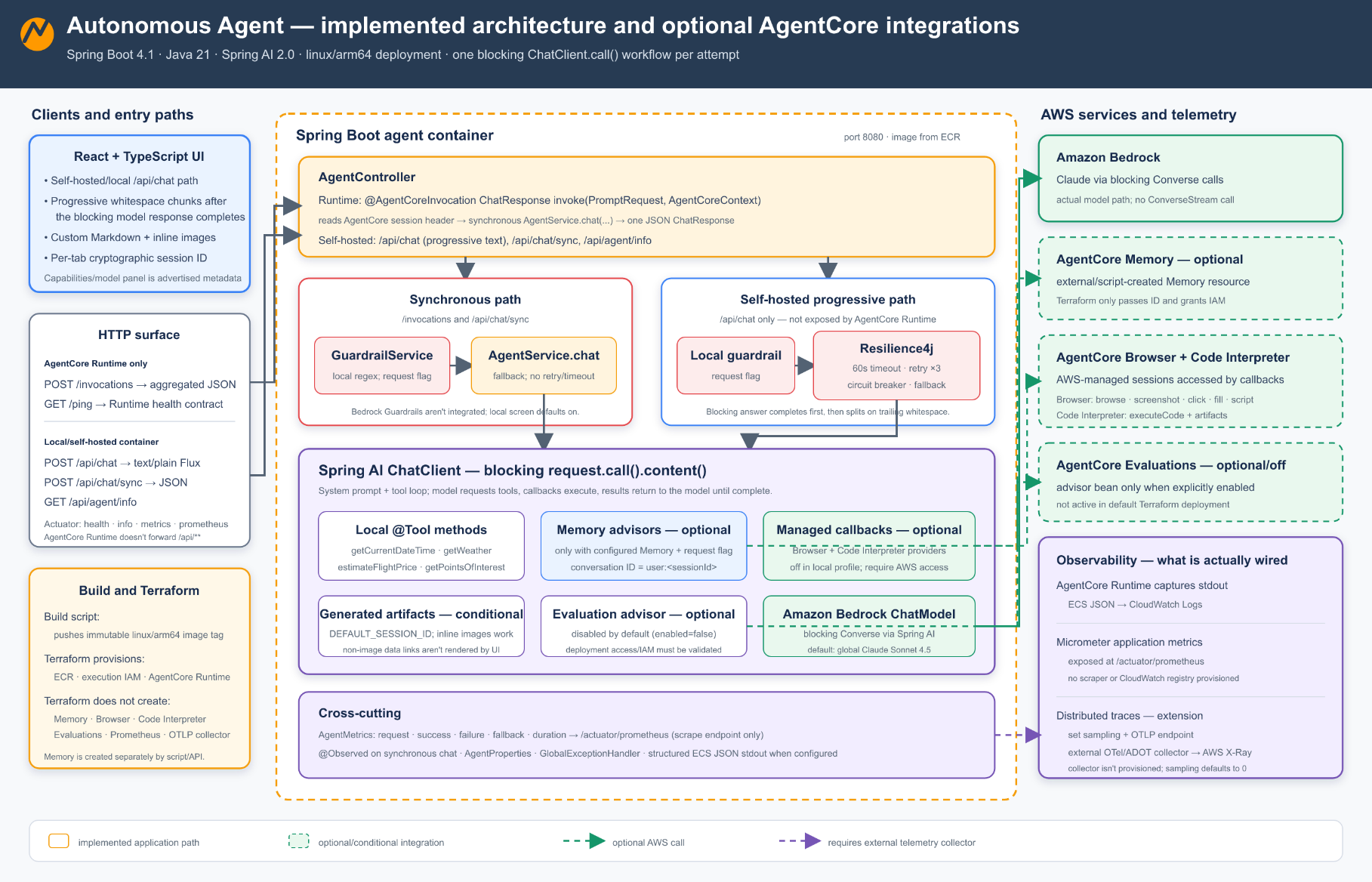
Determine 2: Single-agent journey assistant. The Spring Boot utility exposes each REST endpoints for the React UI and the AgentCore runtime contract, calling Amazon Bedrock by the Converse API whereas instrument calling, streaming, and reminiscence run inside one code base.
The journey assistant runs a single Spring Boot utility with two entry factors, the /invocations and /ping contract required by AgentCore runtime. Spring AI orchestrates calls to Amazon Bedrock by the Converse API and resolves instrument invocations regionally inside the identical course of. Server-Despatched Occasions stream tokens to the shopper as they’re generated. AgentCore reminiscence provides each short-term context inside a session and long-term context throughout periods, so the agent retains dialog historical past with out exterior state administration.
The next diagram exhibits the structure for the IDP multi-agent system.
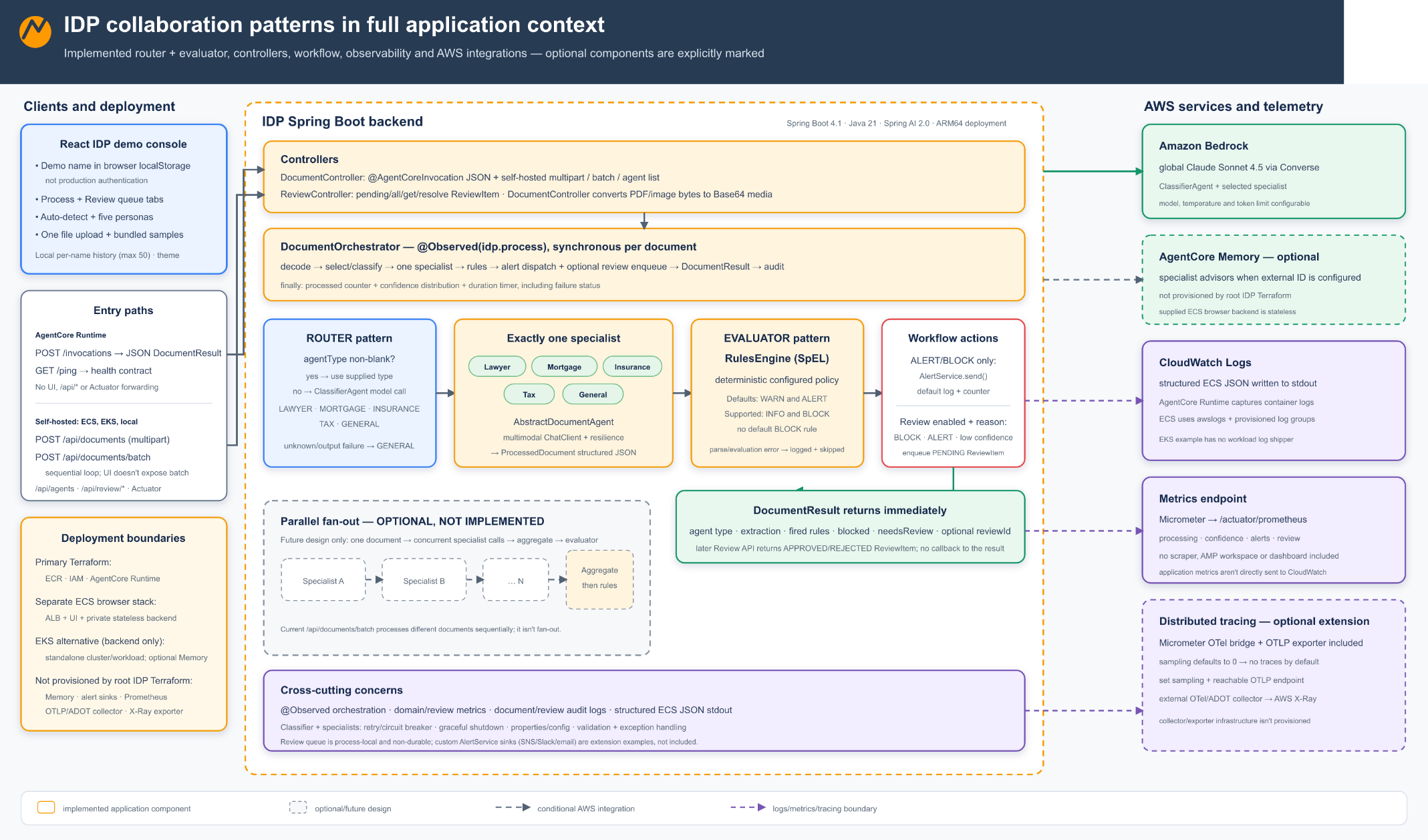
Determine 3: IDP multi-agent system structure. Specialist brokers course of paperwork by a shared ChatClient sample, with outcomes flowing by a guidelines engine and alert service.
The IDP multi-agent system routes paperwork by 5 specialist brokers (Lawyer, Mortgage, Insurance coverage, Tax, and Normal), every constructed on a shared AbstractDocumentAgent template. A ClassifierAgent reads every doc and forwards it to the suitable specialist. The specialist extracts structured JSON with confidence scores utilizing the multimodal Converse API of Amazon Bedrock. A guidelines engine evaluates Spring Expression Language (SpEL) expressions from utility.yml towards the extraction. ALERT or BLOCK severity guidelines dispatch by the AlertService. Low-confidence paperwork go to human evaluation. Metrics, audit path, resilience, and observability apply throughout all phases.
Agent collaboration patterns
When a number of brokers work collectively, how they coordinate determines system conduct. This answer makes use of three patterns:
The next diagram compares the three coordination patterns used on this answer.
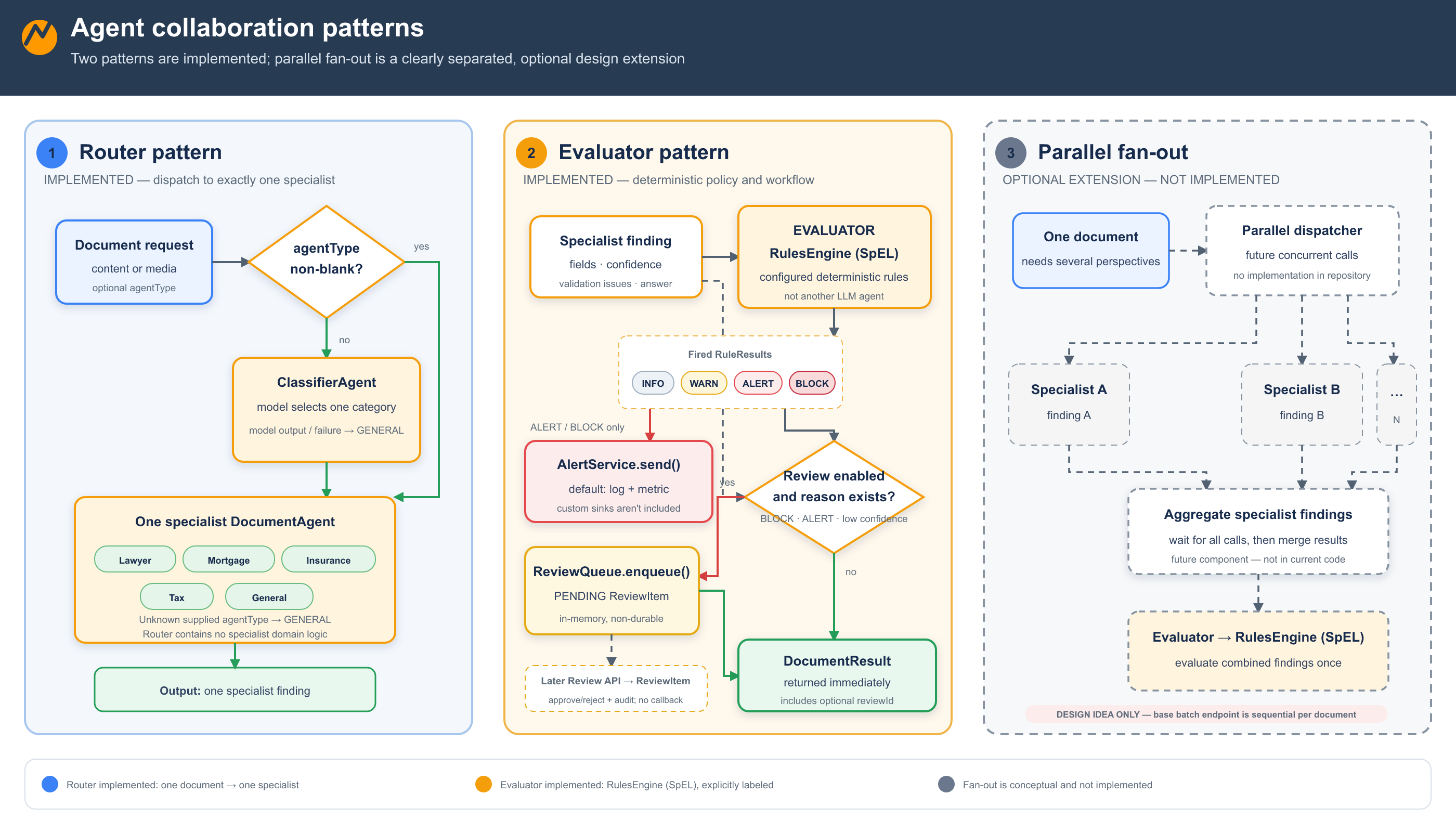
Determine 4: Agent collaboration patterns
Three patterns proven facet by facet. The router dispatches every request to at least one specialist by doc kind. The evaluator passes specialist findings by a guidelines engine that applies to severity ranges and dispatches alerts or blocks for human evaluation. The parallel fan-out sends one request to a number of specialists concurrently and aggregates outcomes earlier than the principles engine runs.
Router sample: A light-weight orchestrator examines the incoming request and routes it to the suitable specialist. Within the IDP multi-agent system, the router inspects doc kind metadata and forwards it to the Lawyer, Mortgage, Insurance coverage, Tax, or Normal agent. The router holds no area logic. It’s a dispatch layer solely.
Parallel fan-out (non-obligatory extension): The bottom answer implements the router and evaluator patterns. The batch endpoint processes paperwork sequentially. When a doc wants a number of views without delay, you may add a parallel fan-out as a drop-in extension. Dispatch to specialists concurrently and mixture their outcomes earlier than the principles engine runs. Wall-clock time for the mixed evaluation is then bounded by the slowest single agent name relatively than the sum of all calls.
Evaluator sample: After specialists return their findings, a guidelines engine evaluates the mixed output towards configurable enterprise guidelines. Guidelines that set off ALERT or BLOCK severity dispatch by a pluggable AlertService for human evaluation.
Walkthrough
The next sections stroll you thru the important thing implementation patterns, beginning with the AgentCore runtime contract and progressing by instrument calling, reminiscence, resilience, and multi-agent orchestration.
Fulfilling the AgentCore runtime contract
Amazon Bedrock AgentCore runtime manages agent lifecycle and scaling. For present charges, see Amazon Bedrock AgentCore pricing and Amazon Bedrock pricing. The runtime routes incoming requests to your agent and screens its well being. Your agent should expose two endpoints:
- POST
/invocations– Receives requests and returns responses as JSON or Server-Despatched Occasions (SSE) streaming. - GET
/ping– Experiences well being standing (WholesomeorHealthyBusy). Lengthy-running duties should sign busy standing, or the runtime may scale down the agent.
The next diagram exhibits how the Spring AI developer mannequin maps onto AgentCore runtime, Reminiscence, Browser, Code Interpreter, and Evaluations.
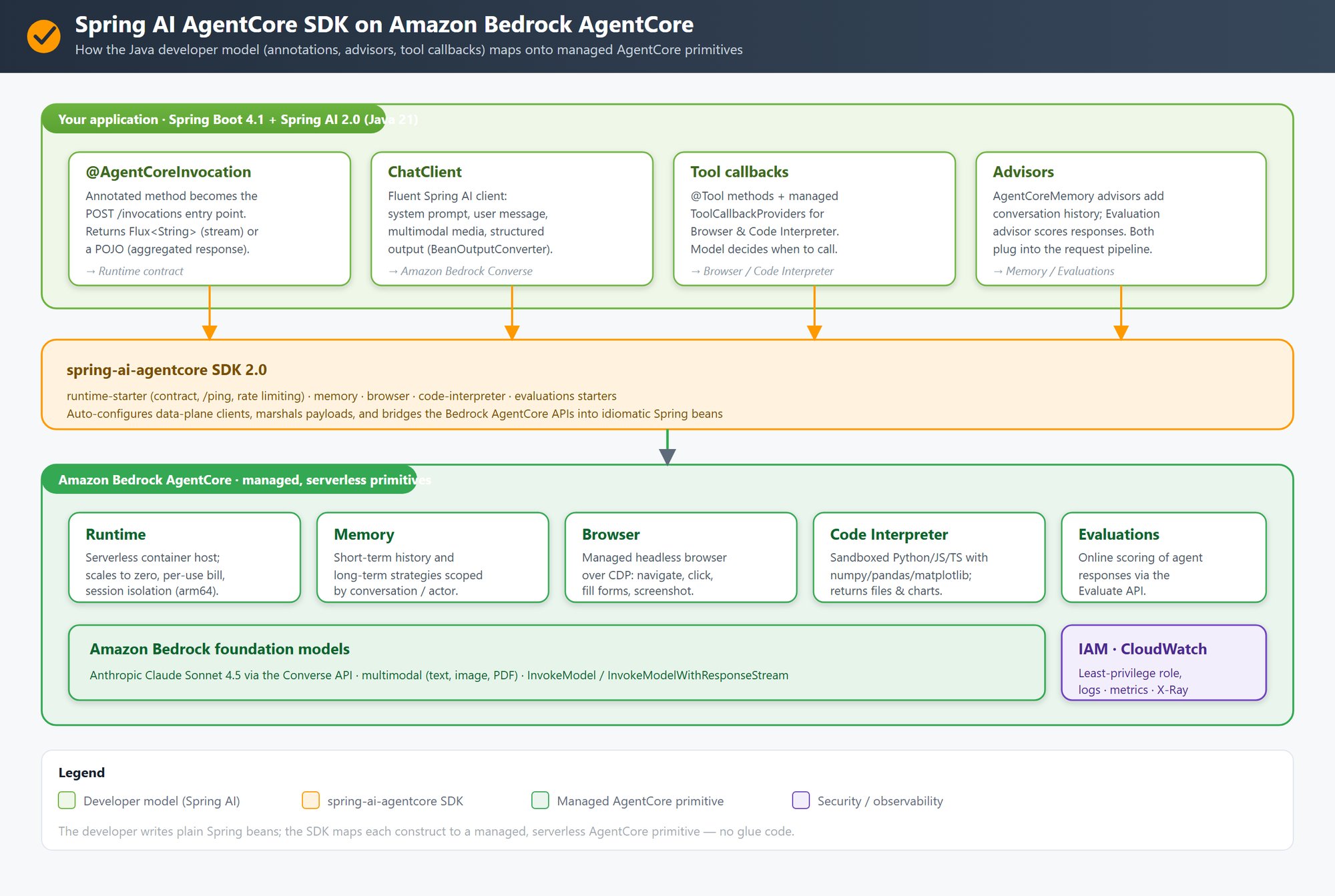
Determine 5: Spring AI AgentCore SDK on Amazon Bedrock AgentCore. Annotations, the ChatClient, instrument callbacks, and advisors map by the spring-ai-agentcore SDK onto AgentCore runtime, AgentCore reminiscence, AgentCore Browser, AgentCore Code Interpreter, and AgentCore Evaluations.
Two layers related by the spring-ai-agentcore SDK. The applying layer makes use of Spring AI parts: @AgentCoreInvocation for endpoint wiring, ChatClient for mannequin interplay, @Instrument callbacks, and advisors for reminiscence and guardrails. The infrastructure layer offers AgentCore runtime, AgentCore reminiscence, AgentCore Browser, AgentCore Code Interpreter, and AgentCore Evaluations, all capabilities of Amazon Bedrock AgentCore. The SDK bridges each, so builders write normal Spring AI code whereas AgentCore handles manufacturing infrastructure.
With the Spring AI AgentCore SDK, a single annotation handles this contract routinely:
The @AgentCoreInvocation annotation auto-configures the /invocations and /ping endpoints, handles JSON serialization, manages SSE framing for streaming responses, and studies well being standing. The identical venture additionally exposes REST endpoints for the React UI, so the agent serves each AgentCore runtime and a browser from one code base.
A be aware on streaming: the previous minimal instance returns the mannequin stream immediately, which is good for a chat UI. When an agent makes multi-argument instrument calls, assemble the response with a blocking name() after which chunk the end result for streaming, so the instrument arguments bind reliably. The journey assistant serves each the AgentCore runtime and the React UI from one service methodology:
With instrument calling, the mannequin can invoke exterior features throughout reasoning. In Spring AI, you annotate a way with @Instrument and the mannequin decides when to name it and with what arguments:
You register instruments on the ChatClient, and the mannequin decides when to name them:
For structured output, request a Java report kind. For multimodal enter, connect media to the consumer message:
Notice: We verified this instance with Anthropic Claude Sonnet 4.5 on Amazon Bedrock. Spring AI provides the report’s schema to the immediate and parses the reply again into the Java kind. Habits can differ for different mannequin households, so seek advice from the Spring AI structured output documentation and the Amazon Bedrock documentation for present assist. It’s best-effort, which means that fashions can often return output that doesn’t match the schema. For stricter outcomes, use a supplier with native schema enforcement or Spring AI validation and retry.
The mannequin receives the instrument definitions as a part of its context, causes about when a instrument name would assist fulfill the consumer request, and returns a structured instrument name response. Spring AI intercepts this, invokes the annotated methodology, and feeds the end result again to the mannequin for additional reasoning.
Including dialog reminiscence
Actual-world brokers should keep in mind what customers stated earlier in a dialog (working reminiscence) and what they’ve realized over time (persistent reminiscence). The Spring AI AgentCore SDK integrates with AgentCore reminiscence by the advisor sample: interceptors that enrich prompts with context earlier than they attain the mannequin.
The session ID turns into a dialog ID in actor:session type, so every consumer’s historical past stays remoted. For user-facing deployments, derive the actor from a verified OAuth 2.0 (JWT) id relatively than a client-supplied worth, so customers can’t entry each other’s historical past.
As well as, AgentCore reminiscence affords long-term reminiscence assist, using the next methods to establish and seize key insights from conversations:
- Semantic – Factual details about customers (for instance, “Person works in finance”)
- Person choice – Specific settings and selections (for instance, “Metric models most popular”)
- Abstract – Condensed dialog historical past for continuity throughout periods.
- Episodic – Previous interactions and classes realized.
Lengthy-term reminiscence extraction is asynchronous and non-obligatory. You select which methods to allow whenever you create the reminiscence, and AgentCore extracts and consolidates information within the background after every dialog, so it by no means blocks the agent’s response. Select methods by workload: use consumer choice for the journey assistant so it remembers models and seating selections. Use abstract when periods span many turns. Use episodic when the agent ought to reuse classes from previous duties. And use semantic to retain sturdy details in regards to the consumer.
Configuring the principles engine
Studying a doc is just half the job. Appearing on what it finds is the opposite half. The IDP multi-agent system features a guidelines engine so operators can add enterprise checks with out touching code. That is an in-process guidelines evaluator that applies SpEL situations to extraction outcomes, not a workflow orchestration service similar to AWS Step Capabilities. Guidelines reside in utility.yml and every situation is a SpEL expression evaluated towards the extraction:
Severity ranges management the engine’s conduct. INFO and WARN are logged, whereas ALERT dispatches by a pluggable AlertService. The default logs and emits a metric, however you may substitute Amazon Easy Notification Service (Amazon SNS), Slack, or electronic mail by offering your individual bean. BLOCK holds the doc for handbook evaluation. As a result of guidelines are operator configuration relatively than finish consumer enter, they supply a protected and auditable extension level. Including new workflows is a configuration change, not a deployment.
The evaluator sample is applied by the principles engine and a pluggable AlertService. The default implementation logs the alert and emits a metric. You present your individual bean to path to Amazon SNS, Slack, or electronic mail:
Manufacturing readiness patterns
The next patterns deal with widespread manufacturing necessities that prototypes sometimes skip.
Resilience
Each mannequin name makes use of a Resilience4j retry with exponential backoff, a circuit breaker that fails quick when mannequin calls repeatedly fail or trip, and a timeout. Streaming paths emit a fallback message as an alternative of a uncooked error. When site visitors exceeds your account and Area service quotas, AgentCore runtime returns HTTP 429 and the retry handles it. For present limits, see the Amazon Bedrock AgentCore quotas documentation.
Twelve-factor configurations
Each configurable worth (Area, mannequin ID, reminiscence ID, timeouts, price limits, system immediate) is an setting variable certain to a typed @ConfigurationProperties class. The applying is stateless, begins quick, drains in-flight activates scale-down, and ships as one immutable ARM64 picture promoted unchanged from improvement to manufacturing.
Safety and id
The Agentcore runtime makes use of AWS Id and Entry Administration (IAM) authentication by default. For user-facing brokers, add an OAuth 2.0 (JWT) authorizer (similar to Amazon Cognito) and derive the reminiscence actor ID (actorId) from the verified id. The IAM execution function follows least privilege:
- Amazon Elastic Container Registry (Amazon ECR) pull.
- Scoped Amazon CloudWatch Logs and AWS X-Ray.
- Amazon Bedrock InvokeModel actions.
- Scoped workload entry tokens (
GetWorkloadAccessTokenForJWT) for the agent’s workload id. - AgentCore reminiscence actions restricted to the precise Reminiscence useful resource ARN.
AgentCore Gateway, a functionality of Amazon Bedrock AgentCore, enforces inbound authentication (performing as an OAuth 2.0 useful resource server that validates JWT bearer tokens by Cognito, Okta, Auth0, or your individual OIDC supplier) and helps configurable price limiting on the gateway layer. Fee limits are fail-open by default, so they need to complement your core safety controls relatively than exchange them.
Accountable AI controls
Autonomous brokers that take real-world actions want security controls as a first-class concern. The pattern ships with a stand-in demonstration of a light-weight in-process pre-check referred to as GuardrailService. This service screens prompts for disallowed intent and immediate injection, toggled per request with the guardrailsEnabled flag. Manufacturing deployments use Amazon Bedrock Guardrails as a regular management utilized to each request, not a per-request toggle.
To improve the demo service for manufacturing, entrance the agent with Amazon Bedrock Guardrails. Guardrails apply configurable insurance policies outdoors the mannequin name, protecting each enter and output:
- Content material filtering. Blocks dangerous or off-topic content material primarily based on configurable thresholds for each prompts and responses.
- Denied subjects. Prevents the agent from partaking with subjects you outline as out-of-scope.
- Delicate data filters. Detects and redacts PII in each prompts and responses, supporting necessities similar to GDPR and HIPAA.
For brokers that retrieve exterior information, allow grounding checks to cut back hallucination threat earlier than the agent acts on instrument calls with real-world unwanted side effects.
To wire Bedrock Guardrails into Spring AI, implement CallAdvisor and StreamAdvisor features that decision the ApplyGuardrail API and register it with defaultAdvisors on the ChatClient. As a result of insurance policies reside within the guardrail, safety groups can replace filters independently of the applying launch cycle.
Observability
The instance devices with the Micrometer Commentary API (@Noticed), producing timers that turn into distributed hint spans whenever you add a tracing bridge (OTLP to AWS X-Ray). The system emits area metrics:
These metrics are uncovered by /actuator/prometheus. The applying additionally emits structured JSON logs to straightforward output, which Amazon Bedrock AgentCore runtime captures in Amazon CloudWatch Logs.
Non-obligatory extension that’s not applied on this put up: The pattern consists of the Micrometer OpenTelemetry bridge and OTLP exporter dependencies, however this put up’s deployment doesn’t provision an OpenTelemetry collector or allow hint sampling. You’ll be able to add distributed tracing by setting a nonzero TRACING_SAMPLING worth, pointing OTLP_TRACES_ENDPOINT to an OpenTelemetry or AWS Distro for OpenTelemetry collector, and configuring the collector to ahead traces to AWS X-Ray.
Non-obligatory extension that’s not applied on this put up: The pattern doesn’t implement an automatic analysis or optimization suggestions loop. You’ll be able to add one by persisting utility metrics, traces, audit occasions, and human-review outcomes as an analysis dataset. AgentCore evaluations or a separate analysis pipeline can then evaluate versioned prompts, fashions, instruments, and routing guidelines towards high quality, security, latency, and price thresholds. Promote adjustments solely after analysis and human approval.
Deploying the answer
This GitHub repository incorporates two AI agent functions demonstrating completely different use instances for autonomous AI. This information exhibits you how you can deploy them to AWS utilizing Amazon Bedrock AgentCore runtime.
The next diagram exhibits the deployment structure: a single Arm64 picture promoted by modular Terraform to the AgentCore runtime, with an non-obligatory Amazon Elastic Kubernetes Service (Amazon EKS) path.
Non-obligatory: working on Amazon EKS. Groups already standardized on Kubernetes can run the identical Arm64 picture on Amazon EKS, utilizing their current cluster for scaling and well being checks towards the /ping endpoint, with IAM Roles for Service Accounts (IRSA) for scoped, least-privilege pod-level entry to Amazon Bedrock and AgentCore reminiscence. The container is an identical, so nothing within the utility adjustments.
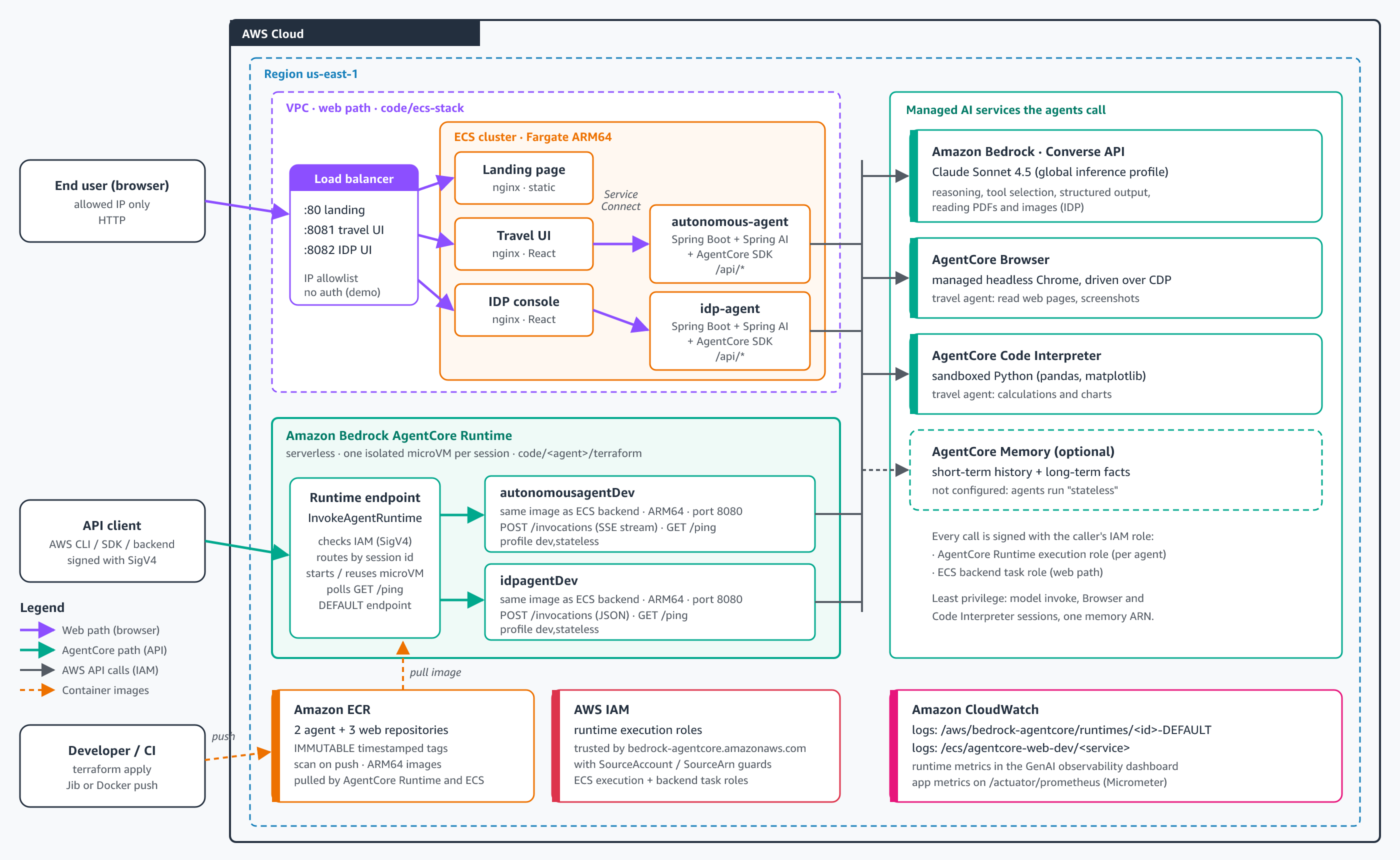
Determine 6: Deployment structure. Modular Terraform provisions Amazon ECR, a least-privilege IAM execution function, and the Bedrock AgentCore runtime, with an non-obligatory Amazon EKS and IRSA path that reuses the identical Arm64 picture.
Three phases: construct and publish, Terraform, and runs on AWS. The CI pipeline packages the applying right into a linux/arm64 picture and pushes it to Amazon ECR with immutable tags. Three Terraform modules provision the ECR repository, a least-privilege IAM execution function, and the AgentCore runtime. The agent runs serverlessly on AgentCore runtime, calling Amazon Bedrock and AgentCore reminiscence. An non-obligatory Amazon EKS path reuses the identical picture with IRSA for scoped pod-level credentials.
Observe these steps to deploy both utility.
Step 1: Clone the repository
Open your terminal and run:
Step 2: Navigate to the listing for the agent you wish to deploy
- Deploy autonomous agent:
- Deploy IDP multi-agent system:
Step 3: Configure Terraform variables
Earlier than deploying the infrastructure, configure your Terraform variables within the terraform.tfvars file positioned within the terraform listing.
Fundamental configuration
The answer makes use of default values for many settings, however you may customise the next in your terraform.tfvars file:
- AWS Area: The AWS Area the place assets are deployed.
- Setting: Setting ID (similar to
devorprod) utilized in useful resource naming. bedrock_model: Amazon Bedrock basis mannequin (for instance:international.anthropic.claude-sonnet-4-5-20250929-v1:0). For mannequin availability by Area, seek advice from Supported fashions by AWS Area in Amazon Bedrock.
Step 4: Run the deployment script
For Linux/macOS:
For Home windows PowerShell:
The deployment script does the next:
- Create an Amazon ECR repository.
- Construct the Java utility.
- Create and push a Docker container picture.
- Create an IAM execution function.
- Deploy the AgentCore runtime.
Step 5: Run the applying
As soon as the deployment is full, you may run the applying utilizing the next instructions.
For Linux/macOS:
For Home windows PowerShell:
Cleansing up
AgentCore runtime scales to zero and payments per invocation, so an idle agent prices virtually nothing. Your important variable price is Amazon Bedrock token utilization, plus a small quantity for Amazon CloudWatch and Amazon ECR storage. For present charges, see Amazon Bedrock AgentCore pricing and Amazon Bedrock pricing. To keep away from incurring future fees, tear down the infrastructure if you find yourself completed:
For Linux/macOS:
For Home windows PowerShell:
Delete any AgentCore reminiscence assets and Amazon ECR pictures you not want utilizing the AWS CLI.
Conclusion
On this put up, you realized how you can construct autonomous AI brokers in Java utilizing Spring AI and Amazon Bedrock. We coated the three capabilities that flip a mannequin into an agent: planning, instrument use, and reminiscence. We additionally confirmed how Amazon Bedrock AgentCore providers carry an agent to manufacturing. The Spring AI AgentCore SDK maps these capabilities onto idiomatic Spring by annotations and a well-recognized ChatClient. Lastly, we outlined structure patterns for multi-agent collaboration. These embrace the router sample, the evaluator sample applied by the principles engine, and parallel fan-out as an non-obligatory extension.
The important thing takeaway for Java groups: you don’t want to depart your setting to construct production-quality brokers. The patterns you already belief (dependency injection, configuration properties, advisors, Actuator, Micrometer) carry immediately into the agentic world. AgentCore provides the runtime, reminiscence, id, and governance that manufacturing calls for.
As subsequent steps, contemplate the next:
- Join enterprise programs by AgentCore Gateway and the Mannequin Context Protocol (MCP)
- Add Amazon Bedrock Data Bases, the absolutely managed RAG functionality, and net search so the agent causes over your knowledge.
- Implement Amazon Cognito JWT authentication with per-user reminiscence isolation.
- Customise Amazon Bedrock Guardrails insurance policies: add domain-specific denied subjects, tighten content-filtering thresholds, and allow grounding checks tuned to your information sources.
- Use AgentCore Evaluations to attain manufacturing traces and promote immediate or mannequin adjustments after evaluation.
Every is an incremental addition to the inspiration you might have constructed right here, not a rewrite.
Concerning the authors


