

AI brokers more and more deal with work that depends upon what modified right now, comparable to safety advisories, product releases, costs, and laws. A mannequin’s coaching information can’t reply these questions, so brokers want internet search. For manufacturing use, groups additionally want outcomes they’ll cite, and management over which sources depend. They need search queries to remain inside their cloud setting as a result of these queries typically reveal inside work.
The Internet Search API in Amazon Bedrock AgentCore is now accessible. It offers brokers and purposes present internet outcomes by a single API name, signed with the AWS credentials they already use. AWS serves each question from an internet index that Amazon operates, and doesn’t ship it to a third-party search engine.
Every consequence consists of the web page’s title, URL, publication date, and an extract related to the question. Requests can embrace or exclude domains, and restrict outcomes to a publication date vary. On AWS Lambda, Amazon Elastic Container Service (Amazon ECS), or Amazon Bedrock AgentCore runtime, your agent calls the API with its execution function. There’s no search API key to retailer or rotate. Internet Search on Amazon Bedrock AgentCore can be accessible by AgentCore Gateway, a functionality of Amazon Bedrock AgentCore. There, one administrator supply coverage covers each agent and Mannequin Context Protocol (MCP) shopper.
For LangChain builders, the AgentCore internet search device in LangChain’s AWS integration now calls the Internet Search API. One operate name offers an agent present, cited search outcomes. The device may also maintain guidelines that the mannequin can’t change, comparable to a date window, a supply blocklist, and a search finances. It returns its outcomes as information that your code can examine. It really works with LangChain brokers, with LangGraph, the orchestration framework that runs them, and with Deep Brokers, which provides subagents, a digital filesystem, and context compression.
On this put up, you construct a day by day dependency look ahead to a safety staff as a LangGraph graph on the Internet Search API. Each morning, the watch checks whether or not something new impacts the open supply packages and container base pictures the staff ships. It researches three bundle ecosystems in parallel, whereas your code retains the date window, the blocklist, and the search finances out of the mannequin’s management. It checks every discovering in opposition to the sources it cites and remembers what it already reported. Then you definitely run the watch on AgentCore runtime, and provide it throughout groups by AgentCore Gateway. In our check, the three branches completed in 36 seconds, in opposition to 99 seconds one after one other.
Resolution overview
The mannequin decides what to seek for and writes the findings. Each rule that should maintain, regardless of the mannequin does, stays in code: the date window, the blocklist, the search finances, and the checks on every discovering. Determine 1 exhibits how these elements match collectively while you run the watch from the pocket book.
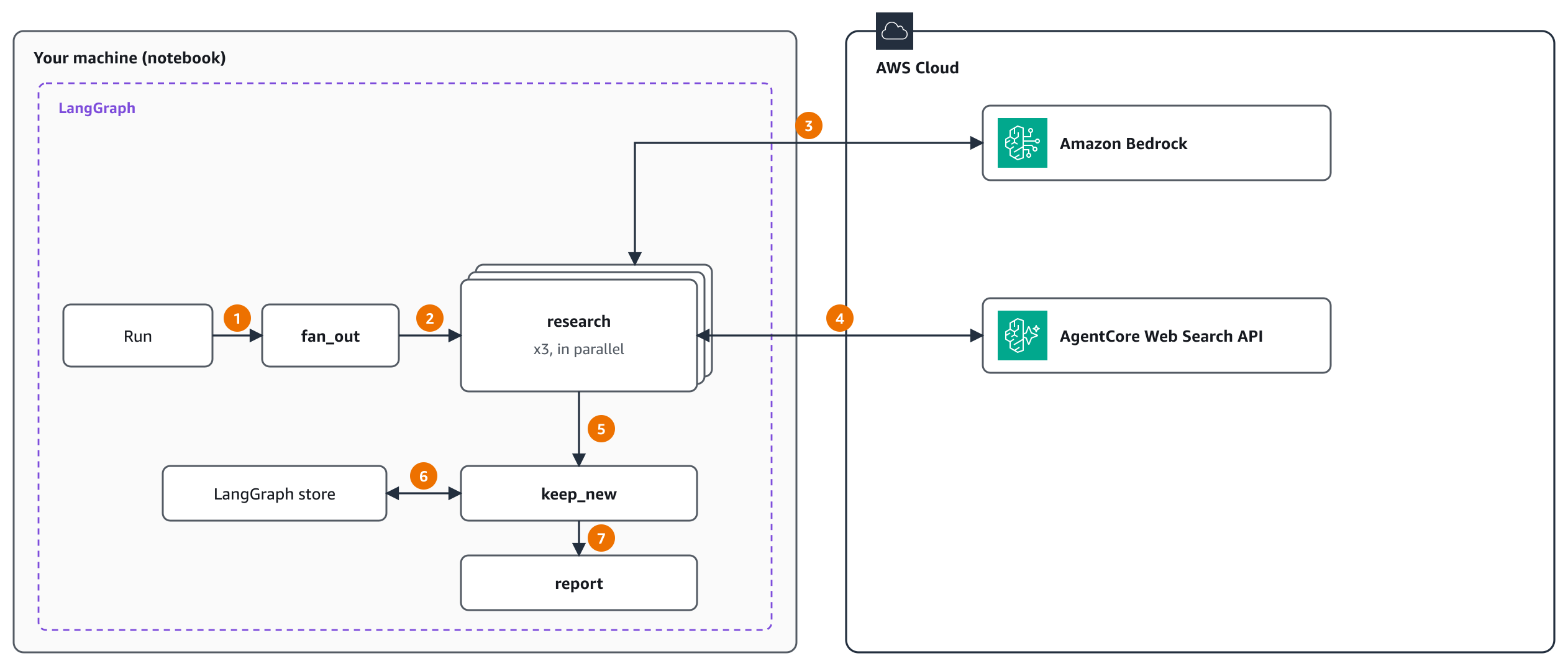
Determine 1: A day by day dependency watch with LangGraph and the Internet Search API, run from a pocket book
The numbered steps:
- A run begins the graph with the watchlist and the watch window.
fan_outbegins one analysis department per ecosystem: npm, PyPI, and container base pictures. LangGraph runs the three branches in parallel.- Inside every department, the agent calls an Anthropic Claude mannequin in Amazon Bedrock. The mannequin decides what to seek for and, on the finish, produces structured findings.
- The department’s search device provides the date window and the blocklist to every question. It calls the Internet Search API with a request signed with AWS Signature Model 4 (SigV4). Steps 3 and 4 repeat, as much as 4 searches per department, in each department on the similar time.
- Every department retains solely findings that its sources assist and that fall contained in the window. When all three branches end, LangGraph merges their findings and runs
keep_newas soon as. keep_newchecks the LangGraph retailer and information new findings, so nothing is reported twice.- report builds the cited desk of recent findings for the safety staff.
Stipulations
Earlier than you begin, you want the next:
- An AWS account, working in an AWS Area that gives the Internet Search API. The examples use the US East (N. Virginia) Area (us-east-1). For different Areas, see Supported AWS Areas.
- Python 3.10 or later.
- AWS credentials for the identification that runs the pocket book, from setting variables or an AWS Command Line Interface (AWS CLI) profile. That identification wants the AWS Identification and Entry Administration (IAM) permission from Step 1 and entry to an Anthropic Claude mannequin in Amazon Bedrock.
- The next Python packages: boto3 1.43.127 or later, the AgentCore Python SDK (bedrock-agentcore) 1.26.0 or later, and langchain-aws 1.9.3 or later. Set up them with this
pipcommand:
Internet Search and mannequin calls are billed per use. For particulars, see Amazon Bedrock AgentCore pricing. One run of the watch makes at most 12 searches.
The whole code is on this pocket book. The pocket book runs each cell, together with setup. The next steps cowl the elements that matter for search.
Step 1: Grant the permission
First, give the identification you run as permission to go looking. The Internet Search API wants one IAM motion on one useful resource that AWS owns, so the assertion is identical in each account. (For the total setup, see Grant permission to name the API.) This makes use of the identical permission {that a} gateway’s service function makes use of for internet search:
Now construct the search device that every analysis department makes use of. The watch can’t let the mannequin select the date window, the trusted sources, or the variety of searches. The graph additionally wants the returned sources as information, to examine findings in opposition to them later. The online search toolkit within the langchain-aws bundle covers all of that with its choices:
With no gateway argument, the device calls the Internet Search API. Each search carries the blocklist and the date ground, and a mannequin’s personal arguments may solely slim them. With model_filters=False, the mannequin sees solely a question argument. The device stops after 4 searches, and it returns the outcomes twice: as textual content for the mannequin, and as an artifact for the graph. Every department creates its personal toolkit, so the branches search in parallel. You can provide the identical instruments to a Deep Brokers subagent.
Step 3: Outline the findings schema
With the search device in place, outline what every department returns. Every department is a create_agent agent with a Pydantic schema as its response format, so it returns findings as a substitute of prose. A discovering has the bundle, a one-line title, and the CVE or advisory ID if the supply offers one. It additionally has the severity that the supply states, whether or not the supply says it’s exploited, a advisable motion, and the supply URL. The pocket book has the total schema and immediate.
Step 4: Construct the graph and its proof examine
Now assemble the graph. fan_out sends one department per ecosystem with the Ship API in LangGraph, so the branches run in parallel.
Earlier than a department returns, code runs 4 checks on each discovering. The checks evaluate the discovering with what that department’s personal searches returned:
- The cited URL got here again from one of many department’s searches.
- The supply’s title or textual content names the bundle as an entire phrase.
- Any CVE or advisory ID within the discovering seems in that textual content.
- The supply’s publication date falls contained in the watch window. The artifact carries every date already parsed, and a lacking date counts as exterior.
In any case branches end, keep_new compares the surviving findings with a LangGraph retailer, and report builds the desk. These checks catch an unsupported URL, a supply that doesn’t title the bundle, an invented ID, and an out-of-window supply. They don’t verify severity, exploitation standing, affected variations, or the advisable motion. In addition they don’t show when a difficulty was first disclosed: a web page that the index dates this week can describe an older incident. For a manufacturing safety workflow, confirm findings in opposition to authoritative vulnerability feeds. Have somebody evaluate a discovering earlier than anybody acts on it.
Step 5: Run the watch
You’re able to run the watch with a 7-day window. In our run, the three branches made 12 searches and bought 80 sources again. They completed in 36 seconds of wall time, in opposition to 99 seconds for the branches added collectively. The proof examine dropped two findings: one whose supply didn’t title the bundle, and one whose CVE ID didn’t seem in its supply. Not one of the sources got here from the blocked area.
4 findings handed the checks, and keep_new reported two of them. Earlier check runs had already reported the opposite two, so the shop held them again. Determine 2 exhibits the run in LangGraph Studio, the visible debugger for LangGraph. Each row of the report hyperlinks to its supply, which the Internet Search acceptable use phrases require for any output proven to customers.
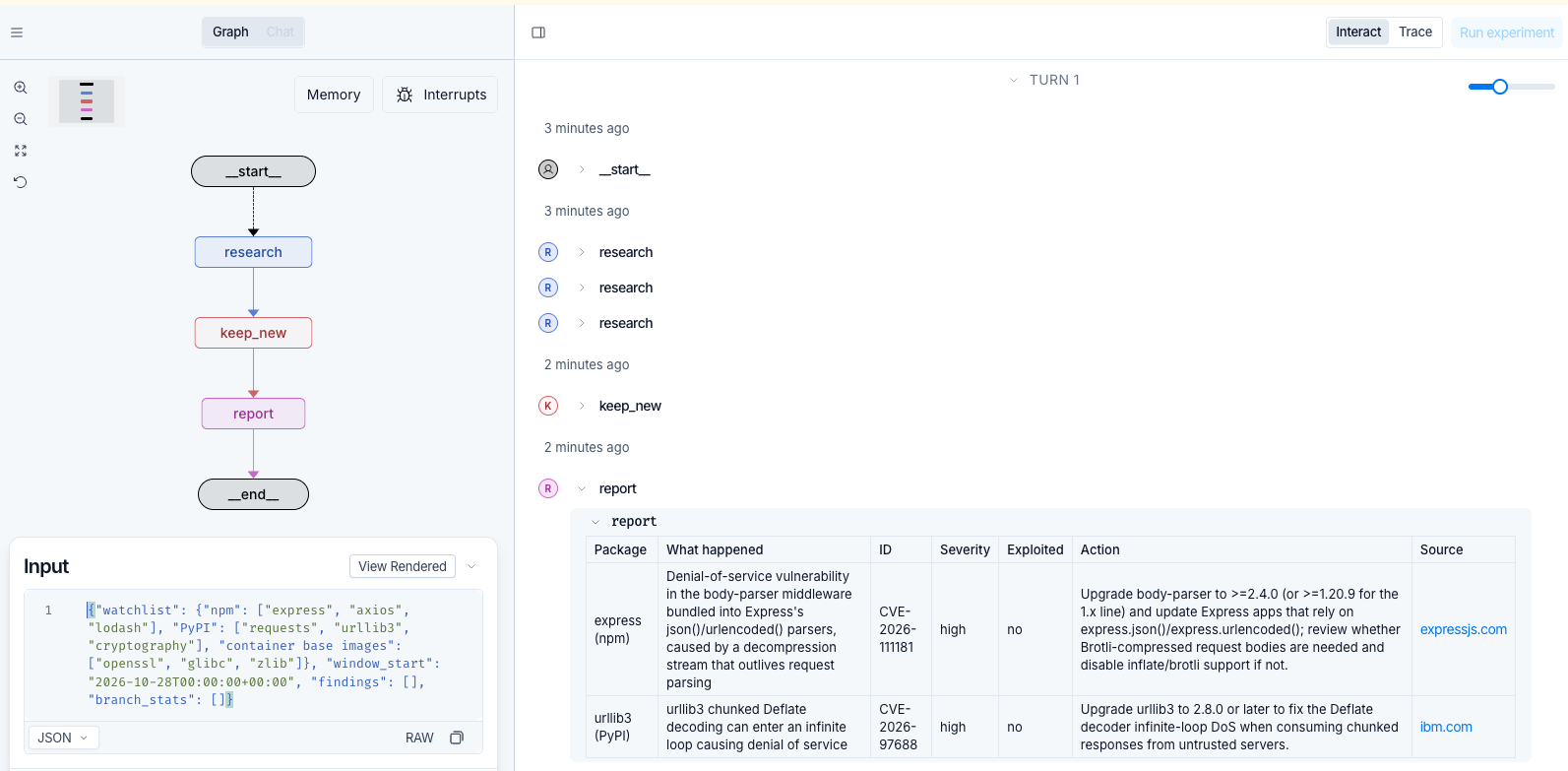
Determine 2: A run of the dependency watch in LangGraph Studio. The three analysis entries on the correct are the three ecosystem branches, which LangGraph ran in parallel. The report lists solely findings that handed the proof examine and weren’t reported earlier than, every linked to its supply
Step 6: Run the watch once more to see solely new findings
Lastly, run the watch a second time to see the shop at work. A scheduled watch runs daily, and the staff shouldn’t see the identical advisory twice. In our second run, the branches searched once more and stored two findings, and the shop had reported each earlier than. So the report had nothing new, as Determine 3 exhibits.
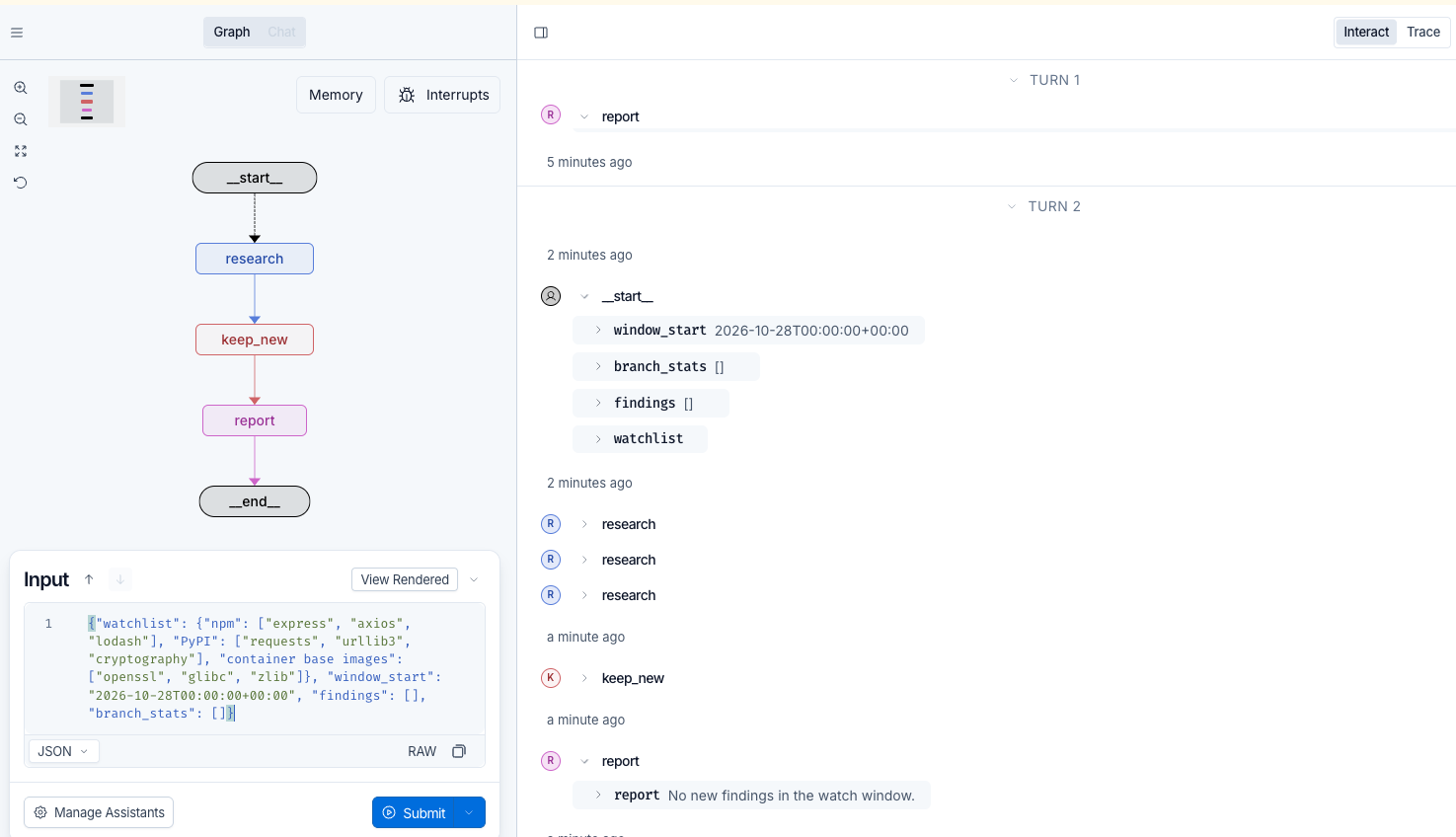
Determine 3: A second run with the identical enter. The branches search once more, however keep_new finds each consequence already within the LangGraph retailer, so the report has nothing new
For a scheduled job, swap InMemoryStore for a sturdy retailer with actual key lookups, comparable to DynamoDBStore from langgraph-checkpoint-aws.
Add internet search to an present LangChain or Deep Brokers app
If you have already got a LangChain agent, including internet search takes just a few modifications. Examine these earlier than you deploy:
- Permission: add the Step 1 assertion to the identification or execution function that your app already runs with. Nothing else must be created.
- Area: the toolkit’s Area should provide the Internet Search API, and it could possibly differ from the Area of your mannequin or the remainder of your app.
- Software title: the device is known as
web_search. In case your agent already has a device with that title, comparable to one other search supplier, set a special title on the device earlier than you add it. - Guidelines and finances: every toolkit carries its personal filters and search finances. Create one toolkit for every agent or department that wants separate guidelines or its personal finances.
- Throughput: all brokers in an account share its Internet Search quota, so parallel branches add up. By default, an account can ship 10 requests per second in every Area. For particulars, see Quotas for Amazon Bedrock AgentCore.
With Deep Brokers, you outline the agent with create_deep_agent: a mannequin, instruments, a system immediate, and subagents. Go the toolkit’s instruments in a subagent’s instruments checklist. Set the principles as toolkit choices, as a result of the device applies them on each search, regardless of the mannequin asks. To examine findings in opposition to their sources, as in Step 4, run that examine on the agent’s output or add it as middleware. In our check, a Deep Brokers coordinator delegated to a researcher subagent with these instruments and returned a cited reply in a few minute.
Take it to manufacturing on AgentCore runtime
Once you’re able to run the watch daily and not using a pocket book, host it on AgentCore runtime. Runtime runs brokers constructed with any framework, together with LangGraph, and not using a rewrite. It provides two compute varieties behind the identical APIs. MicroVMs, the default, give every session its personal remoted microVM, so one run can’t see one other’s information. Cases run your brokers on AWS-managed Amazon Elastic Compute Cloud (Amazon EC2) situations in your personal account. They match multi-day periods, GPU workloads, or a number of brokers that share one occasion.
For the boundaries of every, see Use remoted periods for brokers and Runtime Cases and capability suppliers. The Runtime pattern subsequent to the pocket book holds the identical graph as a Runtime entrypoint. Its coverage grants the Runtime execution function the Step 1 permission and no broader entry. Its README walks by creating, deploying, and invoking the mission with the AgentCore CLI, on both compute sort.
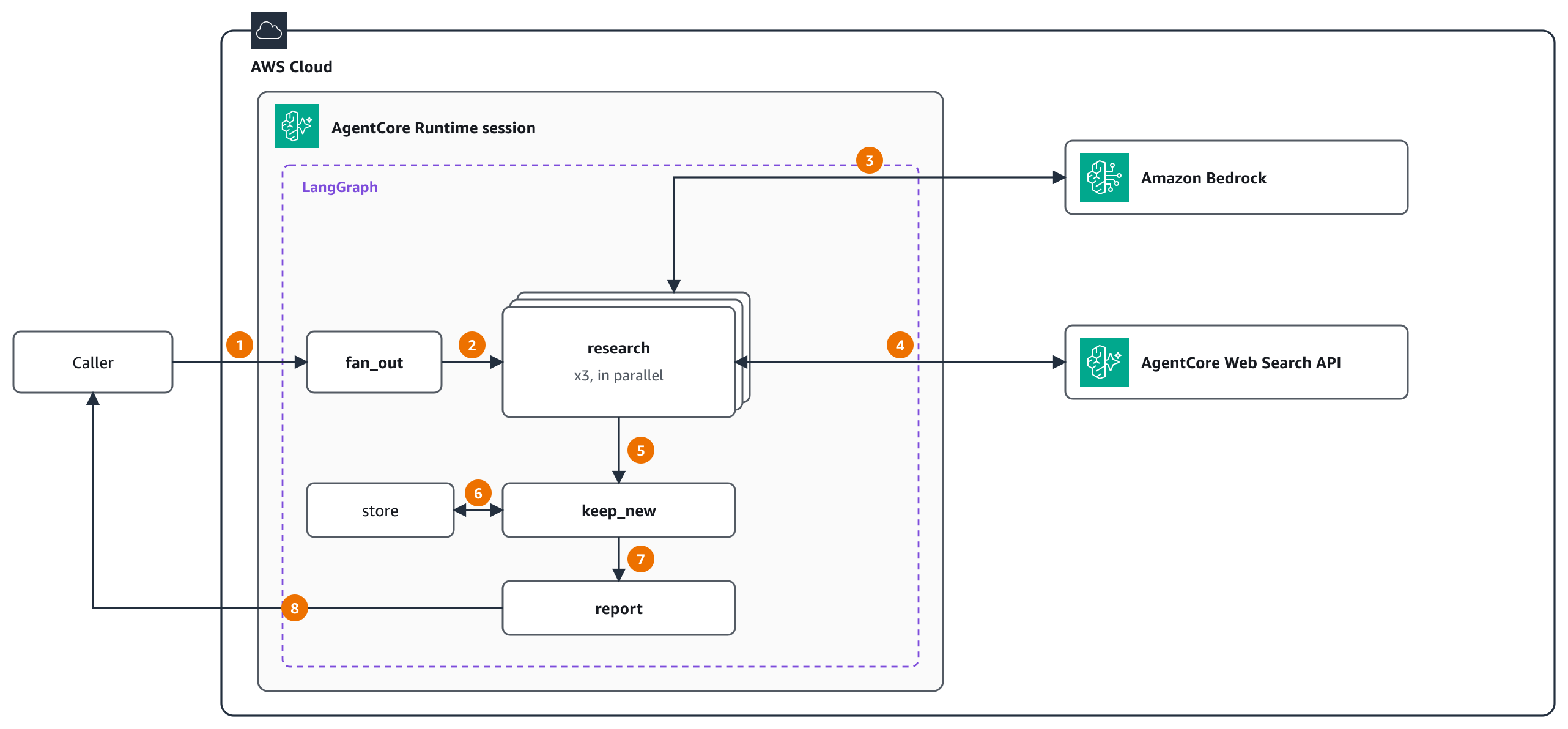
Determine 4: The identical dependency watch hosted on AgentCore runtime. Steps 2 to 7 match Determine 1, with every search signed by the Runtime execution function. At step 1, a caller invokes the runtime, for instance with agentcore invoke. At step 8, the runtime returns the report
Runtime session state is ephemeral, so the in-memory retailer lasts solely so long as the session. A day by day job wants the sturdy retailer from Step 6, invoked on a schedule.
Scale the watch throughout groups with AgentCore Gateway
The Internet Search API and the Internet Search Software on AgentCore Gateway search the identical index, and the identical graph works on each. Select by who enforces the principles and who calls search:
- Use the Internet Search API when your personal utility calls search and enforces its personal guidelines, as in Steps 1 to six. It wants just one IAM permission.
- Use AgentCore Gateway when a platform staff provides search to many brokers or groups and needs AWS to use one administrator supply coverage to each search. The coverage sits on the gateway goal, hidden from the agent, which may’t elevate it.
- Use AgentCore Gateway when MCP purchasers comparable to Claude want search, or while you need internet search subsequent to different instruments behind one MCP endpoint.
The pocket book’s non-compulsory Step 7 runs the watch by a gateway. It creates an internet search goal that carries the blocklist as an administrator coverage, so the search shopper not provides it. This route wants two IAM grants on two completely different principals. The gateway’s service function wants bedrock-agentcore:InvokeWebSearch on the net search device. The credentials your agent indicators with want bedrock-agentcore:InvokeGateway on the gateway. Determine 5 exhibits the move.
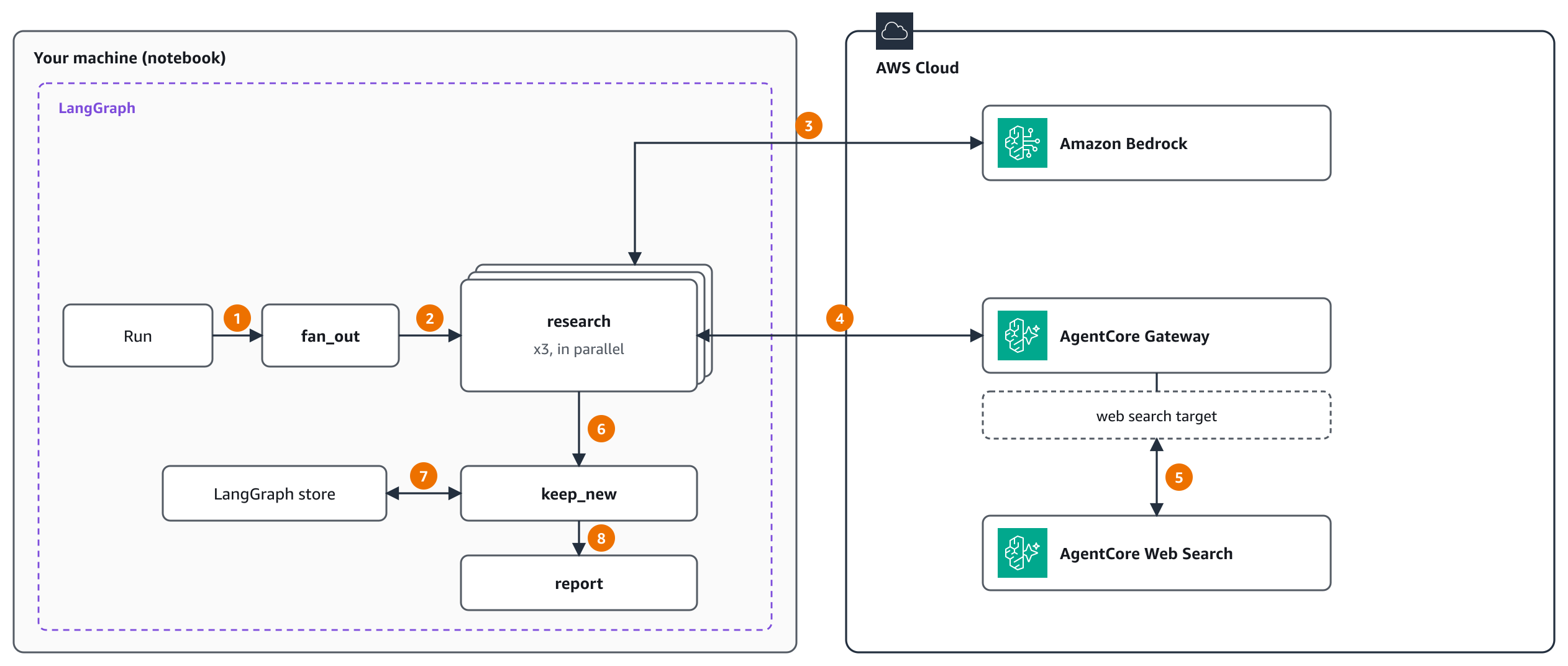
Determine 5: The identical dependency watch by AgentCore Gateway. The graph is identical as in Determine 1. At step 4, the search device calls AgentCore Gateway over MCP, signed with SigV4. At step 5, the online search goal applies the administrator blocklist and calls AgentCore Internet Search
To present every staff its personal coverage, add one internet search goal per staff, every with its personal blocklist. This walkthrough pocket book exhibits that sample. For extra on this route, see Internet Search Software.
Clear up
Steps 1–6 create no AWS assets. If you happen to added the Step 1 permission just for this put up, take away it from the identification you connected it to. If you happen to ran Step 7, delete the goal and the gateway to keep away from ongoing costs. The pocket book’s final cell does this while you set DELETE_GATEWAY = True:
The pocket book leaves the gateway’s service function in place so different gateways can use it. Delete it within the IAM console while you not want it. If you happen to deployed to Runtime, run agentcore take away all after which agentcore deploy -y from the mission folder.
Conclusion
The Internet Search API in Amazon Bedrock AgentCore offers LangChain brokers present, cited internet outcomes with the AWS credentials they already use. The dependency watch exhibits methods to transcend a single device name. Hold the principles the mannequin should not change in code, and maintain the returned sources as information exterior the mannequin’s context. Examine what might be checked, and maintain the citations in all the pieces customers see. When extra groups want the identical search, AgentCore Gateway applies one coverage to all of them.
To get began, open the pocket book. For reference, see the Amazon Bedrock AgentCore Internet Search integration web page within the LangChain documentation and Search the online utilizing Amazon Bedrock AgentCore Internet Search.
Concerning the authors