

At Natera, a frontrunner in cell-free DNA (cfDNA) testing, preserving lab devices up and working is crucial, as a result of gear downtime disrupts pattern processing. Natera’s lab engineering group, led by Ariel Jirau labored with AWS to construct SWARM (Systematic Workflow Analytics and Resolutions Supervisor), an agentic AI system for lab operations.
This submit walks by means of how the Natera group constructed an agentic AI system for lab operations utilizing Amazon Bedrock AgentCore that captures and deploys institutional information at scale. It describes the total structure, from information base development to automated system deployment and analysis, so you’ll be able to apply the identical patterns to your personal operational workflows.
SWARM delivers about 130x sooner first response time and 96.2 p.c automated protection throughout assist tickets, giving engineers quick entry to institutional information the second a ticket arrives.
The problem: Data continuity
Natera’s lab operations depend on a variety of precision devices spanning a number of gear households, every with its personal failure modes, vendor documentation, and determination patterns. The service engineering group accountable for sustaining this infrastructure is organized round deep particular person experience relatively than standardized playbooks. When a senior technician who had spent years diagnosing a selected instrument household departed, the institutional information they carried was successfully misplaced. No system existed to seize, manage, or deploy that experience at scale.
With over 65 tickets per day throughout three Jira queues and a mean first response time of 17.4 hours, instrument downtime delayed lab samples and affected person reporting. Hiring extra engineers couldn’t preserve tempo. SWARM needed to reply in minutes, ship correct diagnostics throughout a variety of apparatus sorts, and enhance repeatedly by means of a structured analysis loop.
Why Natera selected Amazon Bedrock AgentCore
The Natera group selected to construct SWARM on Amazon Bedrock AgentCore, a completely managed, extensible service by AWS designed to construct, deploy, join, safe, and function AI brokers at scale. Three core necessities drove the choice:
- Autonomous processing of high-volume assist tickets with out human intervention.
- Deep integration with present operational instruments corresponding to Jira and Confluence.
- Constructed-in safety and observability (encryption, AWS Identification and Entry Administration (IAM) integration, and distributed tracing) with out requiring the group to construct and keep customized infrastructure.
“We would have liked a managed runtime that may allow us to focus engineering effort on diagnostic accuracy relatively than infrastructure plumbing—AgentCore gave us that, together with built-in id administration and the flexibleness to swap fashions with out rewriting agent logic,” Jirau stated.
AgentCore gives native integration with providers together with Amazon DynamoDB, a completely managed NoSQL database service, Amazon Easy Queue Service (Amazon SQS), and AWS X-Ray, a functionality of Amazon CloudWatch.
How SWARM works: Two brokers, one ability library
SWARM makes use of two complementary runtimes sharing a single ability library. The swarm-agent autonomously generates structured diagnostic experiences earlier than an engineer opens a ticket, whereas engineers use swarm-hive to work together in actual time, add photographs, and discover various troubleshooting paths.
“The system doesn’t substitute engineers—it offers them entry to the total depth of institutional information the second a ticket arrives,” Jirau stated.
4 layers join the structure:
- The occasion layer routes Jira tickets by means of Amazon EventBridge and Amazon SQS.
- The agent layer hosts swarm-agent, swarm-hive, and the ability library, and delivers diagnostic experiences again to engineers.
- The context layer attracts on vendor manuals, historic tickets, and operational knowledge.
- The observability and supply layer captures traces, logs, and metrics.
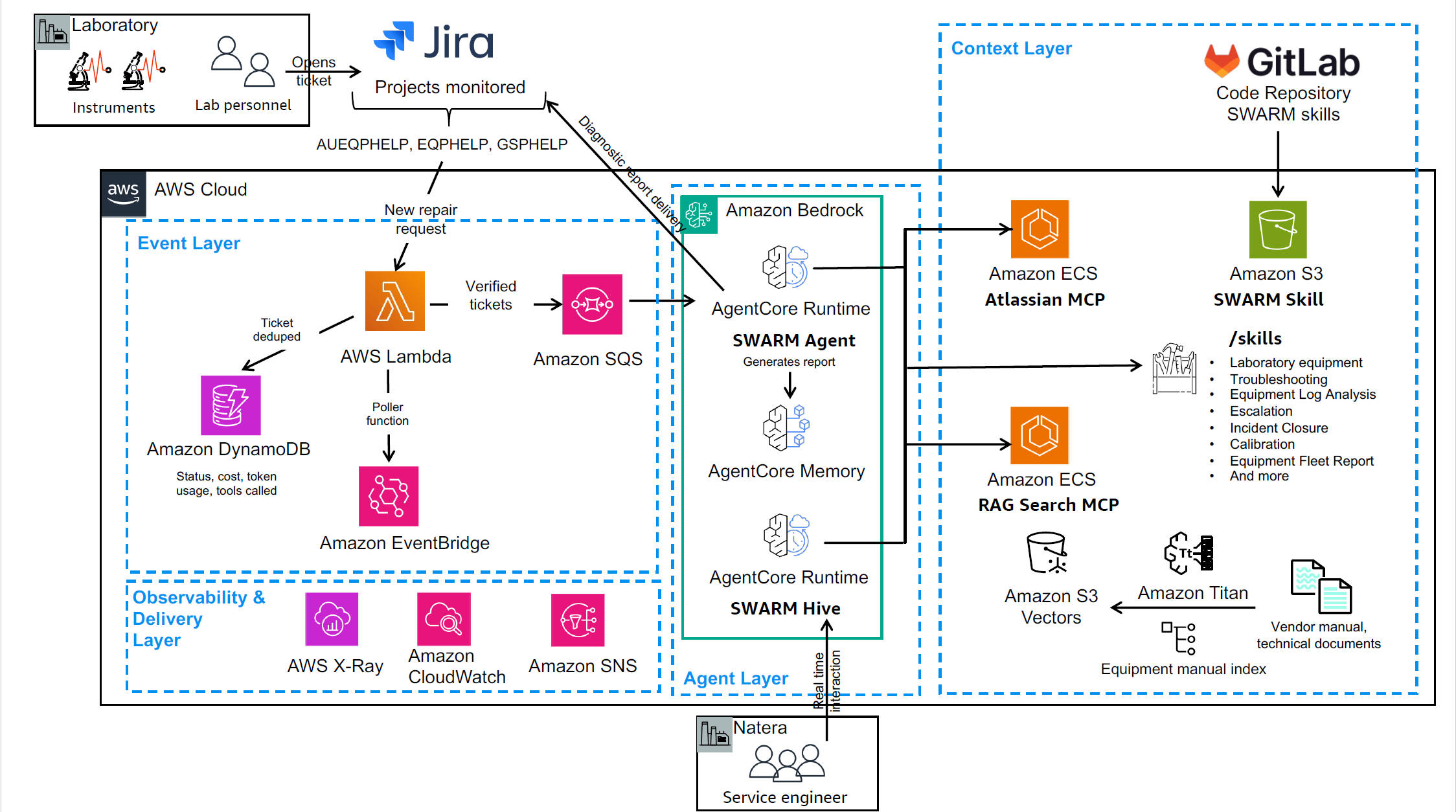
Determine 1: Structure of Natera’s SWARM on Amazon Bedrock AgentCore
Safety structure
The Natera group’s first architectural resolution was the place to run the brokers. The group required a managed runtime that may deal with container orchestration, scaling, and safety with out requiring them to take care of customized infrastructure. They selected AgentCore runtime, a functionality of Amazon Bedrock AgentCore, as a result of it hosts each swarm-agent and swarm-hive in a safe, managed setting with built-in id administration and monitoring, avoiding the necessity to construct and function a customized agent execution layer. You possibly can undertake this sample whatever the framework you select.
The group selected a keyless deployment mannequin as a result of SWARM runs in a scientific setting the place credentials publicity is unacceptable. OpenID Join (OIDC) and AWS Safety Token Service (AWS STS) generate non permanent credentials scoped per deployment, with no long-lived keys within the pipeline. AWS Identification and Entry Administration (IAM) enforces least privilege on the element degree. Amazon Digital Non-public Cloud (Amazon VPC) with non-public subnets and VPC endpoints retains visitors off the general public web. AWS Secrets and techniques Supervisor rotates the few credentials that exist on an computerized 30-day cycle.
GitLab CI runners authenticate to AWS by presenting an OIDC token to an IAM id supplier configured within the account. AWS STS exchanges the token for short-lived credentials scoped to the deployment position (no long-lived entry keys are saved within the pipeline). For setup particulars, see the IAM OIDC supplier documentation.
The next instance illustrates the sample: an IAM OIDC belief coverage for GitLab CI follows this construction:
These infrastructure-level safety controls work in live performance with SWARM’s knowledge governance insurance policies. Collectively they type the total compliance posture required for working an AI system in a regulated scientific setting.
Compliance and knowledge governance
SWARM runs on HIPAA-eligible AWS providers below a Enterprise Affiliate Settlement (BAA), reflecting Natera’s obligations as a scientific laboratory operator. Each agent invocation is audit-logged (a searchable report that satisfies knowledge entry traceability necessities). No patient-identifiable data touches the vector index or the language mannequin. Tickets comprise solely gear and workflow metadata. Groups constructing below HIPAA or comparable regulatory frameworks ought to verify BAA protection and knowledge separation necessities earlier than designing the information base pipeline.
Data base and doc pipeline development
Early prototypes utilizing general-purpose retrieval with out equipment-specific metadata produced inconsistent outcomes, so the Natera group constructed a customized doc processing pipeline tailor-made to technical gear documentation. Amazon Titan Textual content Embeddings generates vector representations for semantic search, and Amazon Bedrock Data Bases gives totally managed Retrieval Augmented Technology (RAG), changing paperwork into embeddings saved in batches of 100, a dimension chosen to steadiness indexing throughput towards API price limits. For closely structured supply paperwork with tables and diagrams, investing in a customized parsing pipeline relatively than counting on default chunking compounds accuracy beneficial properties throughout each prognosis.
Amazon Bedrock providers, together with Amazon Titan Textual content Embeddings, and Amazon Bedrock AgentCore can be found in a number of AWS Areas. For the newest data, see Amazon Bedrock supported Areas and Amazon Bedrock AgentCore supported Areas.
The Natera group makes use of the tiktoken tokenizer with the cl100k_base encoding to measure chunk boundaries. The next instance illustrates the sample, the chunking configuration follows a typical construction:
For extra on batch ingestion patterns, see the Amazon Bedrock Data Bases documentation.
“Diagnostic accuracy is an information high quality drawback first,” Jirau stated. “Including lacking vendor manuals for the lowest-scoring instrument household lifted accuracy from 71% to 75% with no mannequin adjustments.”
This formed the Natera group’s enchancment strategy: when accuracy plateaus, the group checks knowledge protection earlier than mannequin tuning, as a result of gaps in vendor documentation are the commonest explanation for missed diagnoses. The pipeline reprocesses new or up to date paperwork and refreshes the vector index with out disrupting energetic operations.
Ability library structure
The Natera group confronted a key architectural alternative: embed logic instantly in agent prompts, or construct a separate, versioned ability library. Natera selected the library strategy as a result of it makes SWARM auditable and improvable.
“When a prognosis is improper, we have to level to a particular ability relatively than debug the entire system — that’s why we constructed a versioned ability library from the beginning,” Jirau stated.
The library comprises 33 expertise: 24 instrument-specific expertise masking the total vary of apparatus households Natera helps, plus 9 cross-cutting workflow expertise that apply broadly throughout ticket sorts. Every ability has an outlined interface, is independently testable, and is evaluated towards the identical requirements as the general system, handled as manufacturing software program, not embedded immediate logic.
The ability structure follows a transparent break up: Python handles deterministic duties corresponding to parsing Jira fields or formatting HTML experiences, whereas giant language mannequin (LLM) expertise deal with language reasoning corresponding to deciphering signs, matching vendor documentation, and producing diagnostic narratives. For groups constructing a multi-skill agent, this break up between deterministic Python expertise and LLM-powered reasoning expertise is likely one of the highest-impact selections to make.
Agent runtime deployment
Natera break up diagnostic work into two distinct runtimes as a result of autonomous background evaluation and interactive engineering collaboration have basically totally different latency and context necessities. The swarm-agent is constructed for throughput. It selects expertise primarily based on gear sort and signs, queries the information base, and produces a structured HTML report with a lead trigger speculation, ranked troubleshooting steps, and a confidence label. The report is delivered to Amazon Easy Storage Service (Amazon S3) and linked to the Jira ticket inside minutes. Swarm-hive is designed for depth: engineers can interact in interactive follow-up, add photographs, and discover various paths, with AgentCore reminiscence, a functionality of Amazon Bedrock AgentCore, retaining per-engineer conversational context throughout periods.
As a result of swarm-hive accepts free-form engineer enter, prompts are routed by means of Amazon Bedrock Guardrails for content material filtering.
Occasion-driven Jira integration
SWARM integrates with Jira by means of Amazon EventBridge Scheduler and a polling AWS Lambda operate, a serverless compute service that runs code in response to occasions, avoiding webhook configuration. Verified tickets enter an Amazon SQS queue for dependable supply. DynamoDB handles deduplication utilizing the ticket ID as a partition key with time-to-live (TTL) primarily based expiry, and shops per-run metadata corresponding to standing, value, and token utilization to feed the analysis loop. This EventBridge-to-SQS sample decouples the agent runtime from the ticketing system’s availability.
The next instance illustrates the sample. The deduplication desk makes use of a minimal schema with TTL-based expiry:
Observability design
Agentic programs with many interacting elements are tough to debug with out per-invocation traces, so the Natera group constructed observability into SWARM earlier than the primary manufacturing deployment. When you’re working brokers in manufacturing, per-invocation tracing is non-negotiable: with out it, debugging a foul prognosis means guessing which ability misbehaved.
In a scientific lab setting, the place instrument downtime instantly impacts affected person reporting, the power to hint, alert on, and audit each agent motion isn’t a “good to have”. It’s a regulatory and operational requirement.
SWARM’s observability stack makes use of Amazon CloudWatch to seize searchable logs for each run, offering a transparent report of operational well being. AWS X-Ray traces every run from ticket consumption to diagnostic report, recording time and value per instrument name so the group can pinpoint the precise ability accountable when one thing is sluggish or costly relatively than guessing. Amazon Easy Notification Service delivers failure alerts by electronic mail, whereas a Slack tracker offers the whole group real-time visibility into agent exercise.
Steady analysis methodology
SWARM makes use of a steady analysis loop relatively than testing as soon as at deployment, which is very crucial for programs dealing with altering documentation or evolving workflows. On each ticket processed, the agent gives a lead trigger speculation, ranked troubleshooting steps, and a self-rated confidence label. Engineers report what they discovered and stuck, and an evaluator grades every response as Correct, Partial, or Flawed, damaged down by instrument household. Outcomes are reviewed to determine the place the agent is underperforming, the repair is utilized (usually by updating the information base), and the analysis set is re-run to verify enchancment.
SWARM’s self-rated confidence labels present a directional relationship with precise accuracy. Tickets labeled Excessive confidence obtain 74 p.c accuracy throughout 154 evaluated instances, whereas Reasonable and Low confidence tickets each obtain 65 p.c throughout 78 and 37 instances respectively. Word that Reasonable and Low at the moment share the identical accuracy price. The Low confidence pattern dimension of 37 instances is just too small to attract statistically significant conclusions, and the Natera group expects the 2 tiers to diverge because the analysis dataset expands.
The separation between Excessive and the remaining tiers offers engineers a helpful sign for the way a lot weight to position on every prognosis on the level of studying a diagnostic report.
SWARM efficiency
The Natera group evaluated SWARM throughout 524 assist tickets to ascertain a efficiency baseline. Of the 524 tickets within the analysis set, 269 acquired a Excessive, Reasonable, or Low confidence label and had a corresponding engineer-verified decision accessible for comparability. The remaining tickets had been both labeled none or lacked a verified decision on the time of research.
Common first response time dropped from 17.4 hours to roughly 8 minutes (about 130x sooner). These measurements had been collected from Jira ticket metadata over a 90-day manufacturing analysis interval. Protection issues simply as a lot: 96.2 p.c of tickets get an automatic first response with out an engineer having to provoke the diagnostic course of. Protection was measured as the share of incoming tickets that acquired a SWARM-generated diagnostic report earlier than engineer evaluation.
Classes from constructing agentic AI in manufacturing
A number of architectural selections in SWARM translate instantly to groups constructing comparable programs.
- Deal with chunk dimension and overlap as tunable parameters. The proper values rely upon how your supply paperwork are structured.
- Construct traceability into your ability library from the beginning. When a prognosis is improper, you need to level to a particular ability, not debug the entire system.
- In case your workload mixes batch processing with interactive querying, separate them into distinct runtimes.
Getting began
Strive these patterns your self with the AgentCore samples repository, Constructing Agentic programs on AWS or the Getting Began with Amazon Bedrock AgentCore information for deploying brokers securely at scale. Healthcare and life sciences organizations dealing with comparable challenges with institutional information loss, high-volume operational workflows, or scientific compliance necessities will discover that the architectural patterns Natera developed with SWARM present a replicable, production-tested basis for constructing agentic AI programs on AWS.
In regards to the authors


