

This put up is co-written with Tala Qraitem from AWS and Jörg Fischer from Customary Financial institution Group
Having an AI coverage is one factor. Proving, one use case at a time, that AI techniques observe it’s one other. Each new generative AI software provides yet another system to show. Groups can now construct one in days, however every nonetheless wants a threat committee’s approval earlier than it reaches clients or workers. When that approval will depend on reviewers studying paperwork and testing the system by hand, governance turns into the slowest step within the pipeline.
Customary Financial institution Group selected to automate that proof. Working with AWS Skilled Providers, the financial institution deployed an automatic evaluation that scores every generative AI use case in opposition to worldwide AI requirements and its personal insurance policies. The evaluation produces studies and a dashboard that present what’s already in place, what’s working nicely, and what nonetheless wants mitigation. This put up explains how the evaluation runs on AWS and what Customary Financial institution Group realized from its first runs.
Governing AI with the framework you have already got
Customary Financial institution Group didn’t want a brand new AI coverage. Like most massive banks, it already had a longtime mannequin threat observe that covers issues corresponding to explainability and equity, and a change threat course of that assesses every new use case in response to its stage of threat earlier than it goes stay.
Generative AI will increase the complexity, as a result of fashions and tooling change each three to 6 months, but every use case nonetheless wants to fulfill the identical excessive safety and compliance bar.
“At Customary Financial institution, this evaluation demonstrates how we’re working with AWS to embed clever, automated threat administration into our AI journey, permitting us to speed up significant enterprise worth whereas sustaining the belief and controls that banking calls for. We imagine accountable AI will not be about slowing innovation down however enabling it to construct and scale with confidence.”
— Jörg Fischer, Group Chief Data and AI Officer, Customary Financial institution Group
The objective was to automate proof gathering and testing, then feed the outcomes into the approval gates Customary Financial institution Group already runs. Overview and approval stick with the chance committee, however the committee now bases every resolution on constant proof, collected the identical manner throughout use circumstances.
How the evaluation works
Determine 1 exhibits how the evaluation’s elements match collectively in Customary Financial institution Group’s AWS account, from consumption via analysis to reporting.
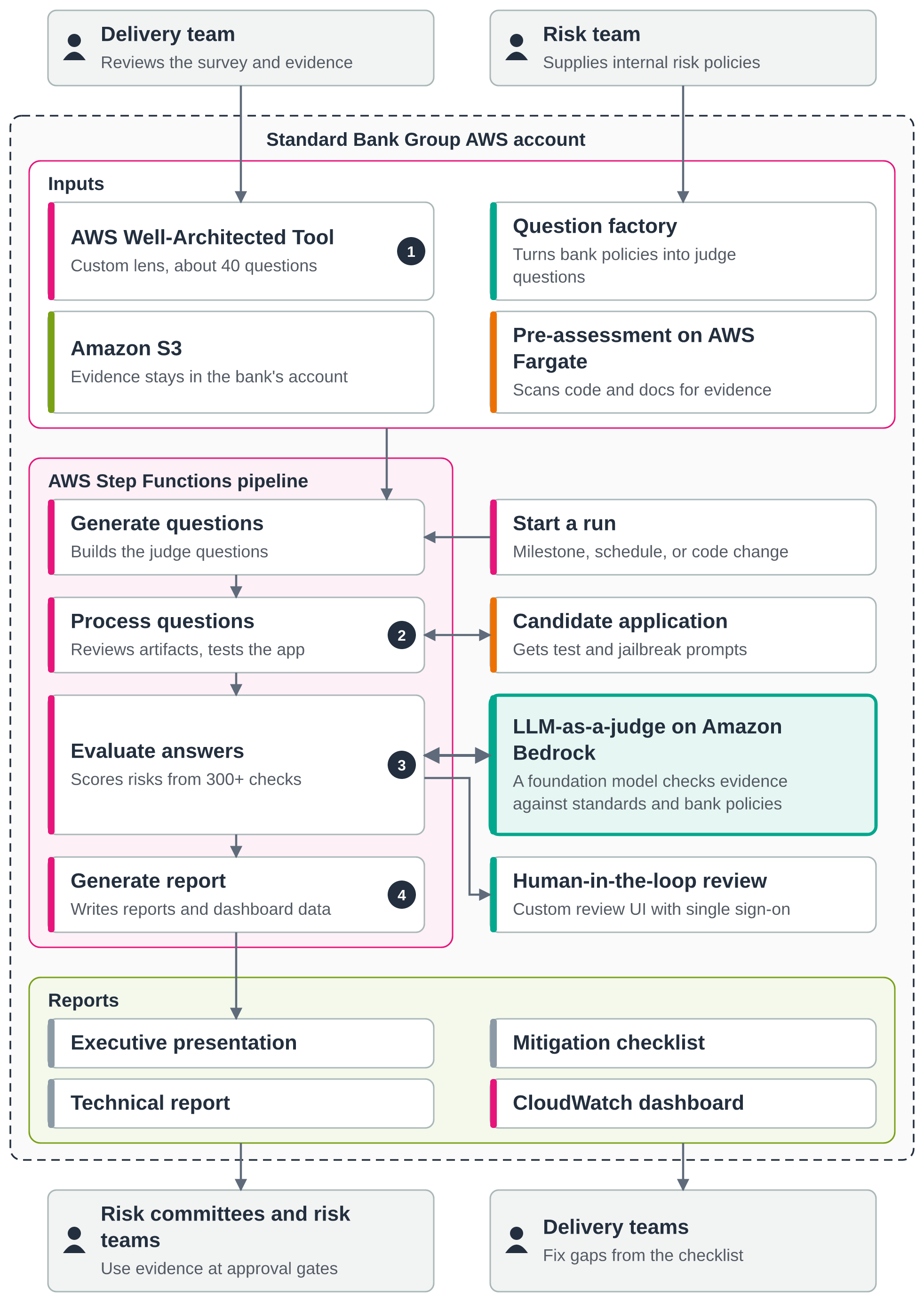
Determine 1: The evaluation pipeline in Customary Financial institution Group’s AWS account, from consumption via analysis to reporting
The evaluation runs fully in Customary Financial institution Group’s personal AWS account. Paperwork, code, and take a look at outcomes keep in an Amazon Easy Storage Service (Amazon S3) bucket there. The AWS Effectively-Architected Instrument handles consumption, AWS Step Capabilities orchestrates the pipeline, and a basis mannequin on Amazon Bedrock evaluates the proof. It makes use of a method known as LLM-as-a-judge, through which a big language mannequin checks proof in opposition to outlined standards.
With Amazon Bedrock, Customary Financial institution Group might use a basis mannequin with out stepping exterior the controls it already runs on AWS. The financial institution controls entry to the mannequin via AWS Identification and Entry Administration (IAM), simply because it does for its different AWS workloads. Amazon Bedrock doesn’t share the financial institution’s prompts or mannequin outputs with mannequin suppliers, and doesn’t use them to coach fashions. As a result of Amazon Bedrock gives many basis fashions via one API, the staff can transfer to a more moderen decide mannequin by altering a configuration setting as an alternative of rebuilding the pipeline.
Every evaluation strikes via 4 steps. Within the first two, a pre-assessment agent collects proof in regards to the use case, then the pipeline examines it and exams the appliance instantly. The third evaluates that proof in opposition to controls. The fourth summarizes the leads to a regular, predefined format and delivers them to the individuals who act on them.
Step 1: A pre-assessment agent collects the proof
The customized lens within the Effectively-Architected Instrument holds about 40 questions, every masking a threat occasion corresponding to incomplete technical documentation or inadequate human oversight. Supply groups not fill it in from scratch. A pre-assessment agent working on AWS Fargate scans the use case’s code repository and documentation. It maps related information to every query and pre-populates the lens with solutions and hyperlinks to the proof. The supply staff then critiques these solutions, corrects any errors, and provides the proof the agent couldn’t discover.
Step 2: The pipeline examines the artifacts and exams the appliance
The pipeline works from 4 sorts of proof.
- System documentation, which describes how the appliance was designed, constructed, and evaluated.
- Coverage paperwork, which set out roles, tasks, and procedures corresponding to incident dealing with.
- Supply code and the system immediate, which present how controls are carried out.
- Dwell calls to the appliance, which present the way it behaves in observe.
For paperwork and code, the pipeline checks whether or not every artifact incorporates what its mapped management requires. Every management comes from a global AI commonplace or framework, or from Customary Financial institution Group’s personal insurance policies. An incident process, for instance, wants to explain how incidents are reported.
For stay testing, the pipeline calls the appliance via its AWS Lambda perform or API. The supply staff provides questions a typical person would ask. The pipeline provides a built-in set of jailbreak makes an attempt and off-topic questions, which the appliance is anticipated to say no. It additionally sends the identical immediate a number of occasions, in its authentic and reworded types, and makes use of an embedding mannequin on Amazon Bedrock to test that the solutions keep constant in which means. The place the staff offers anticipated solutions, the pipeline measures how carefully the responses match them. Each response is saved in Amazon S3, so reviewers can see precisely what the appliance generated.
Step 3: LLM-as-a-judge analysis in opposition to requirements
On this step, a basis mannequin on Amazon Bedrock acts because the decide. The evaluation makes use of the mannequin as-is with no fine-tuning or customization. (Mannequin availability varies by AWS Area, so test the supported fashions by Area earlier than you deploy.) For every query, the mannequin checks whether or not particular proof seems within the artifacts and within the software’s responses, and returns sure or no.
Each test maps to a management in a global commonplace or framework for AI administration, AI threat, or AI safety. Customary Financial institution Group additionally custom-made the lens with decide questions constructed from its personal requirements, bringing the entire to greater than 300. The checks cowl the eight AWS accountable AI dimensions within the following desk:
| Dimension | What the evaluation seems to be for |
| Veracity and robustness | Appropriate outputs, even with surprising or adversarial inputs |
| Privateness and safety | Acceptable assortment, use, and safety of information and fashions |
| Transparency | Data that helps stakeholders make knowledgeable decisions about their use of an AI system |
| Equity | Consideration of impacts on completely different teams of stakeholders |
| Security | Prevention of dangerous output and misuse |
| Controllability | Mechanisms to watch and steer system habits |
| Governance | Finest practices throughout the AI provide chain, together with suppliers and deployers |
| Explainability | Methods to know and consider system outputs |
Every threat receives a chance rating, the share of required proof the mannequin couldn’t discover, and a hard and fast severity stage that the financial institution’s threat staff can modify. Collectively they produce a score from Very low to Important. Every lacking piece of proof maps to a selected mitigation and to the clause of the usual or coverage it got here from. A threat officer can then hint any findings again to their supply when explaining choices to a regulator. Determine 2 follows one lacking piece of proof via this course of, from the proof request to the advisable repair.
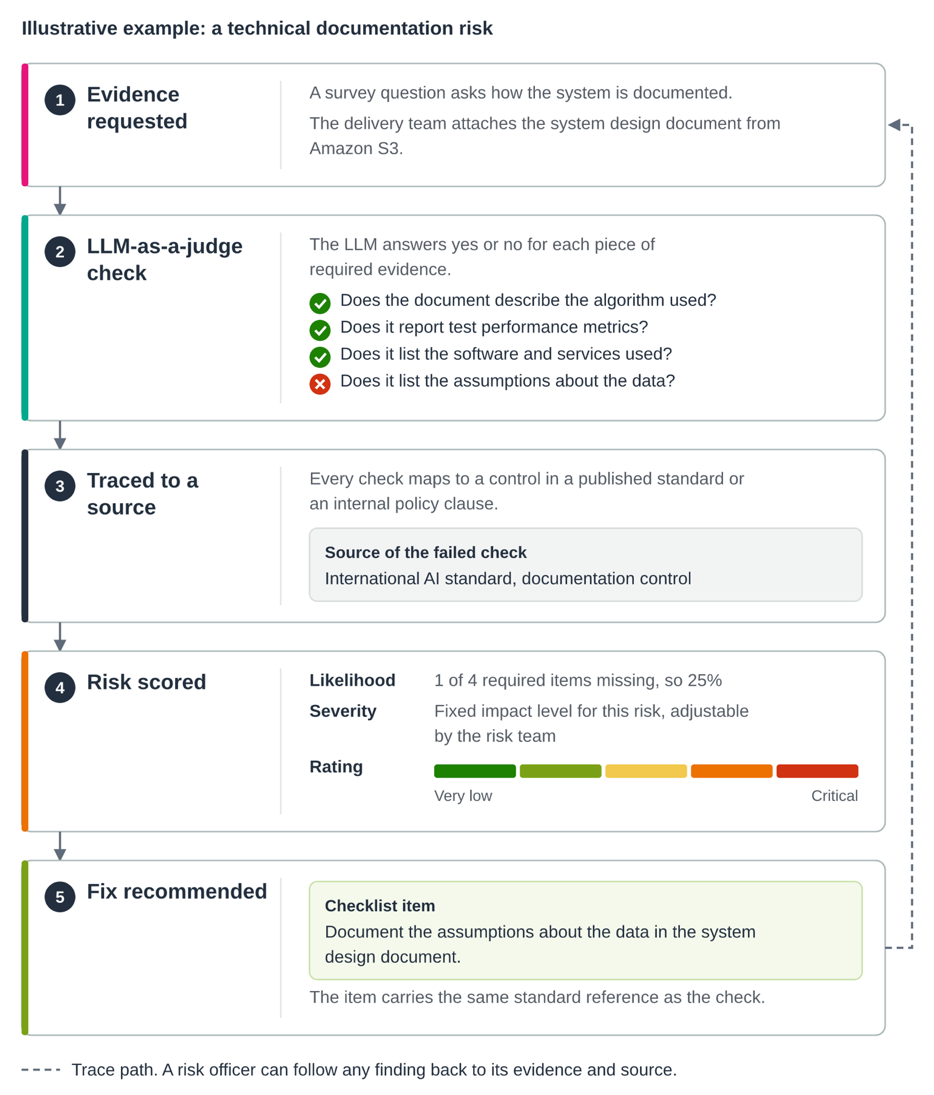
Determine 2: How one discovering is traced from proof to repair
Customary Financial institution Group protects and checks the evaluation’s output in two methods. Each AI mannequin interplay is protected by Amazon Bedrock Guardrails, guaranteeing alignment with the financial institution’s established safety and accountable AI requirements. The evaluation’s mannequin calls cross via the identical safeguards the financial institution enforces throughout its AWS accounts for its AI workloads. These guardrails display for dangerous content material and for makes an attempt to govern the mannequin.
The evaluation can also be designed so its output will be checked. As a substitute of asking the mannequin for an open-ended opinion, the pipeline asks slim yes-or-no questions, every worded to match a selected management. A set system that the chance staff can examine turns these solutions into scores. Every analysis runs a number of occasions to measure how constant the solutions are and any inconsistent findings are flagged within the evaluation interface. Each judgment is saved with the proof behind it in order that reviewers and auditors can hint the way it was reached.
Step 4: Studies for every viewers
The pipeline summarizes the leads to a regular format and delivers them as an government presentation, a mitigation guidelines, an in depth technical report, and an Amazon CloudWatch dashboard that tracks scores throughout use circumstances over time. Earlier than a gate resolution, reviewers affirm findings in a customized evaluation interface with single sign-on. There they will add the use case, evaluation the questions, amend solutions with a enterprise justification, and rewrite the output.
The evaluation produces proof in opposition to controls. It doesn’t certify compliance with any regulation, and Customary Financial institution Group stays accountable for its personal regulatory determinations.
Testing in opposition to Customary Financial institution Group’s personal guidelines
Worldwide requirements give each use case a standard baseline, however the financial institution’s threat committees approve use circumstances in opposition to its personal coverage. A query manufacturing facility addresses this by producing additional decide questions from inner paperwork. Customary Financial institution Group’s threat staff used it to show inner insurance policies into checks that run on each use case.
As a result of these checks are derived instantly from coverage language, a coverage change turns into a take a look at change. Each subsequent evaluation applies the up to date rule routinely, with minimal handbook rework by the chance staff.
“Most organizations deal with coverage as one thing you learn. Customary Financial institution Group treats it as one thing you run. When each rule turns into a test that runs in opposition to the stay system, a coverage replace stops being a memo and turns into a take a look at. That basically adjustments how briskly a financial institution can scale AI responsibly.”
— Sri Elaprolu, Director, Frontier AI Science & Engineering, AWS
Constructed into the use case lifecycle
The evaluation suits into three levels of the use case lifecycle. Throughout a proof of idea, it’s non-obligatory, giving groups an early view of potential gaps. On the construct stage, it turns into obligatory, and the approval gate attracts on its outcomes as formal proof. At the moment the evaluation runs in Customary Financial institution Group’s manufacturing setting, evaluating use circumstances earlier than they go stay. After stay workloads are linked, the evaluation will rerun on a schedule or at any time when code or configuration adjustments, conserving the proof present nicely past launch. The financial institution’s groups already set off assessments on their very own via a central system the place use circumstances movement from consumption to analysis in a single workflow.
What this implies for monetary establishments
At Customary Financial institution Group, the evaluation diminished a historically handbook two-week evaluation to a complete threat report generated in roughly two hours, demonstrated throughout six assessments. It additionally delivered a 14% enchancment in use-case threat scores after remediation. This strengthens accountable AI governance, reduces compliance bottlenecks, and shortens the trail from evaluation to manufacturing.
This strategy can profit three teams concerned in approving AI use circumstances:
- Threat and compliance leaders get proof in the identical format for each use case, traceable to a printed commonplace or an inner coverage clause. Begin from the framework you already run, as Customary Financial institution Group did with its current threat processes and approval gates.
- Supply groups be taught what to repair throughout the proof of idea, when adjustments price the least, as an alternative of assembly a rejection on the approval gate.
- Executives can develop the AI portfolio with out rising the evaluation effort on the similar price.
“Adoption of AI at scale throughout the enterprise requires belief, each internally and with our clients. This evaluation is proving key in enabling all our product groups to reveal that they’re constructing enterprise-grade options aligned with each our personal and business greatest practices.”
— Duncan Macdonald, Chief Expertise Officer, Customary Financial institution Group
From approval gates to steady assurance
Banks designed approval gates for techniques that modified a couple of occasions a yr. Generative AI purposes change with each immediate replace, mannequin model, and new information supply. As they tackle extra autonomous duties, the variety of choices that want proof retains rising. Including reviewers can’t preserve tempo with that price of change.
Customary Financial institution Group’s strategy factors to a distinct working mannequin. When insurance policies develop into exams and proof is collected routinely, governance strikes out of a checkpoint on the finish of supply and into the system itself. Each AI software within the portfolio can carry a present, auditable file of the way it meets the financial institution’s requirements, refreshed at any time when its code or configuration adjustments. Threat groups spend their time on judgment calls and coverage design, and the financial institution can present regulators the identical proof it makes use of for its personal choices.
The identical basis extends additional. Steady reassessment retains proof aligned with a altering code base after launch. New rules will be encoded as soon as as checks and utilized throughout each use case. Aggregated scores give boards an enterprise-wide view of AI threat as an alternative of a group of particular person critiques.
For any establishment scaling AI, the query price asking is what number of of its insurance policies have ever been examined in opposition to a working system. To discover how AWS Skilled Providers may also help your group automate AI threat evaluation, contact your AWS account staff. To be taught extra about constructing AI responsibly on AWS, go to Accountable AI on AWS.
In regards to the authors