
Worldwide Specific (a part of ShipStation World) had constructed one thing huge: roughly $5 billion in systemwide income, over 75 less-than-truckload (LTL) carriers and greater than 130,000 clients. However that very same scale had a hidden value. Each month, $15 million in free money stream sat frozen, locked in billing exceptions nobody had resolved but. Every one needed to be chased down by hand, provider by provider, with its personal guidelines to test. Worldwide Specific outsourced to a crew that labored circumstances one by one, calling clients and carriers for every dispute. The exceptions piled up, money stayed caught, and each order took longer to show into cash.
Worldwide Specific labored with AWS and LTM to construct a multi-agentic AI resolution with Amazon Bedrock that plugs straight into their transportation administration system (TMS), SpeedShip. Six months after launch, the corporate reported a 75 p.c discount in energetic exceptions, a 4-week enchancment in time-to-cash, $1M annual financial savings, and a one-time $10M free money stream infusion.
On this submit, we describe the problem, clarify how Worldwide Specific designed the multi-agent resolution, and share the outcomes.
The problem
In LTL freight, roughly 14 p.c of invoices fail the usual three-way match between the acquisition order, the products receipt, and the provider bill. When a match fails, the bill enters exception dealing with. For Worldwide Specific, exceptions fell into three classes:
- Line-item mismatches: Portions or service codes that didn’t align with the cargo report.
- Pricing variances: The provider billed a fee completely different from the contracted value.
- Sudden accessorial prices: Liftgate charges, residential surcharges, or reweigh changes that weren’t on the unique quote.
Every exception triggered a five-step handbook course of:
- Determine the exception sort by cross-referencing the bill in opposition to the acquisition order, items receipt, and pricing.
- Analysis the foundation trigger in vendor data.
- Ship e mail to the provider or warehouse with dispute particulars.
- Look forward to a response.
- Execute the decision within the TMS.
With every provider working underneath its personal tariff construction and dispute workflow, this course of consumed many of the FinOps crew’s bandwidth.
Rule-based course of automation (RPA) can deal with structured, predictable workflows. Nevertheless, exception decision requires contextual judgment: decoding a provider’s accessorial coverage, evaluating prices in opposition to cargo knowledge, and deciding validity given a provider, exception sort, and greenback quantity. That variability is what made the issue a match for the agentic AI framework.
From evaluation to manufacturing
In June 2025, Worldwide Specific engaged the AWS Enterprise Transformation & Worth Advisory crew to determine 19 automation alternatives throughout the Order-to-Money lifecycle. Figuring out the enterprise worth of exceptions automation, Worldwide Specific moved from evaluation to manufacturing in lower than 6 months.
The way it works
The answer runs on AWS. Amazon Bedrock offers AI reasoning, and Amazon Elastic Compute Cloud (Amazon EC2) is the engine. The design requires fine-grained management over how every agent causes, the place determination boundaries sit, and the way exceptions are routed between brokers. Constructing the framework straight on Amazon EC2, with Amazon Bedrock offering inference, retains that orchestration logic absolutely within the crew’s fingers and helps open supply agent libraries. Manufacturing controls of enterprise logic make every agent’s function, inputs, and determination boundaries specific and auditable. In a billing-dispute workflow, each automated determination must be explainable.
Brokers
When an bill exception is detected, the system routes it to certainly one of three specialised AI brokers, every dealing with a particular sort of billing dispute:
- Bill Matching Agent finds the matching cargo report and flags what doesn’t line up.
- Pricing Variance Agent compares the provider’s cost in opposition to the contracted fee and determines whether or not the distinction is legitimate.
- Accessorial Validation Agent checks whether or not surprising charges (comparable to residential supply or liftgate prices) are supported by the precise supply occasions.
Every agent pulls particular provider billing guidelines and insurance policies earlier than making a advice. After the exception is resolved, the system generates a plain-language be aware explaining what was discovered and what motion was taken.
Every customized agent has an instruction immediate (defining its function, determination boundaries, and output format), a set of actions (integrations into SpeedShip), and entry to carrier-specific data bases. By utilizing Amazon Bedrock, every agent accesses an appropriate basis mannequin by way of a single API whereas inheriting current AWS governance. For mannequin availability by Area, consult with Supported fashions by AWS Area in Amazon Bedrock.
Actions
The brokers hook up with SpeedShip by way of the identical APIs that analysts use. Meaning the AI sees precisely what a human reviewer would see (contract charges, cargo particulars, supply proof) and writes its decision into the identical workflow. SpeedShip has APIs on AWS, so the brokers wire into the identical endpoints as different current methods.
Provider data base
Each provider has completely different billing guidelines, payment definitions, and dispute procedures. Worldwide Specific shops every provider’s documentation: tariff guidelines, surcharge definitions, dispute steps, and variance thresholds. When an agent processes an exception, it retrieves that particular provider’s insurance policies and normal working process (SOP) paperwork earlier than deciding, so every determination is grounded within the provider’s personal guidelines. The identical three brokers deal with all carriers with none carrier-specific code.
Human-in-the-loop
The approval step was needed for FinOps adoption through the preliminary rollout. Initially, a human reviewer would use the present SpeedShip UI to approve suggestions earlier than they’re finalized. Finally when accuracy exceeded 99 p.c, bulk approval grew to become the default.
Observability
Worldwide Specific’s crew constructed dashboards monitoring automation fee by provider, error fee by exception sort, decision time, and human override frequency. When a reviewer rejects a advice, the system logs the suggestions. The crew refines instruction prompts and data bases based mostly on rejection historical past, steadily growing automation protection.
Finish-to-end stream
The next diagram exhibits the end-to-end stream, from exception detection by way of the three specialised brokers to human approval. Within the diagram, exceptions from the information sources (the SpeedShip TMS, a delivery system, an digital knowledge interchange (EDI) server, and provider and vendor portals) are detected and routed to certainly one of three brokers. Every agent runs on Amazon EC2 with Auto Scaling, makes use of an agent framework with its personal immediate, instruments, and provider data base, and calls Amazon Bedrock for mannequin inference. The brokers produce a decision report. Value finalization and an AI-written be aware then go to a human reviewer for approval within the SpeedShip analyst UI.
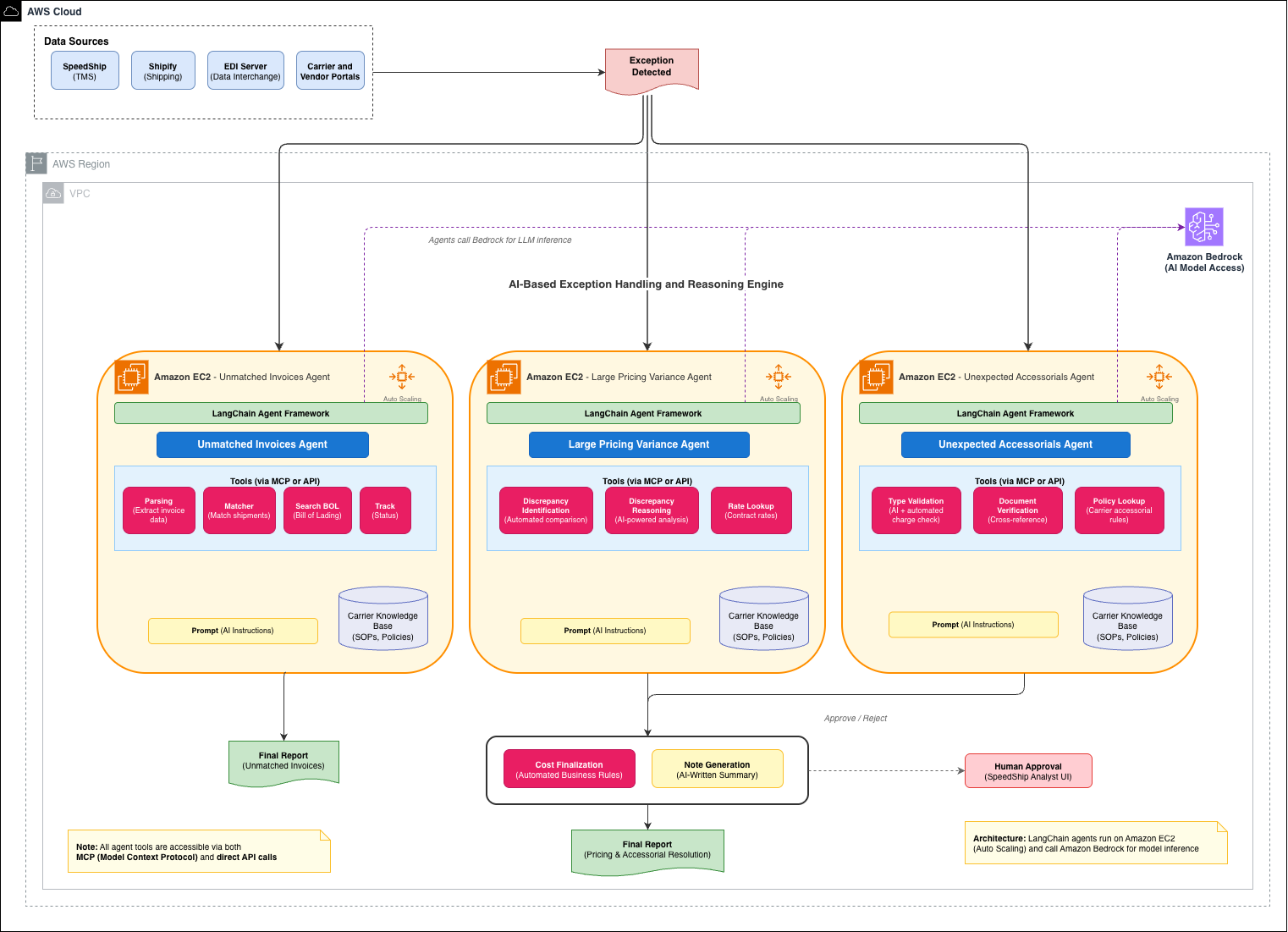
Determine 1: Worldwide Specific’s AI-powered exception dealing with structure on AWS
Outcomes
Six months in, Worldwide Specific has deployed the answer throughout over 40 LTL carriers. The brokers at the moment shut 10,000 (roughly 50 p.c) exceptions weekly with a lower than 1 p.c error fee. This shifted the FinOps crew’s time from routine decision to advanced, high-value disputes.
The affect exhibits up most clearly within the backlog of energetic exceptions, which fell from $15M in June 2025 to $4M six months later, a 75 p.c discount. Worldwide Specific unlocked $10M in freed-up money stream, over $1M in annual value financial savings, and 60x first-year ROI. The corporate studies time-to-cash bettering by 4 weeks.
“With AWS, we’ve automated greater than 40 p.c of weekly billing exceptions, considerably decreasing prices and accelerating billing cycles from days to minutes. At this time, we launch roughly $10 million extra in buyer billings every week at a pace that merely wasn’t potential earlier than.”
— Nathanael Pearson, VP of FinOps, Worldwide Specific
Trying ahead
Worldwide Specific is already increasing this strategy to different components of the Order-to-Money cycle. For logistics firms managing excessive provider volumes, the trail ahead is to begin small. Automate essentially the most repetitive exception sort first, show accuracy, then scale throughout the remainder of the portfolio.
Conclusion
Worldwide Specific’s exception automation exhibits what’s potential when agentic AI meets a well-scoped enterprise downside. The mix of Amazon Bedrock, carrier-specific data bases, and a human-in-the-loop approval design let Worldwide Specific transfer from evaluation to manufacturing in lower than 6 months whereas sustaining monetary controls. The corporate is now increasing automation to different Order-to-Money processes.
To discover whether or not an analogous strategy would possibly work in your group, request a dialog together with your account crew or be taught extra about Amazon Bedrock. Companions like LTM can run a Proof of Worth dash with your personal knowledge.
In regards to the authors