

Fantastic-tuning is the method of constant to coach a pretrained giant language mannequin (LLM) on an organization’s personal knowledge so it adapts to a selected area, activity, or type fairly than counting on general-purpose data alone. For companies, the worth is twofold. A fine-tuned mannequin delivers measurably higher accuracy on domain-specific work whereas decreasing prices: a smaller specialised mannequin can match or exceed a frontier mannequin in your activity at a fraction of the per-token inference value. These financial savings compound throughout thousands and thousands of requests. Fantastic-tuning has subsequently develop into a necessary course of for companies seeking to get extra worth from LLMs at decrease prices.
Parameter-efficient fine-tuning (PEFT) strategies like Low-Rank Adaptation (LoRA) have emerged as a sensible resolution for fine-tuning LLMs to downstream duties, decreasing GPU capability necessities by updating solely a small subset of LLM parameters. LoRA goals to strike a stability between effectivity and expressiveness, nonetheless, the low-rank nature of the burden replace inherently limits the illustration energy of LoRA fine-tuned fashions, probably compromising efficiency on advanced duties. This trade-off hampers the flexibility of LoRA strategies to seize advanced patterns wanted for numerous duties. To deal with these challenges, Full Fantastic-Tuning (FFT) updates mannequin parameters concurrently, overcoming the low-rank limitations so LLMs can absolutely soak up advanced domain-specific data.
Amazon SageMaker AI Serverless Mannequin Customization now helps Full Fantastic-Tuning (FFT), so you possibly can obtain superior mannequin high quality with out managing infrastructure. There isn’t any GPU provisioning, cluster setup, or distributed-training configuration required. On this publish, we discover when and the place FFT constantly outperforms LoRA throughout key benchmarks, look at the spectral properties of mannequin weight matrices that specify this high quality hole, present sensible hyperparameter tuning tips backed by managed experiments utilizing SageMaker AI Serverless Mannequin Customization, and present you learn how to get began with FFT on SageMaker AI.
Full Fantastic-Tuning: Why it issues
Mannequin customization sorts like LoRA cut back trainable parameters by freezing the pre-trained mannequin’s weights and injecting small, separate pairs of alternative matrices (referred to as low-rank matrices) into the mannequin layers. This works properly for easy diversifications, however the low-rank construction inherently limits the illustration energy of the fine-tuned mannequin. As duties develop extra advanced and datasets scale past tens of hundreds of examples, LoRA hits an accuracy plateau the place rising rank (and thus trainable parameters) fails to bridge the accuracy hole with normal fine-tuning. This plateau reveals that the efficiency hole isn’t merely due to fewer parameters. It’s attributable to rank deficiency itself. The low-rank replace can’t seize the complete complexity of the burden adjustments wanted for deep activity adaptation.
Nonetheless, for advanced duties and domains the place giant, good-quality datasets exist, full-rank fine-tuning excels by updating mannequin parameters concurrently. FFT modifies the mannequin’s weight matrix uniformly, utilizing the complete representational capability of the mannequin’s weight matrices fairly than proscribing updates to a small subspace, and with out introducing the abrupt, localized distortions attribute of low-rank strategies. The result’s stronger mannequin convergence, higher activation alignment throughout mannequin layers, and a mannequin that faithfully captures each the goal activity distribution and the richness of its pre-trained data. FFT’s high quality benefit grows with dataset scale: at 100K+ coaching examples, FFT achieved 90.0 % on LLM-as-Choose semantic correctness throughout code technology duties, as proven within the following chart.
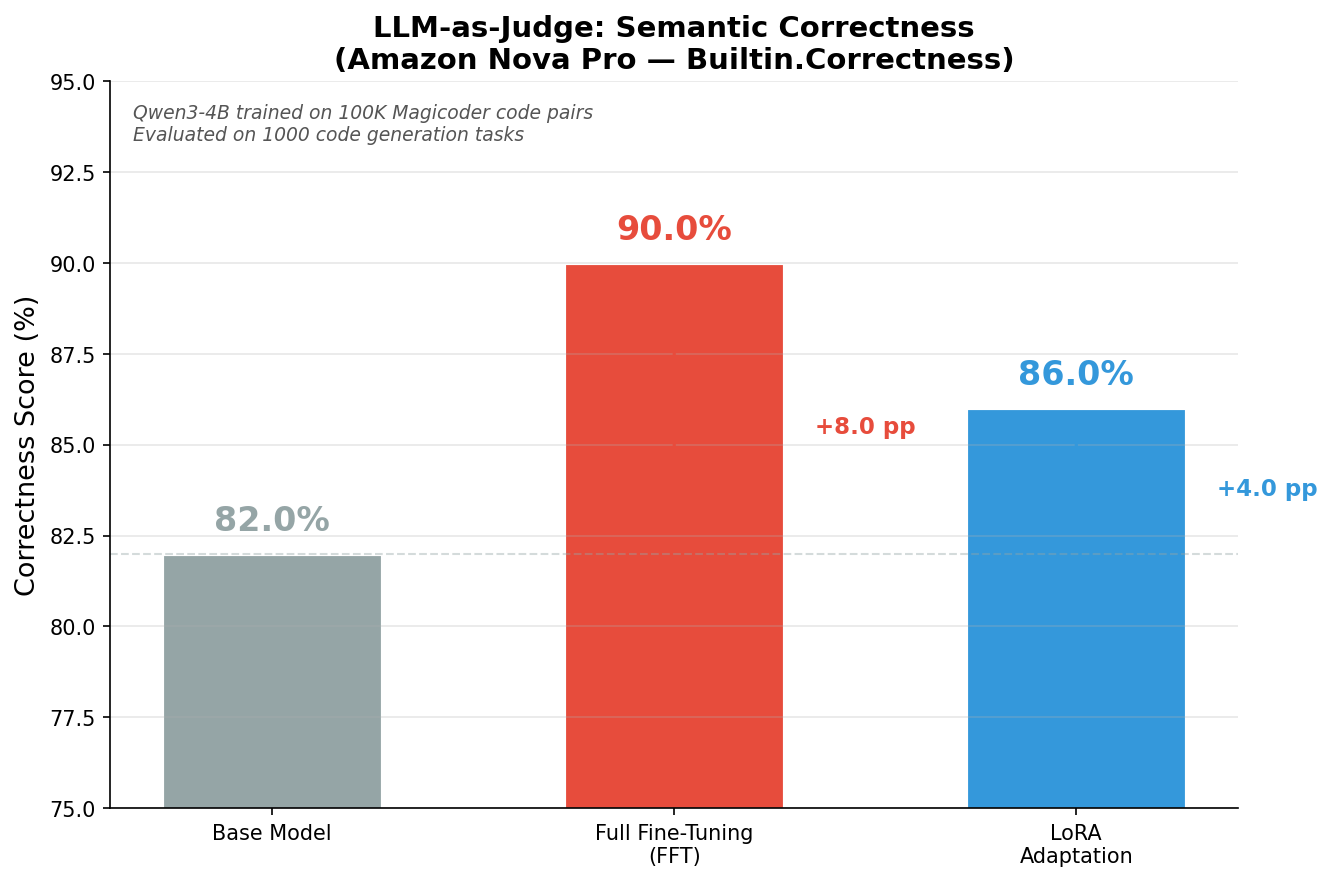
Determine 1: LLM-as-Choose semantic correctness by coaching technique as coaching knowledge scales to 100K+ examples
Moreover, the next radar chart supplies a holistic view: the bottom mannequin (inside polygon) exhibits constantly low scores throughout all axes. LoRA (center polygon) exhibits sturdy, balanced enchancment. FFT (outer polygon) extends additional on each dimension, with notably pronounced leads on BLEU and ROUGE-2 scores. This multi-dimensional high quality lead confirms that it isn’t a metric-specific artifact however a basic benefit of full-rank optimization.
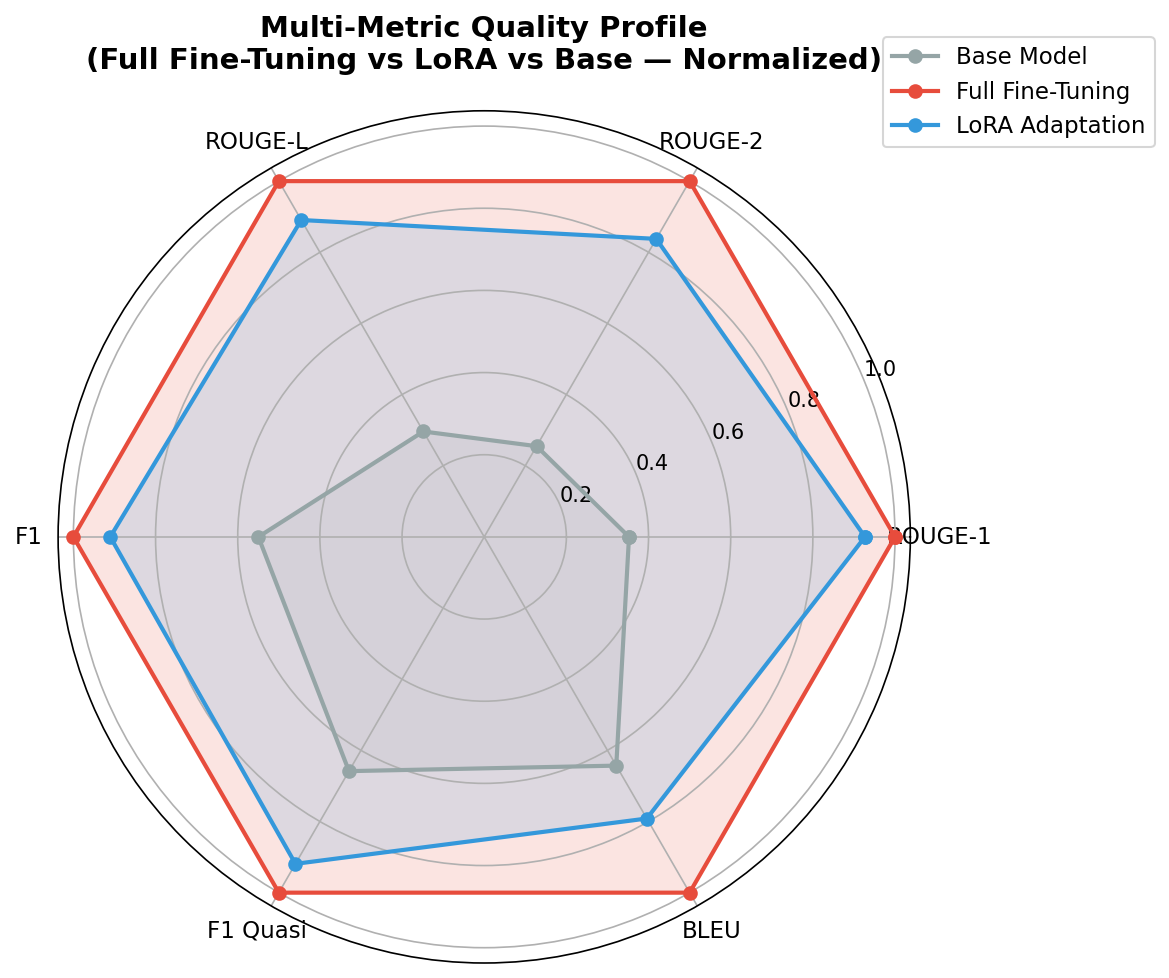
Determine 2: Radar chart evaluating the bottom mannequin, LoRA, and FFT throughout high quality dimensions
The small print of how we arrived at these outcomes, the coding datasets used for mannequin customization, and the experimentation course of are defined intimately within the following sections.
Experimentation and benchmark outcomes
On this publish we used the Supervised Fantastic-Tuning (SFT) method on a Qwen3-4B base mannequin provided inside Amazon SageMaker AI Studio and carried out all of the fine-tuning experiments utilizing SageMaker AI Serverless Mannequin Customization throughout LoRA and FFT coaching strategies. Inside every experiment, each strategies acquired the identical prompts, targets, and analysis code.
Dataset: Code technology 110K instruction pairs
For all of the experimentation, we fine-tuned the Qwen3-4B base mannequin on the Magicoder-Evol-Instruct-110K dataset, a curated corpus of 110,000 coding instruction-response pairs spanning algorithm design, debugging, knowledge constructions, and techniques programming. We utilized a 90/5/5 cut up to the dataset: 99,000 information for coaching, 5,500 for validation to watch convergence and coaching loss through the customization job, and 5,500 reserved as a held-out check set for unbiased analysis of the ultimate mannequin, as registered in SageMaker AI dataset belongings and proven within the following determine.
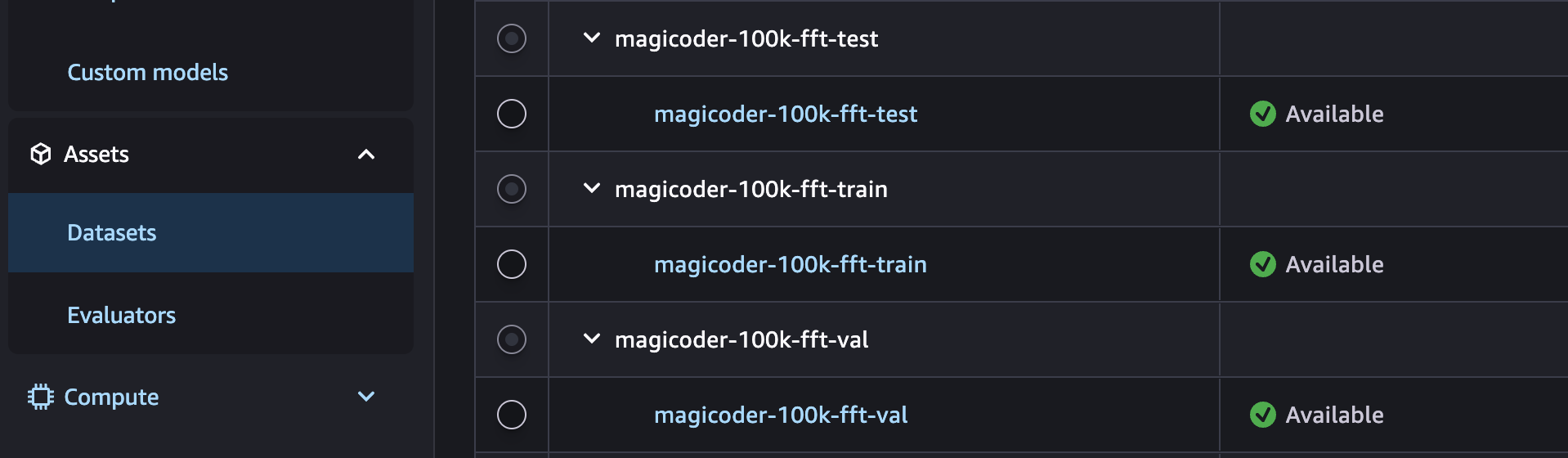
Determine 3: The 110K instruction-pair dataset registered in SageMaker AI dataset belongings
Serverless Mannequin Customization job
All of the mannequin customization experiments on this publish had been carried out on Amazon SageMaker AI Serverless Mannequin Customization. Serverless Mannequin Customization on SageMaker AI lets knowledge scientists and machine studying (ML) engineers concentrate on mannequin fine-tuning with out managing infrastructure or GPU capability planning. You specify the bottom mannequin, dataset, and hyperparameters, and the service handles compute allocation and checkpoint administration mechanically in a serverless style. The next code snippet exhibits one such experiment for launching a Full Fantastic-Tuning (FFT) job on Serverless Mannequin Customization utilizing the SageMaker Python SDK.
The code triggers a serverless mannequin customization job, proven within the following screenshot, with coaching efficiency metrics tracked within the job and viewable within the linked MLflow app.
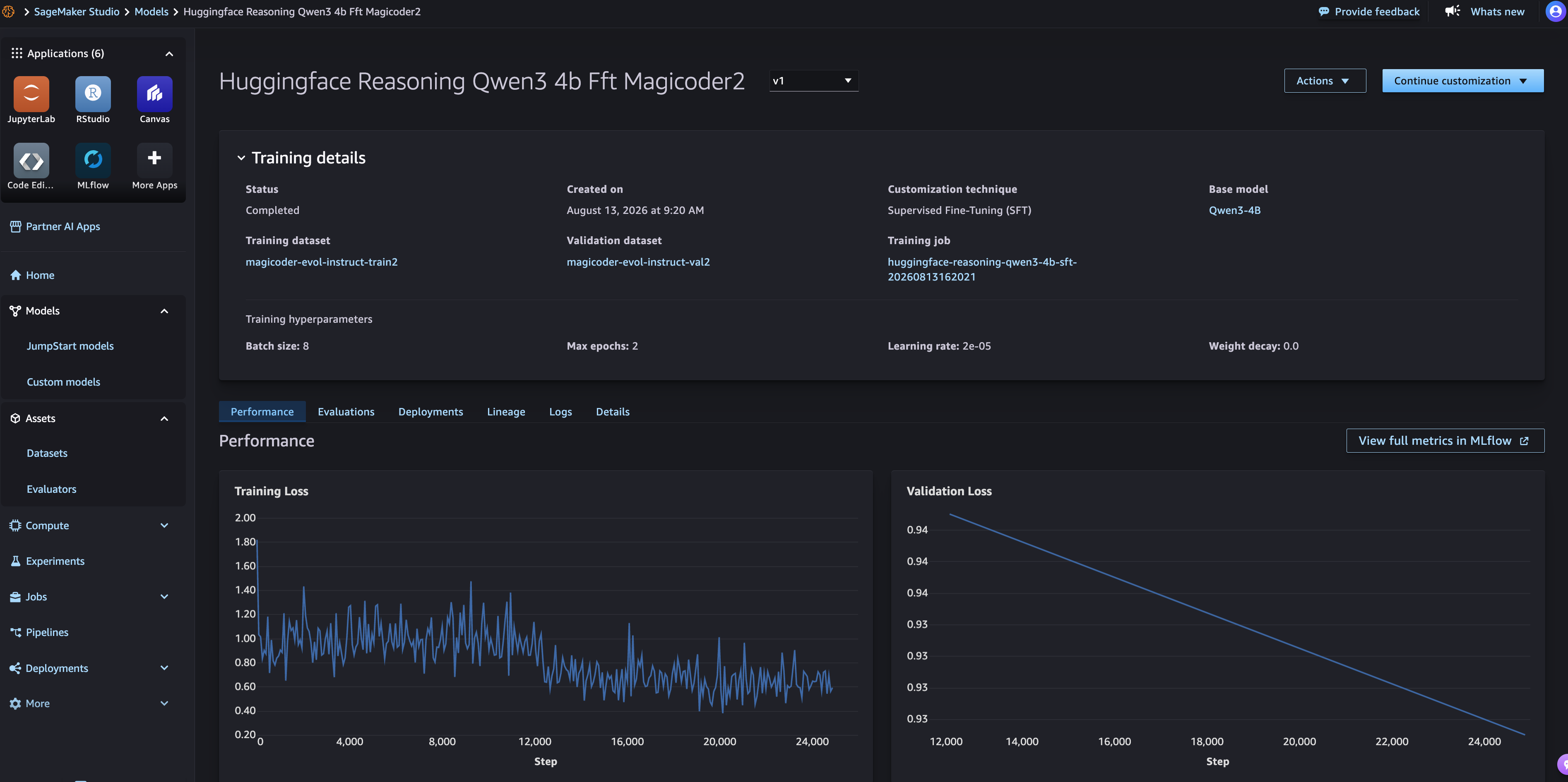
Determine 4: Serverless mannequin customization job with coaching metrics tracked in MLflow
Switching from Full Fantastic-Tuning to LoRA requires just one change: set TrainingType.FULL to TrainingType.LORA. The remainder of the code stays an identical:
Mannequin analysis and benchmarking
We examined the ensuing custom-made fashions throughout three numerous analysis strategies constructed into SageMaker AI Serverless Mannequin Customization: LLM-as-Choose, PRIMECODE, and MMLU, proven within the following picture. Every targets a distinct dimension of mannequin high quality: semantic correctness, code technology constancy, and common data retention. Collectively they supply a complete image of the mannequin customization high quality.
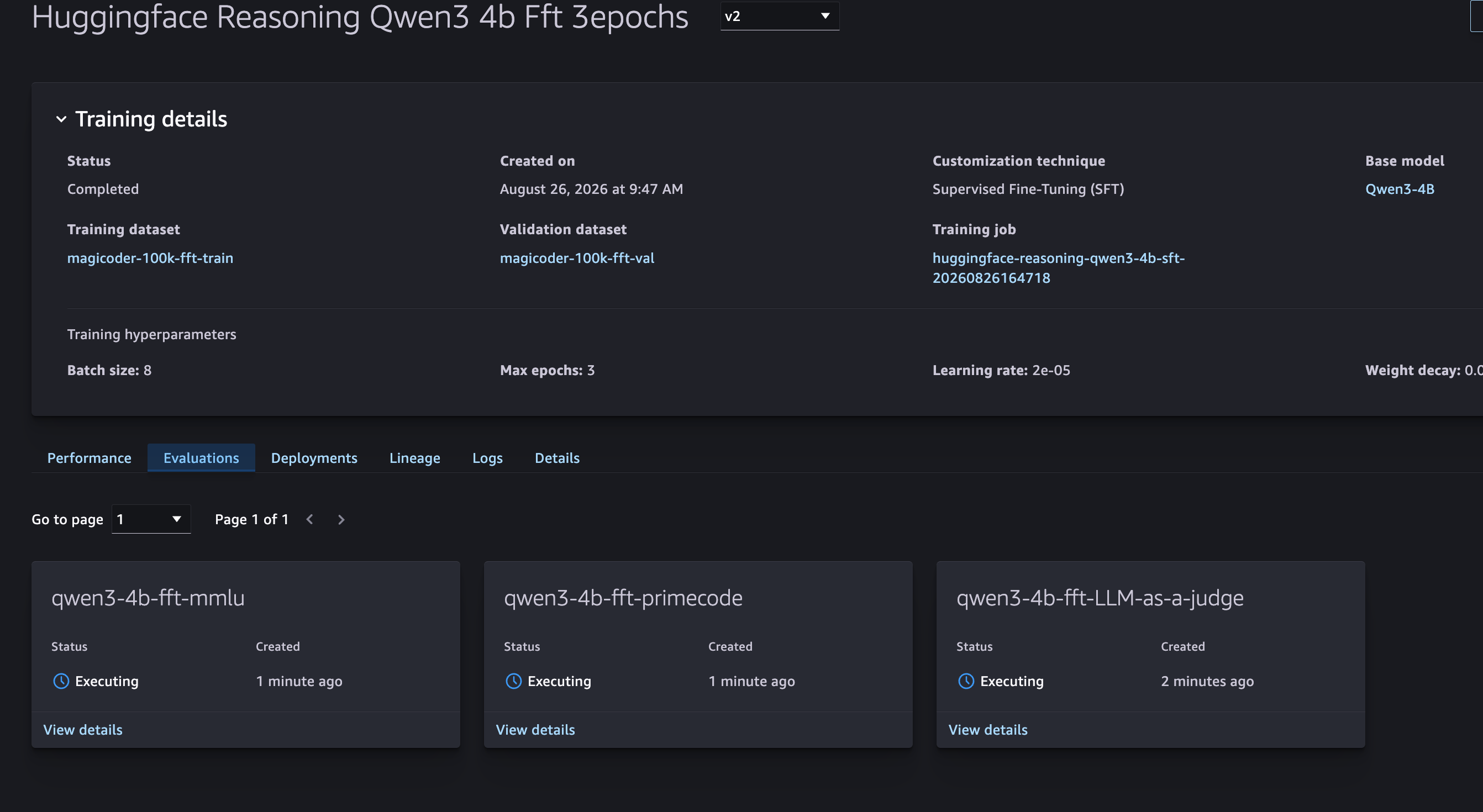
Determine 5: The three built-in analysis strategies in SageMaker AI Serverless Mannequin Customization
The LLM-as-Choose metric makes use of a frontier mannequin (on this publish, Amazon Nova Professional) as an automatic evaluator that reads the mannequin’s generated code alongside the unique immediate and judges whether or not the answer is logically appropriate. On serverless mannequin customization you possibly can consider each the custom-made mannequin alongside the bottom mannequin, as proven within the following determine.
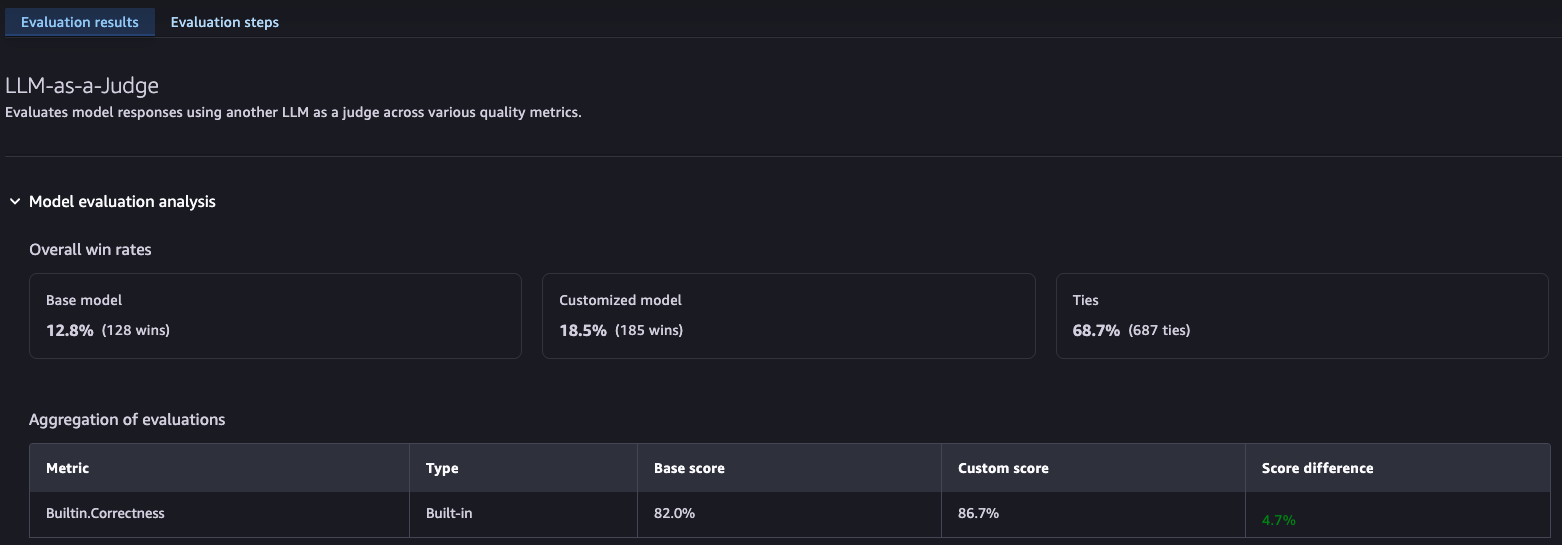
Determine 6: LLM-as-Choose analysis evaluating the custom-made mannequin and the bottom mannequin
PRIMECODE is a customized scorer analysis that measures how carefully the mannequin’s generated code matches reference options utilizing deterministic text-similarity metrics: BLEU (n-gram precision), ROUGE-1/2/L (recall-oriented overlap), and F1 (precision-recall stability). These metrics are absolutely reproducible, making them superb for managed ablation research. We used PRIMECODE as our major metric for surface-level code high quality as a result of it quantifies how properly the mannequin has realized the coding patterns, formatting conventions, and implementation type current within the coaching knowledge. A excessive BLEU rating means the mannequin generates code that appears structurally much like expert-written options, as proven within the following outcomes.
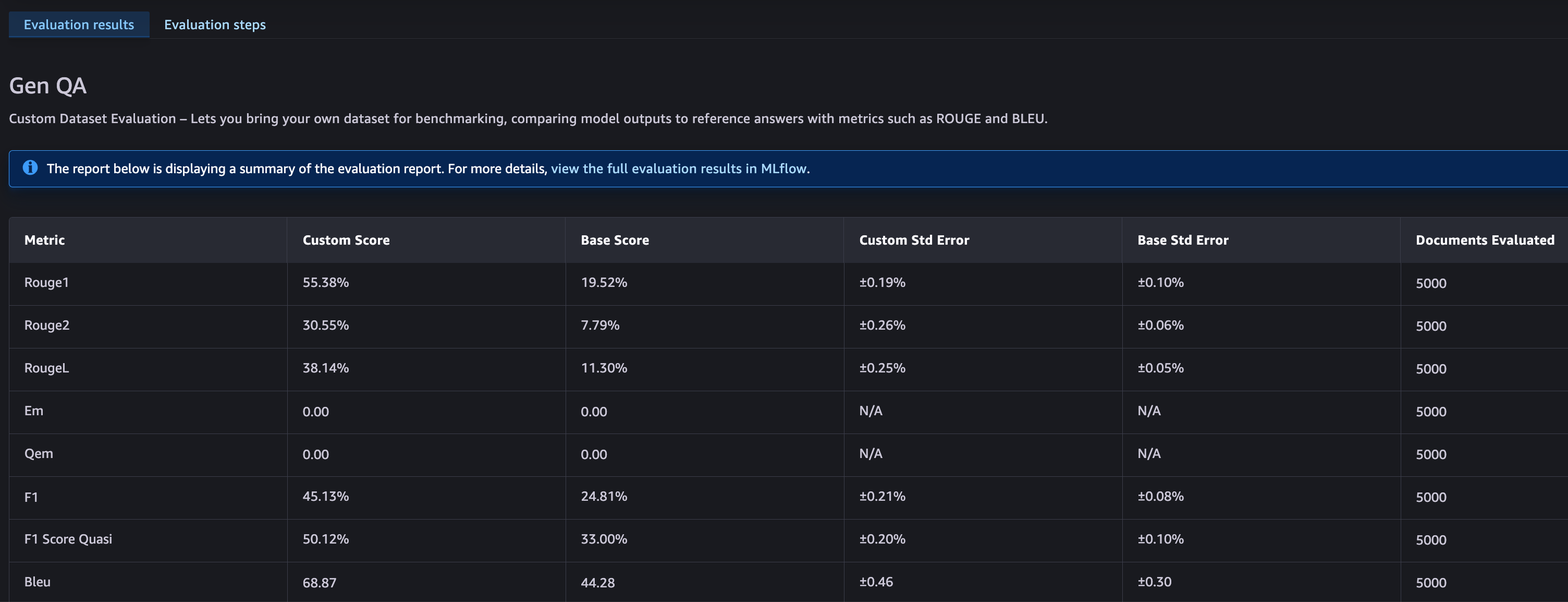
Determine 7: PRIMECODE text-similarity scores for the custom-made mannequin
MMLU (Huge Multitask Language Understanding) is a built-in benchmark that exams the mannequin throughout 57 tutorial topics from summary algebra and anatomy to Vitamin and Philosophy. It measures whether or not the mannequin retains its broad common data after domain-specific fine-tuning, as proven within the following determine. We used MMLU as our forgetting detection guardrail. Fantastic-tuning on code can overwrite common capabilities saved within the mannequin’s weights. By monitoring MMLU accuracy earlier than and after fine-tuning, we are able to quantify precisely how a lot common data the mannequin sacrifices for code technology enchancment, and whether or not our hyperparameter selections speed up or mitigate this trade-off.
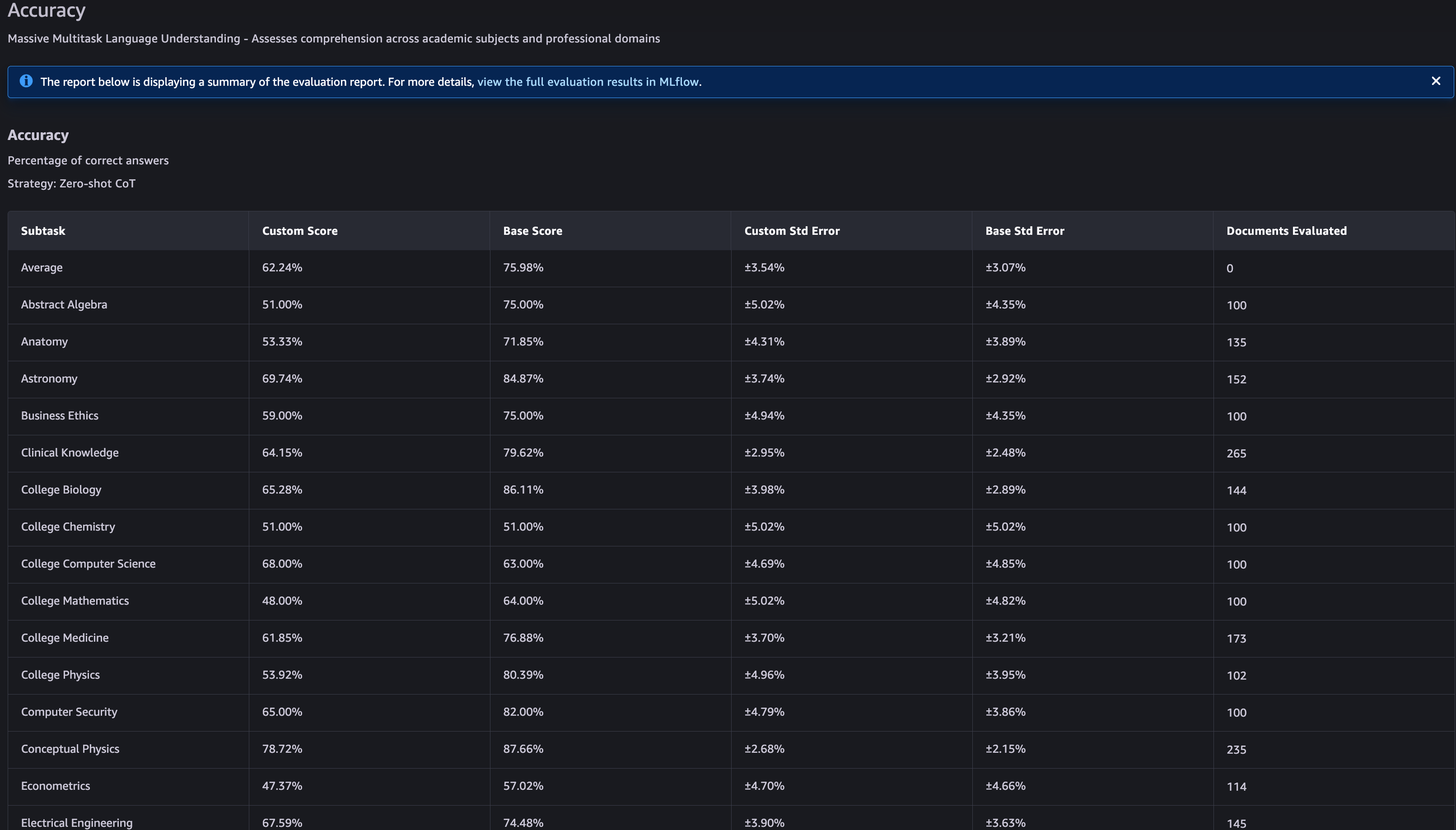
Determine 8: MMLU accuracy earlier than and after fine-tuning
Speedy experimentation at scale
The benefit of setup and use of SageMaker AI Serverless Mannequin Customization allow us to carry out fast experimentation with out re-provisioning infrastructure. We modified coaching sorts between LoRA and FFT, swept hyperparameters, and examined throughout a number of base fashions. Over a short while window, we ran tens of mannequin customization experiments throughout a number of supported base fashions (Qwen3-4B, DeepSeek-R1-1.5B, Nemotron-30B, Gemma-4-26B), systematically ablating studying fee, batch measurement, warmup ratio, epoch rely, and dataset scale. Every experiment, from job submission to analysis outcomes, accomplished in a couple of hours and the ensuing fine-tuned fashions had been mechanically registered in SageMaker Mannequin Registry as versioned Mannequin Packages, prepared for assessment or deployment.
Hyperparameter choices
SageMaker AI Serverless Mannequin Customization helps many hyperparameters. On this part, we clarify a couple of necessary ones, knowledgeable by the collection of experiments that we ran throughout a number of hyperparameter configurations inside the beforehand talked about code technology activity. Whereas efficient values will differ by activity, the patterns noticed throughout these experiments present helpful beginning factors when configuring FFT mannequin customization jobs. For extra details about the hyperparameters that you would be able to configure earlier than launching an FFT mannequin customization job, see the hyperparameters documentation web page.
1. learning_rate
In full fine-tuning, the educational fee controls how aggressively each weight is up to date. Not like LoRA, the place solely small adapter matrices change, an FFT studying fee that’s too excessive completely overwrites pretrained data. In our experiments, the next LR × dataset-size danger map exhibits that an LR of 2e-5 on a big dataset (over 100 thousand) was the secure zone.
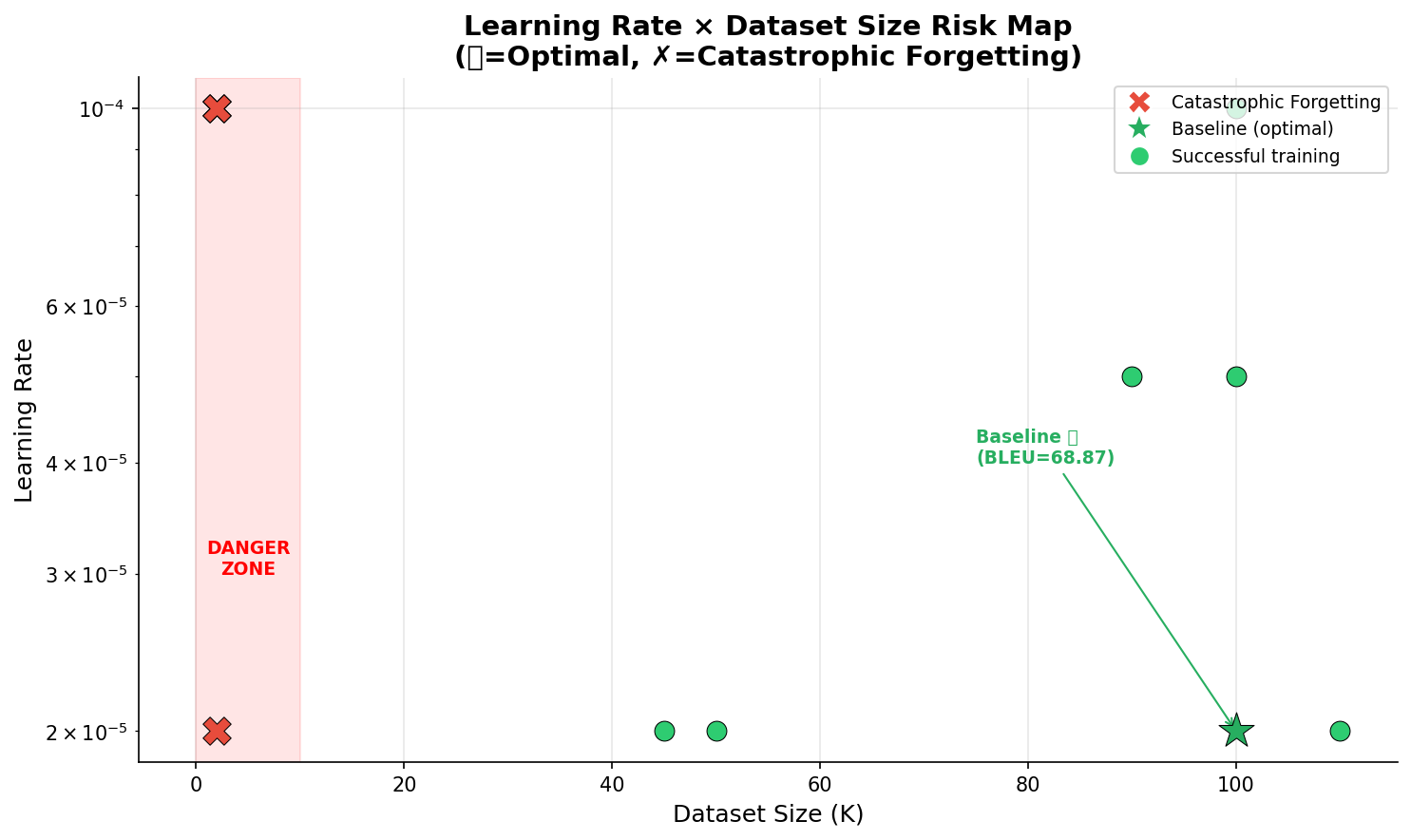
Determine 9: Studying fee and dataset-size danger map for full fine-tuning
2. max_epochs
Epoch rely in FFT is essentially a forgetting query, not a loss-curve query. Coaching loss will hold falling and your held-out validation will look wholesome as a result of it shares a distribution with coaching knowledge, however capabilities on the whole lot you didn’t practice on quietly degrade. The LLM-as-Choose correctness rating rose to 90.0 % at 3 epochs, and increasing past 3 epochs degraded each variant we experimented with.
3. global_batch_size
Batch measurement determines what number of examples contribute to every gradient step. At a set studying fee, smaller batches produce extra noisy updates that behave very similar to the next studying fee, rising forgetting danger. Bigger batches cut back noise but additionally cut back the variety of optimization steps, probably underfitting.
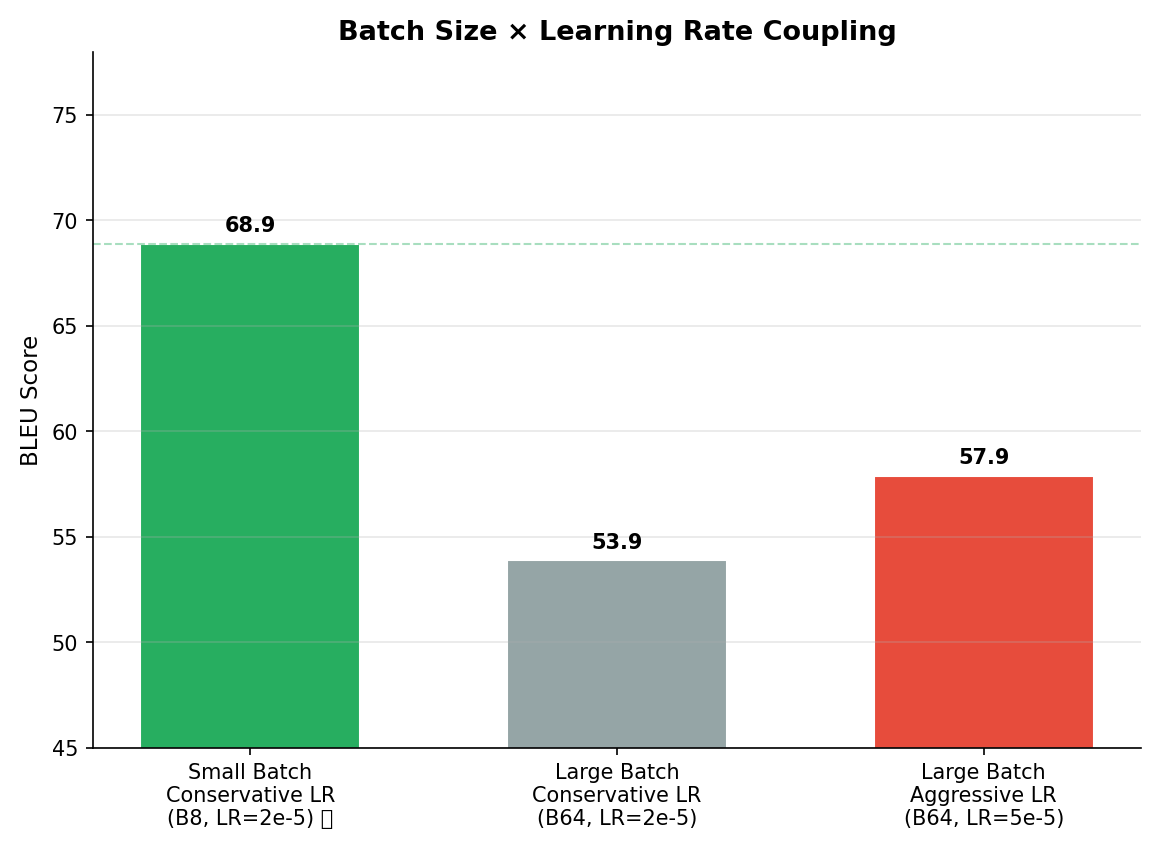
Determine 10: Impact of worldwide batch measurement on mannequin high quality
Catastrophic forgetting danger
FFT modifies each parameter within the mannequin, together with the parameters that encode common data acquired throughout pre-training. When fine-tuning pushes these parameters too aggressively towards a slim area, the mannequin can “overlook” its broader capabilities, a phenomenon generally known as catastrophic forgetting. We examined for this systematically utilizing MMLU, measuring common data retention throughout all our fine-tuning configurations. A baseline configuration with warmup=5 %, batch measurement 8, and LR=2e-5 finest preserved common data (MMLU), as proven within the following determine.
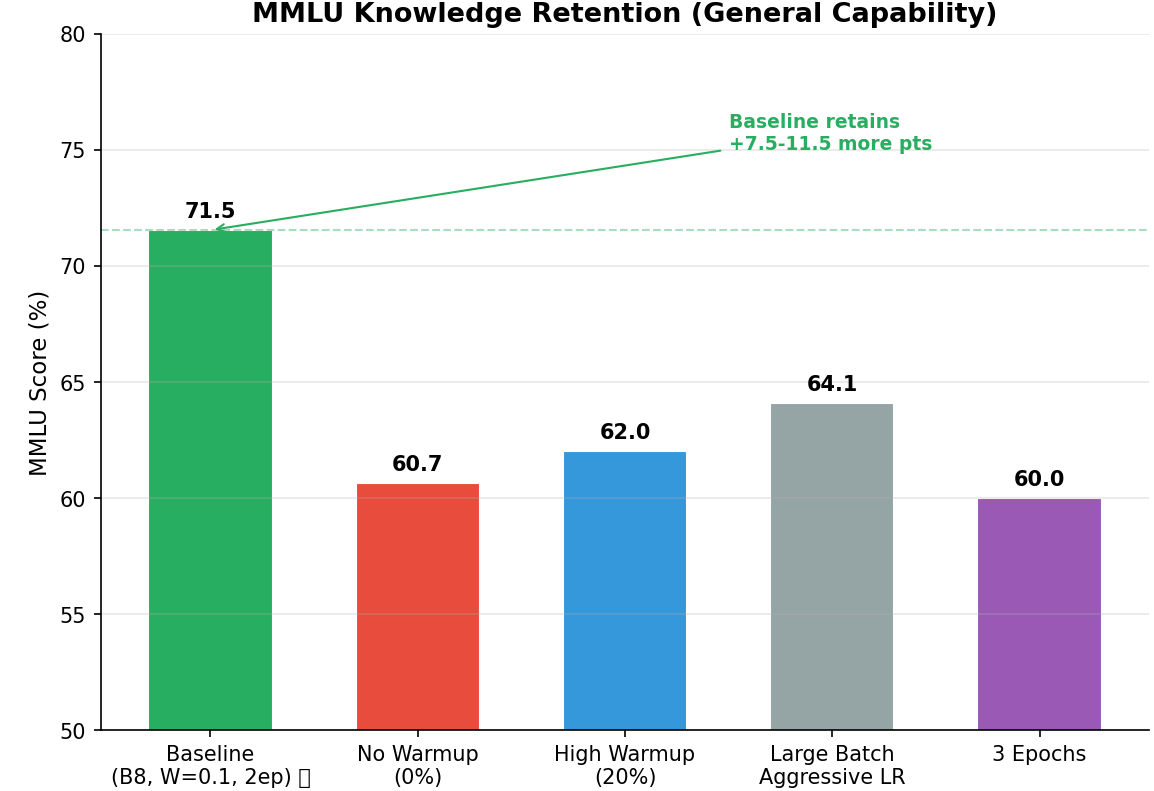
Determine 11: MMLU general-knowledge retention throughout hyperparameter configurations
Therefore, you will need to word that FFT isn’t universally superior to LoRA, and its effectiveness is extraordinarily delicate to hyperparameter selections. For instance, in our experiments, each FFT and LoRA underperformed the bottom mannequin on MATH precise match, underscoring the problem of preserving reasoning capabilities throughout domain-specific fine-tuning. Aggressive studying charges (LR ≥ 5e-5) in FFT proved notably harmful, inflicting MATH scores to plummet to 2–3 % and MMLU accuracy to drop to three.6 %, clear proof of catastrophic forgetting. Moreover, LoRA barely outperformed FFT on the LLM-as-Choose metric (81.5 % in comparison with 79.5 %), demonstrating that parameter-efficient strategies can nonetheless maintain an edge on subjective high quality assessments. These findings reinforce that the selection between FFT and LoRA must be guided by cautious experimentation, dataset traits, and a transparent understanding of the trade-offs concerned.
Conclusion
With Full Fantastic-Tuning on Amazon SageMaker AI Serverless Mannequin Customization, your mannequin can absolutely soak up domain-specific data when activity complexity and knowledge scale demand it. In case your use case requires deep adaptation, resembling specialised reasoning, code technology, or domain-specific language understanding, and you’ve got ample high-quality coaching knowledge, FFT delivers measurably stronger outcomes.
You will get began with FFT on SageMaker AI Serverless Mannequin Customization with serverless coaching, built-in analysis, and with out infrastructure or compute capability planning, so you possibly can focus in your knowledge and hyperparameter selections. You need to use the SageMaker Python SDK to configure and launch your coaching and analysis jobs programmatically. You’ll be able to see the documentation for supported base fashions accessible for Full Fantastic-Tuning on Serverless Mannequin Customization.
Concerning the creator


