
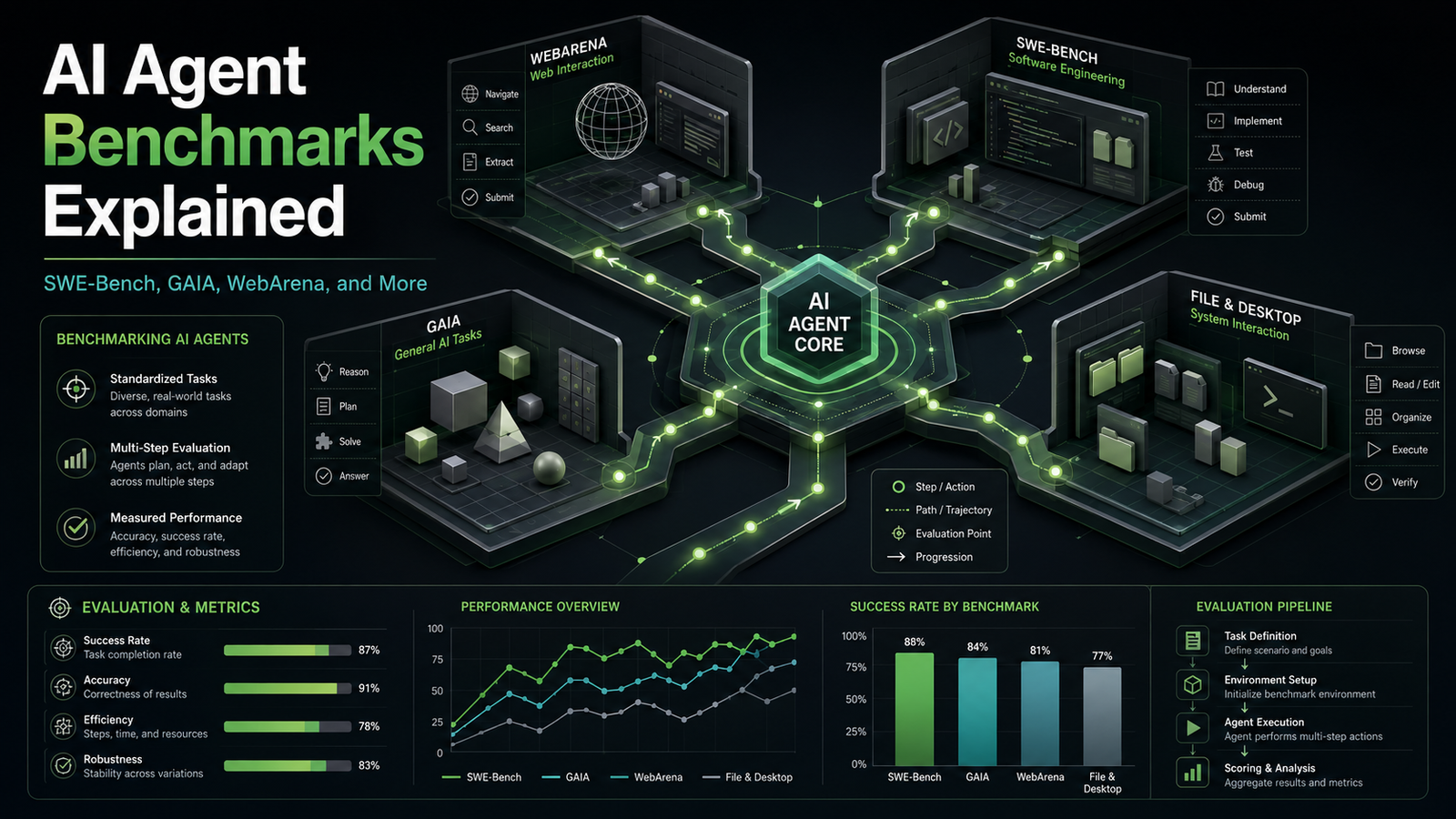
On this article, you’ll study what the foremost AI agent benchmarks measure, how they differ from conventional mannequin benchmarks, and how one can use them as directional indicators fairly than efficiency ensures.
Matters we’ll cowl embrace:
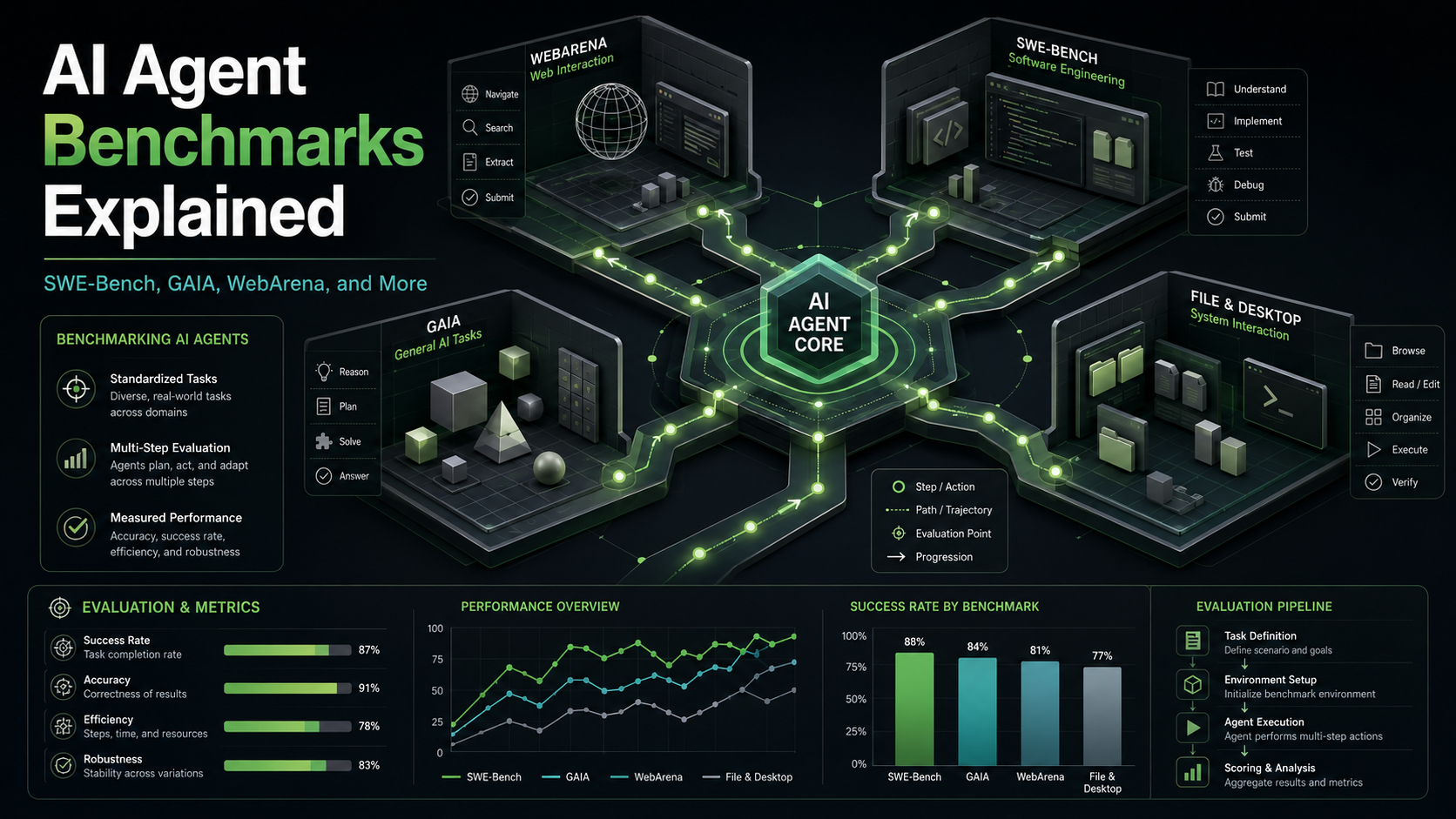
- How agent benchmarks like SWE-Bench, GAIA, WebArena, and OSWorld differ from each other and what each really exams.
- What leaderboard scores constantly pass over, together with value, latency, security, and error restoration.
- The best way to mix public benchmarks with personal evaluations to make extra dependable selections about agent deployment.
Introduction
Each AI supplier claims their agent is cutting-edge. Leaderboards replace weekly. Advertising pages glow with spectacular percentages. However for anybody who has really deployed an AI agent in manufacturing, one query issues greater than any rating: does it reliably do the job you employed it for?
This information cuts by the leaderboard noise. You’ll study what the foremost AI agent benchmarks really measure, why each captures solely a slice of real-world functionality, and how one can use these evaluations as directional indicators fairly than efficiency ensures.
Agent Benchmarks vs. Mannequin Benchmarks
Earlier than inspecting particular evaluations, it helps to know what separates an agent benchmark from an ordinary mannequin benchmark.
Conventional benchmarks like MMLU or HumanEval check a mannequin’s means to generate an accurate response in a single flip. You ask a query, the mannequin solutions, and a choose scores the output. These exams are helpful for measuring uncooked language understanding and reasoning, however they are saying nothing about whether or not a system can navigate the true world.
Agent benchmarks introduce a categorically totally different problem. They drop a mannequin into an atmosphere the place it should take sequences of actions over a number of steps, use exterior instruments, adapt when one thing goes mistaken, and in the end obtain a objective that may’t be reached in a single response. The mannequin would possibly browse web sites, write and execute code, click on by interfaces, or manipulate information. Failure isn’t only a mistaken reply — it may be a caught loop, a damaged workflow, or a process deserted midway by.
The distinction is stark: a conventional benchmark is a written examination. An agent benchmark is a reside work simulation the place the candidate should navigate actual instruments, actual friction, and actual surprises. With that distinction in thoughts, let’s stroll by the foremost evaluations and what each really exams.
The Main Benchmarks, Defined
SWE-Bench and SWE-Bench Verified
SWE-bench is the closest factor to a gold customary for software program engineering brokers. It presents the agent with an actual GitHub difficulty drawn from widespread Python repositories, together with initiatives like Django and scikit-learn, and asks the agent to provide a code patch that resolves the issue. Success is measured by whether or not the patch passes the repository’s current unit exams.
SWE-bench Verified is a curated subset the place human engineers have confirmed that every process is genuinely solvable and that the unit exams precisely replicate whether or not the repair labored. This addresses an actual weak spot of the unique benchmark: some duties had been ambiguous or had flawed check suites that might cross with incorrect options.
The catch is value understanding. Passing a unit check suite is just not the identical as writing good code. An agent can produce a patch that technically passes each check whereas concurrently introducing a reminiscence leak, making a safety vulnerability, or fixing solely a slender edge case whereas breaking three others. SWE-bench measures whether or not an agent can fulfill a particular, automated criterion — it doesn’t measure code high quality, maintainability, or security. With that limitation in thoughts, let’s have a look at a benchmark concentrating on a really totally different functionality.
GAIA
GAIA, which stands for Common AI Assistants, targets the flexibility to reply complicated questions that require reasoning throughout a number of instruments and modalities. A GAIA process would possibly ask an agent to lookup a doc, cross-reference it with data from the online, carry out a calculation, and synthesize a closing reply.
What makes GAIA distinctive is that its questions are designed to be trivially simple for a human with web entry however genuinely tough for present AI programs. The benchmark exams whether or not an agent can coordinate net looking, file dealing with, and multi-step deduction in the suitable sequence with out dropping monitor of the unique objective.
The limitation is that GAIA duties, by design, are inclined to have single appropriate solutions. Actual assistant workflows are messier: objectives shift, directions are ambiguous, and the suitable reply typically is dependent upon context that an agent can’t retrieve from a search engine. From reasoning and retrieval, we will transfer to a benchmark that focuses squarely on one thing most brokers encounter day by day: the online browser.
WebArena and BrowserGym
WebArena exams whether or not an agent can navigate sensible net functions to finish multi-step duties. Moderately than utilizing reside web sites, it spins up sandboxed variations of e-commerce platforms, content material administration programs, boards, and different frequent net environments. The agent should work together with these interfaces the way in which a human would: clicking buttons, filling out kinds, navigating menus, and decoding web page content material.
BrowserGym extends this right into a extra modular framework, permitting researchers to plug in several net environments and analysis standards. Collectively, these benchmarks are the very best present instruments for evaluating browser-based brokers.
The contamination downside looms giant right here. A lot of WebArena’s unique duties have been in circulation lengthy sufficient that they could seem within the coaching knowledge of newer fashions. A excessive rating may replicate real functionality or pattern-matching towards memorized process buildings. Researchers and distributors hardly ever disclose how completely they’ve checked for this. If WebArena represents the browser, the ultimate benchmark takes issues a step additional, handing the agent a whole pc.
OSWorld
OSWorld takes probably the most expansive view of agent functionality. It locations an agent inside a sandboxed desktop working system and duties it with finishing actual computer-use workflows: manipulating information, navigating GUI functions, adjusting system settings, and coordinating throughout a number of packages.
This benchmark is probably the most formidable in scope as a result of it mirrors how a human assistant would really function a pc. It’s additionally probably the most fragile. If the simulated working system crashes, the show renders incorrectly, or an software behaves unexpectedly, the agent fails even when its reasoning was sound. OSWorld scores are due to this fact closely depending on the soundness of the infrastructure working the analysis, not simply the aptitude of the mannequin being examined.
What Leaderboards Don’t Present
Now that we’ve coated what every benchmark measures, it’s value stepping again to look at what all of them miss. Benchmark scores are designed to be comparable throughout programs, which is helpful, however it additionally means they systematically exclude the issues which can be hardest to standardize and most necessary in manufacturing.
Price and effectivity. An agent that scores 80% on SWE-bench would possibly obtain that by exhaustively attempting dozens of approaches, burning by huge numbers of tokens and API calls alongside the way in which. One other agent scoring 70% would possibly attain its options in a fraction of the compute. Leaderboards present success charges, not payments.
Latency. Whether or not a process takes thirty seconds or twenty minutes issues for each consumer expertise and infrastructure prices. No main benchmark ranks brokers on pace.
Security and boundary-following. An agent ought to know what it’s not speculated to do. Does it respect permissioning boundaries? Does it refuse to take damaging actions when unsure? Does it ask for clarification fairly than guessing on high-stakes selections? Not one of the main benchmarks consider this constantly.
Error restoration. Probably the most revealing check of an agent is just not the way it performs when all the pieces works. It’s the way it responds when it hits a damaged hyperlink, an sudden interface, or a failing subprocess. Some benchmarks embrace partial credit score for restoration, however this dimension is basically underrepresented throughout the sphere.
Automated grading noise. Many evaluations use one other language mannequin to attain whether or not an agent’s output was appropriate. This introduces its personal failure mode: a confident-sounding however mistaken reply can idiot an automatic grader, inflating scores in ways in which wouldn’t survive human evaluate.
Utilizing Benchmarks Correctly
With a clearer image of what benchmarks can and might’t inform you, the query turns into how one can use them productively.
Public benchmarks are genuinely helpful for narrowing down which agent architectures are value exploring. A system that scores close to zero on SWE-bench isn’t prepared for a software program engineering workflow. A system that struggles on GAIA is unlikely to deal with complicated analysis duties reliably. These evaluations can remove choices and floor candidates value investigating additional.
The error is treating benchmark scores as predictions of manufacturing efficiency. The hole between a managed check atmosphere and a reside workflow is large. Duties in manufacturing are messier, objectives are much less exactly outlined, and the implications of failure are actual.
Probably the most dependable strategy is to make use of public benchmarks as a primary filter, then construct personal evaluations designed round your particular workflows. In case your agent will likely be reserving journey, check it on reserving journey. If will probably be summarizing contracts, consider it on contracts that resemble yours. The duty you care about, run in situations that approximate your atmosphere, is the one benchmark that tells you what you really have to know.
Conclusion
AI agent benchmarks like SWE-bench, GAIA, WebArena, and OSWorld symbolize real progress in evaluating autonomous programs. Each illuminates an actual dimension of functionality. None of them tells the entire story. Understanding what every benchmark measures, and the place each breaks down, is what separates groups that deploy brokers confidently from groups which can be shocked by manufacturing failures. Use the leaderboards to begin the dialog. Construct your personal evaluations to complete it.