
If you construct Retrieval Augmented Technology (RAG) functions, reply high quality will depend on the information that you just ingest. Amazon Bedrock Information Bases is the totally managed RAG functionality of Amazon Bedrock. With Amazon Bedrock Managed Information Base, you join your information sources, and Amazon Bedrock manages ingestion, storage, indexing, and retrieval for you. You don’t provision or scale a vector retailer, and embedding and reranking use service-managed fashions by default.
For internet content material, begin with the Amazon Bedrock Net Crawler information supply connector for managed data bases. You give it the seed URLs or sitemaps that you just’re licensed to crawl, and it crawls inside the scope and fee limits that you just set. Scheduled syncs hold your data base present as pages change, and the connector can look forward to content material that masses with JavaScript. There’s no crawler so that you can construct, host, or function, so this connector is the place to begin for many public web site content material.
Some sources want extra management over what reaches the data base. You may wish to index solely the principle content material area of every web page, take away navigation and different boilerplate, or connect your individual metadata attributes to each doc. For that class of supply materials, you possibly can prolong the attain of your data base with a preparation step constructed with Crawl4AI, an open supply Python crawler. The step writes Markdown and a metadata sidecar for every web page to Amazon Easy Storage Service (Amazon S3), and the data base ingests each by means of its Amazon S3 information supply.
On this put up, we present you ways to decide on the suitable internet ingestion path and implement customized preparation for content material that wants further processing. You then begin ingestion right into a managed data base and validate retrieval high quality. The companion aws-samples repository gives the entire workflow as a pattern implementation.
That is batch ingestion of identified internet properties, not real-time internet entry at inference time comparable to Net Grounding with Amazon Nova.
Answer overview
Begin with the Amazon Bedrock Net Crawler when it could attain and index the pages you want. It respects robots.txt, and after the primary full crawl, every sync captures solely added, up to date, and deleted content material.
Use the Crawl4AI preparation path when public supply materials wants a number of of the next earlier than ingestion:
- Structured Markdown preparation: Use
DefaultMarkdownGeneratorwith a pruning content material filter to scale back navigation and different boilerplate whereas preserving headings, lists, and tables. As a result of pruning is heuristic, evaluate consultant output out of your websites. - Bounded, focused extraction: Extract solely the web page area that an non-obligatory CSS selector matches. Constrain breadth-first traversal by seed origin, web page/path/host scope, depth and web page caps, and URL patterns.
- Customized metadata: Connect supply URLs, crawl timestamps, content material sort, and your individual attributes to every doc, to be able to filter retrieval outcomes on them.
As a result of managed and customer-managed data bases each assist Amazon S3 information sources, the Crawl4AI path works with both sort. This put up makes use of a managed data base and notes the place a customer-managed data base differs.
The remainder of this put up follows the companion pattern. Deal with its structure and defaults as a place to begin, not as necessities of Amazon Bedrock Information Bases.
By default, the pattern runs the AWS Fargate job in a public subnet, the place it reaches your configured web sites by means of an web gateway. Crawl4AI’s function ends as soon as it has ready the supply paperwork and metadata sidecars. From ingestion onward, Amazon Bedrock Information Bases handles parsing, chunking, embedding, indexing, and retrieval. The next diagram reveals the Crawl4AI path from the schedule by means of to retrieval.
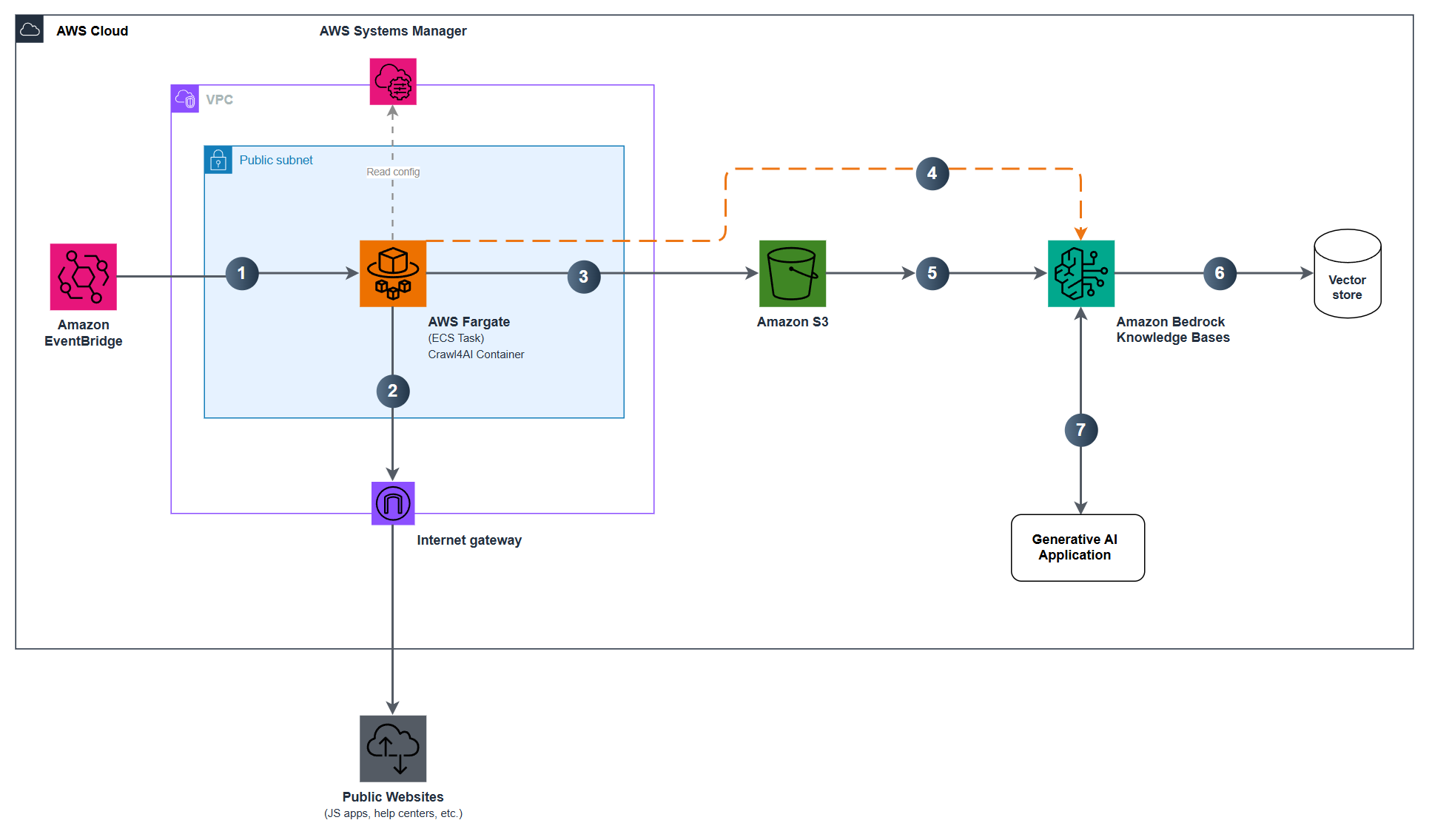
Determine 1: The Crawl4AI-to-Amazon S3 ingestion path for Amazon Bedrock Information Bases
The numbered steps within the diagram map to the next workflow:
- Amazon EventBridge begins the Amazon Elastic Container Service (Amazon ECS) job on AWS Fargate on the configured schedule.
- The duty crawls the general public web sites you configured and prepares Markdown with a metadata sidecar for every web page.
- The duty uploads the ready information to the Amazon S3 bucket that backs the data base information supply.
- The duty begins an Amazon Bedrock Information Bases ingestion job.
- Amazon Bedrock Information Bases reads the brand new and adjusted objects, parses them, and applies the chunking technique you chose.
- It creates embeddings and indexes them within the data base’s vector retailer, which Amazon Bedrock manages for a managed data base.
- Your generative AI software queries the data base for related chunks or for a generated response with citations.
The duty reads its non-secret pipeline configuration from AWS Techniques Supervisor Parameter Retailer at startup.
The workflow processes public pages solely and doesn’t implement authenticated periods. For websites that require sign-in, consider the Amazon Bedrock Net Crawler authentication choices first, which embody primary, form-based, and SAML authentication. Extending the pattern with authentication requires session dealing with, credentials in AWS Secrets and techniques Supervisor, and a safety evaluate.
How the workflow works
The AWS Cloud Improvement Package (AWS CDK) app packages the implementation in a container picture throughout deployment. When the schedule fires, the container runs scripts/container_entrypoint.py and executes crawl, add, and ingestion in sequence. The next three steps clarify the core logic.
Step 1: Crawl and extract content material
The crawl step performs bounded crawling and writes a Markdown file with a metadata sidecar for every efficiently ready web page. The next excerpt is simplified. The module src/crawl4ai_bedrock_kb/crawl.py accommodates the entire seed pacing, URL filtering and scoping, web page limits, and redirect checks:
Amazon Bedrock Information Bases helps a number of doc codecs for Amazon S3 information sources, together with plain textual content, HTML, Markdown, PDF, and DOCX. The workflow writes Markdown as a result of it preserves headings, lists, and tables with out carrying all uncooked HTML into ingestion.
Step 2: Add to Amazon S3
The add step sends every ready Markdown doc and its matching metadata sidecar to the configured S3 bucket, underneath the workflow’s s3Prefix. For web page.md, the sidecar have to be named web page.md.metadata.json, the entire supply filename with .metadata.json appended. The workflow shops every sidecar in the identical S3 location as its doc. Amazon Bedrock limits every metadata sidecar to 10 KB. If a sidecar would exceed that restrict, the run stops with an error earlier than it writes both file.
Every attribute within the sidecar makes use of the typed format that each managed and customer-managed data bases settle for for Amazon S3 information sources. The next abbreviated sidecar, formatted for readability, reveals three of the attributes that the workflow writes:
The pipeline uploads solely the paths produced by the present crawl, so stale native information aren’t despatched.
Step 3: Let Amazon Bedrock Information Bases chunk, embed, and index
After content material is in S3, an ingestion job palms every doc to the information supply’s ingestion pipeline. By default, a managed data base parses every file with its managed parser, which routinely selects a parsing strategy in your content material. You choose the chunking technique once you join the information supply. You’ll be able to’t change it afterward, so consider the choices earlier than you create a manufacturing information supply. A managed data base provides the next chunking methods:
- Default chunking makes use of fixed-size chunks of 300 tokens with 20 % overlap.
- Fastened-size chunking splits content material by a most token depend and an overlap share that you just set.
- No chunking treats every file as a single chunk, for content material that you’ve already cut up.
Chunk boundaries and retrieval outcomes rely on the content material and the chosen technique, so examine the choices with consultant pages and analysis questions. To vary methods later, create a brand new information supply. For extra info, see Customise ingestion for a knowledge supply. A customer-managed data base additionally provides semantic and hierarchical chunking and extra parsing choices. For particulars, see How content material chunking works for data bases.
The workflow then begins an ingestion job so the data base processes the brand new paperwork. The next simplified excerpt from src/crawl4ai_bedrock_kb/ingest.py reveals the decision:
The identical StartIngestionJob and GetIngestionJob calls work for each data base sorts, and you too can monitor progress on the console.
Deploy the answer
On this part, you deploy the workflow into your AWS account with AWS CDK. Solely the data base stipulations differ between the 2 data base sorts. If you’re completed, observe the steps within the Clear up part to take away the sources.
Conditions
Earlier than you begin, just remember to have:
- An AWS account.
- One of many following data bases:
- A managed data base, which this put up makes use of, in an AWS Area the place managed data bases can be found. For directions, see Create a managed data base and the Amazon S3 connector. On the information supply, depart Metadata information prefix empty, as a result of the workflow writes every metadata sidecar alongside its doc.
- An present customer-managed data base. So as to add an Amazon S3 information supply, see Connect with Amazon S3 in your data base. The workflow writes a metadata sidecar for each doc, so affirm that your vector retailer can retailer and filter these attributes, as described in Metadata and filtering. For instance, an Amazon OpenSearch Serverless vector index should use the
faissengine. An Amazon Aurora vector index wants a customized metadata column or a column for every metadata attribute. With Amazon S3 Vectors, a functionality of Amazon S3, you possibly can connect as much as 1 KB of customized metadata to every vector, so hold attributes that you just add brief.
- An Amazon S3 information supply in that data base whose standing is
AVAILABLE. It may be a brand new information supply or one you already use. It should use the S3 bucket that you just configure for this workflow. If the information supply filters content material by prefix or file sample, the filters should permit the information that the workflow writes underneath itss3Prefix(defaultweb-content/). - The data base, the S3 bucket, and the stack you deploy multi functional Area.
- Authorization to crawl the general public web sites you configure.
- A deployment workstation with Git, Python 3.10 or later,
Node.js, the AWS Command Line Interface (AWS CLI) model 2, the AWS CDK CLI v2, and a operating Docker-compatible container engine. The deployment information lists the minimal AWS CDK CLI model. - AWS credentials configured on the deployment workstation with permission to bootstrap the goal setting and deploy the CDK stack.
- A bootstrapped CDK setting within the goal account and Area. The deployment steps embody the bootstrap command.
You want the workstation solely to construct and deploy. After deployment, the schedule runs the duty in AWS.
Deploy the scheduled workflow
Clone the companion repository and set up the deployment dependencies:
Maintain Docker operating. Set AWS_DEFAULT_REGION to your data base’s Area first, as a result of cdk deploy makes use of the Area out of your setting or AWS profile, not the one within the bootstrap command. Bootstrap the goal account and Area as soon as, if wanted. Then deploy the stack along with your data base, information supply, S3 bucket, and licensed seed URLs:
Substitute each instance worth, together with ACCOUNT_ID, REGION, and the 4 required context keys, with your individual. The instance values are syntactically legitimate, so an unedited command deploys a stack that factors at a bucket you don’t personal. You can too set these keys in cdk.json.
The maxDepth and maxPages values restrict the primary crawl to 1 hyperlink degree and 25 pages. Elevate them after you evaluate the ready output. To preview which pages a crawl prepares, you too can run the pipeline domestically with --dry-run, as described within the README. The stack title is fastened, so one other cdk deploy in the identical account and Area updates this stack.
The pattern builds an ARM64 container picture by default. If Docker in your x86_64 workstation can’t construct ARM64 photographs, add -c cpuArchitecture=X86_64 to the cdk deploy command.
In case your account activates VPC Block Public Entry, the duty can’t attain the web from the default public subnet. To examine the mode, run aws ec2 describe-vpc-block-public-access-options. In ingress-only mode, deploy with -c egressMode=nat, which provides a NAT gateway with hourly costs. Bidirectional mode additionally wants an exclusion, because the deployment information describes.
The stack doesn’t create or change your data base or information supply.
With the default fee(24 hours) schedule, the primary run begins when the deployment creates the Amazon EventBridge rule. To observe that run, use the command within the TailLogsCommand output, which cdk deploy prints when it finishes. A profitable run logs job_status: COMPLETE. To begin one other run exterior the schedule, use the command within the RunTaskCommand output after the present run finishes. To checklist the outputs later, run aws cloudformation describe-stacks --stack-name Crawl4aiBedrockKbCrawler --region REGION --query "Stacks[0].Outputs".
The deployment information covers the remaining configuration, together with crawl boundaries, the schedule, networking, container structure, monitoring, and on-demand runs.
Validate retrieval high quality
After ingestion, check consultant questions with Retrieve earlier than you add era. A managed data base makes use of hybrid search. When it makes use of the default managed embedding mannequin, it additionally reranks outcomes with its managed reranker. You’ll be able to slender outcomes with the metadata from the sidecars. The pattern’s default configuration provides content_category set to internet to each web page. The next instance returns as much as 5 chunks from these pages that had been crawled within the final seven days. It requires the AWS SDK for Python (Boto3) 1.43.32 or later, which you’ll be able to set up with python -m pip set up "boto3>=1.43.32". Substitute the Area and data base ID with your individual values:
The instance passes an integer timestamp, which each data base sorts settle for in quantity filters. A managed data base doesn’t assist the startsWith and stringContains filters. For a customer-managed data base, move the identical filter in vectorSearchConfiguration as a substitute of managedSearchConfiguration. The operators it helps rely on its vector retailer.
Metadata filtering can enhance retrieval precision, however it’s not an authorization boundary. If totally different customers ought to see totally different pages, the Amazon S3 connector for managed data bases helps document-level entry management with entry management checklist (ACL) information that you just present. The pattern doesn’t create ACL information.
To generate responses from a managed data base, use agentic retrieval. The AgenticRetrieveStream operation returns the retrieved outcomes and a generated response with citations to these outcomes. For a customer-managed data base, use RetrieveAndGenerate. In each instances, every cited consequence consists of the source_url metadata from its sidecar, which your software can current because the user-facing supply.
Consider retrieval relevance, source-page protection, and quotation high quality everytime you change content material preparation, chunking, or retrieval settings. For the retrieval settings you could tune, see Configure and customise queries for managed data bases.
Operating it repeatedly
Every scheduled occasion launches one standalone Fargate job. The stack doesn’t forestall overlapping runs, so select an interval longer than the anticipated crawl and ingestion period. A failed run isn’t introduced, as a result of the pattern provides no retry coverage, dead-letter queue, or alarm. An ingestion job may also report COMPLETE when some paperwork fail to ingest, and the duty then exits with code 0. The duty logs the job’s failure causes. Add the monitoring you want, together with an alarm on these failure causes, earlier than you depend on the schedule.
Every run incurs Fargate costs for the configured job measurement, which defaults to 2 vCPU and 4 GB. The duty retains operating whereas it polls the ingestion job for as much as half-hour, so a sluggish ingestion job extends billable job time. If ingestion takes longer, the duty exits with a nonzero code, and the ingestion job retains operating. The stack activates Container Insights for the cluster, and move logs for an Amazon Digital Non-public Cloud (Amazon VPC) that it creates. Each add Amazon CloudWatch costs. The stack’s AWS KMS key has a month-to-month cost, and the duty’s public IPv4 tackle is billed whereas the duty runs. With egressMode=nat or privateEndpoints=true, the NAT gateway and interface endpoints are billed hourly, even when no job is operating. Information base utilization is billed individually. For particulars, see Amazon VPC pricing and Amazon Bedrock pricing.
Uploads are additive: eradicating a URL or lacking a web page throughout a later crawl doesn’t delete its present S3 objects. To take away stale content material, delete the out of date doc and matching sidecar underneath the configured prefix, then begin ingestion once more. If you happen to activate the doc deletion safeguard (deletion safety) for a managed data base information supply, examine its threshold. A sync that may delete greater than that share of paperwork skips its delete part, so these paperwork keep listed. To begin ingestion routinely every time objects within the bucket change, see Construct and deploy an automated sync resolution for Amazon Bedrock Information Bases.
Accountable AI issues
Retrieved passages turn out to be the context {that a} basis mannequin makes use of to generate a response. Apply the next controls earlier than you run this workflow in manufacturing:
- Amazon Bedrock Guardrails: Connect a guardrail to your agentic retrieval or
RetrieveAndGeneraterequests to use content material filters, denied subjects, phrase filters, and delicate info filters. Agentic retrieval helps solely the guardrailBLOCKmotion, notMASK. - Contextual grounding checks: Activate the Guardrails contextual grounding examine to attain every response for grounding towards the retrieved passages and for relevance to the question. The guardrail blocks responses that rating beneath the thresholds you set. For agentic retrieval, you possibly can run the examine on the generated reply with the
ApplyGuardrailAPI. The examine helps query answering and summarization, not conversational chatbot use instances. - Deal with crawled content material as untrusted enter: Ready internet pages turn out to be mannequin context, so textual content on a public web page can try immediate injection by means of retrieval. Don’t depend on guardrails alone to catch it. Limit seed URLs to websites you belief, and apply the ingestion filtering patterns described within the subsequent part earlier than content material reaches the data base.
- Citations and human evaluate: Return citations with each generated response so customers can confirm claims towards the supply web page. For higher-risk use instances, hold a human reviewer within the loop.
Safety and compliance issues
Evaluation the next issues earlier than you run this workflow towards manufacturing content material:
- Use trusted public crawl targets: Seed URLs and crawl settings are deployment configuration, and the Fargate job permits outbound entry so it could attain public web sites. Within the pattern’s default networking mode, the duty runs in a public subnet with a public IP. Configure solely licensed public websites. Don’t use this pattern to crawl personal or inner endpoints. Evaluation community egress and vacation spot controls earlier than adapting the workflow for different belief fashions.
- Respect crawl directives: The workflow activates Crawl4AI’s
robots.txtexamine by default, and the CDK path pins it on with no context key to disable it. Confirm you will have authorization to crawl the goal websites, in keeping with the AWS Acceptable Use Coverage. - Price limiting: Configure delays between requests to keep away from overwhelming supply web sites.
- Encryption at relaxation: The stack creates an AWS Key Administration Service (AWS KMS) buyer managed key with automated key rotation and encrypts its CloudWatch log teams with it. Amazon S3 encrypts new objects with server-side encryption with Amazon S3 managed keys (SSE-S3) by default. In case your information classification requires a buyer managed key for the bucket, configure the bucket to make use of it. Then grant the uploader and the data base service function the required AWS KMS permissions in each AWS Identification and Entry Administration (IAM) and the important thing coverage. The stack’s job function doesn’t embody AWS KMS permissions. A managed data base encrypts its information with an AWS owned key by default, or with a buyer managed key that you just specify once you create it. For a customer-managed data base, evaluate encryption for its vector retailer.
- Least privilege IAM: The CDK stack grants the Fargate job function
s3:PutObjecton the configured bucket prefix. It additionally grantsbedrock:StartIngestionJobandbedrock:GetIngestionJobon the goal data base, plusssm:GetParameterfor its single configuration parameter. Separate roles cowl Amazon EventBridge job launch and the usual container picture pull and log supply. The pipeline doesn’t learn or checklist S3 and doesn’t nameInvokeModelorRetrieve. - Container and template checks: The container runs as a non-root consumer, and the CDK app runs cdk-nag AWS Options checks on each synthesis with resource-scoped suppressions.
- Defend deployment configuration: The CDK app shops non-secret pipeline settings in a plaintext Parameter Retailer
Stringparameter. Solely the parameter title is positioned within the job definition. Don’t put passwords, cookies, tokens, or different secrets and techniques in CDK context or this parameter. - Ingestion pipeline safety: See Securing the RAG ingestion pipeline: Filtering mechanisms for filtering and validation patterns to use earlier than content material reaches the data base.
Clear up
To keep away from ongoing costs, delete the sources created throughout this walkthrough:
- From the repository’s
deploy/listing, runcdk destroyin the identical Area, with the identical 4 required-cvalues that you just handed tocdk deploy. The app checks them on each command. This removes the stack’s Amazon EventBridge rule, ECS cluster, job definition, log teams, IAM roles, Parameter Retailer parameter, and safety teams, and the VPC if the stack created it. It additionally schedules the stack’s AWS KMS key for deletion after a 30-day ready interval. It doesn’t delete an imported VPC, your data base, your S3 bucket, or the objects that the workflow uploaded. CDK additionally retains the container picture and templates in its bootstrap sources. It additionally leaves the cluster’s Container Insights log group, whose title begins with/aws/ecs/containerinsights/Crawl4aiBedrockKbCrawler-. - To take away the ingested internet content material, delete the ready objects underneath
s3://and sync the information supply once more. If the doc deletion safeguard is on for a managed data base information supply, a sync that may delete greater than its threshold share of paperwork skips its delete part./ - Delete the managed data base provided that you created it solely for this walkthrough. A managed data base has no separate vector retailer to delete.
- For a customer-managed data base, delete the Amazon S3 information supply provided that you created it for this walkthrough. Its information deletion coverage determines whether or not Amazon Bedrock additionally deletes the information supply’s vector embeddings out of your vector retailer.
Conclusion
On this put up, you discovered the best way to prolong Amazon Bedrock Information Bases to licensed public internet content material that wants preparation earlier than ingestion. A scheduled Fargate job makes use of Crawl4AI for bounded crawling, prepares Markdown with web page.md.metadata.json sidecars, uploads them to an Amazon S3 information supply, and begins ingestion. The data base then handles parsing, chunking, embeddings, indexing, retrieval, and grounded responses with citations.
Begin with the Amazon Bedrock Net Crawler in a managed data base for many public web sites. Use the Crawl4AI path once you want management over which a part of every web page is listed or which metadata travels with it. To get began, deploy the scheduled Fargate workflow from the companion sample-crawl4ai-bedrock-knowledge-base repository, after which validate retrieval high quality and citations with consultant content material earlier than scaling.
Study extra
For extra details about the companies and patterns on this put up, check with the next sources:
Acknowledgments
This product consists of software program developed by UncleCode as a part of the Crawl4AI challenge.
In regards to the authors