
For those who’ve tried to get an agent into manufacturing, the mannequin and gear use will not be the blocker. The principle bottleneck is all the things round them: what number of groups can construct inside a safe atmosphere, which group owns every mannequin and gear, how AgentOps and error dealing with keep inside a pre-defined boundary, and the way platform, Workstream, and finance groups see price and well being throughout accounts. For a Platform group that wishes to assist many agentic use instances, that’s a platform product to design and function. On this publish, we seek advice from the group that manages the platform because the Platform group, and to the groups that construct on it as Workstream groups. Workstream groups are the area or product groups that construct and personal brokers on the platform.
Every Workstream group wants a paved street with authorized fashions and instruments, short-lived workload id, remoted runtime and reminiscence, automated analysis, rollback, telemetry, and price attribution. These controls want to stay constant as Workstream groups customise prompts, instruments, information entry, and utility conduct. When each group assembles them, controls drift, shared providers grow to be a bottleneck, and possession is tough to audit.
On this publish, we stroll by means of the structure and reference implementation of an enterprise Agentic AI Platform on Amazon Bedrock and Amazon Bedrock AgentCore. We cowl the multi-account working mannequin, the Platform management aircraft, a repeatable per-Workstream deployment sample, separate inference and gear gateways, and an analysis pipeline that gates every agent earlier than promotion to manufacturing. By the tip, you must be capable to deploy a ruled Workstream from the companion blueprint, validate its safety and lifecycle contracts, and use it as the muse in your personal agentic AI platform within the group.
Amazon Bedrock AgentCore supplies modular providers for constructing, deploying, and working brokers at scale, together with runtime, gateway, id, reminiscence, coverage, registry, and evaluations. The Enterprise Agentic AI Platform Blueprint, constructed on AgentCore, provides the encircling enterprise contracts as deployable infrastructure as code: possession, account boundaries, software program supply, observability, price governance, and retirement.
Architectural ideas
Earlier than diving into the answer particulars, it helps to know the organizational wants that drive the platform structure. The widespread challenges we’ve got heard from clients who set up an agent platform fall into these 5 classes:
- Ruled mannequin entry: Each untrusted inference request should cross by means of an authorized inference gateway. The gateway applies the group’s guardrails (for instance, Amazon Bedrock Guardrails or a third-party supplier), restricts which fashions and inference AWS Areas every Workstream can use, and enforces per-Workstream fee limits, token quotas, and budgets in order that no single group can exhaust shared capability. It additionally carries workload id and emits attribution information.
- Ruled device entry: Brokers should uncover and invoke solely authorized instruments by means of an authenticated Mannequin Context Protocol (MCP) gateway, with precise targets, least-privilege execution roles, coverage choices, and an auditable proprietor.
- Delegated supply: Workstream groups (for instance, product groups) must ship and roll again independently inside pre-approved boundaries, with out ready for the platform group to deploy every utility or granting builders a direct infrastructure write path.
- Fleet operations and price: A number of personas want visibility throughout accounts with out gaining write entry to group workloads. Agent operations engineers want logs, metrics, traces, and quotas. Workstream house owners want price per agent in opposition to their budgets. FinOps and finance groups want chargeback by group or enterprise unit by means of AWS Value Explorer and the AWS Value and Utilization Report (CUR). Safety and governance leads want proof of which workload known as which mannequin and gear.
- Bounded proof and lifecycle: Each agent launch wants proof at every boundary it touches:
- Mannequin entry: An authorized mannequin name succeeds, and a name to an unapproved mannequin or Area is denied.
- Software entry: A subscribed device name succeeds, and a name to a device outdoors the agent’s subscription is denied with the anticipated error.
- Id: A request from one other workstream’s account or id is rejected.
- Launch: The earlier agent runtime model will be restored.
- Retirement: Teardown removes the agent’s runtime, reminiscence, device gateway, and gear grants in dependency order, and confirms nothing is left behind.
The blueprint addresses these wants by means of 4 related planes: developer expertise, platform management, Workstream execution, and assurance and operations. The unit of scale is the Workstream cell, not a manually configured agent or one shared workload account. The blueprint README paperwork the tasks of every aircraft intimately. And you’ll learn the principle planes: Agentic AI Platform management aircraft and Repeatable Workstream cell within the later paragraphs.
Working fashions and platform elements
Enterprises normally undertake certainly one of three working fashions for agentic AI:
- Centralized: A single synthetic intelligence and machine studying (AI/ML) group builds and runs each agent. Governance is constant, however that group rapidly turns into a bottleneck because the variety of use instances grows.
- Decentralized: Every enterprise unit builds and operates its personal brokers. Groups can transfer rapidly, however with out shared requirements, controls are likely to drift, effort will get duplicated, and price visibility suffers.
- Federated: A central Platform group supplies shared, ruled providers whereas area groups retain possession of their brokers, instruments, and information. This mannequin balances group autonomy with constant guardrails and is the place most enterprises land.
- For help selecting, see the AWS Prescriptive Steerage web page on Governance Fashions.
Following patterns we’ve got noticed in buyer engagements, the blueprint implements the federated mannequin. The Platform group is the hub, sometimes a Platform product supervisor, architect, platform engineers, agent operations engineers, and a safety and governance lead. Workstream groups are the spokes, made up of agent builders, a website tech lead, and AI/ML engineers. An govt sponsor and the CISO sit above each.
On this blueprint, the Platform group owns the definition of every element: templates, variations, insurance policies, and admission. Every Workstream account runs its personal occasion of the per-team elements (Runtime, Reminiscence, Software Gateway), so a failure or rollback stays inside one group’s boundary.
Answer overview
This resolution delivers a ruled, multi-account Agentic AI Platform that platform groups function, and workstream groups similar to inner product and engineering groups eat by means of versioned, self-service interfaces.
At enterprise scale, the developer expertise aircraft is a catalog of organization-approved, versioned agent templates. The blueprint ships reference templates for Strands, LangGraph, and CrewAI, however you need to use your alternative of framework when the template preserves the identical inference gateway, device gateway, id, coverage, analysis, and supply contracts. Software groups personal prompts, agent logic, instruments, and analysis instances. The Platform group owns the widespread controls and launch necessities.
Out of the 4 planes, two carry many of the structure:
- Agentic AI Platform management aircraft: The Platform account publishes versioned templates and interfaces, operates AWS Agent Registry governance data and shared Inference Gateways, admits fashions and Guardrails, orchestrates reviewed releases, and aggregates fleet alerts. Groups eat these capabilities by means of code, descriptors, and pipelines slightly than administrator classes or deployment tickets.
- Repeatable Workstream cell: Every product or area receives an remoted boundary with a team-owned supply repository, a Workload pipeline, and three Amazon Bedrock AgentCore capabilities: AgentCore Runtime, actor-scoped AgentCore Reminiscence, and an AgentCore Gateway that makes use of AWS_IAM authorization and exposes solely the authorized device targets. The cell additionally holds native buyer managed AWS KMS keys, tags, alarms, budgets, and a CloudWatch Observability Entry Supervisor (OAM) supply hyperlink. One cell can deploy, fail, roll again, or retire with out coordinating with one other group’s launch.
Key elements
The next diagram illustrates the working mannequin and ruled circulation of the answer.
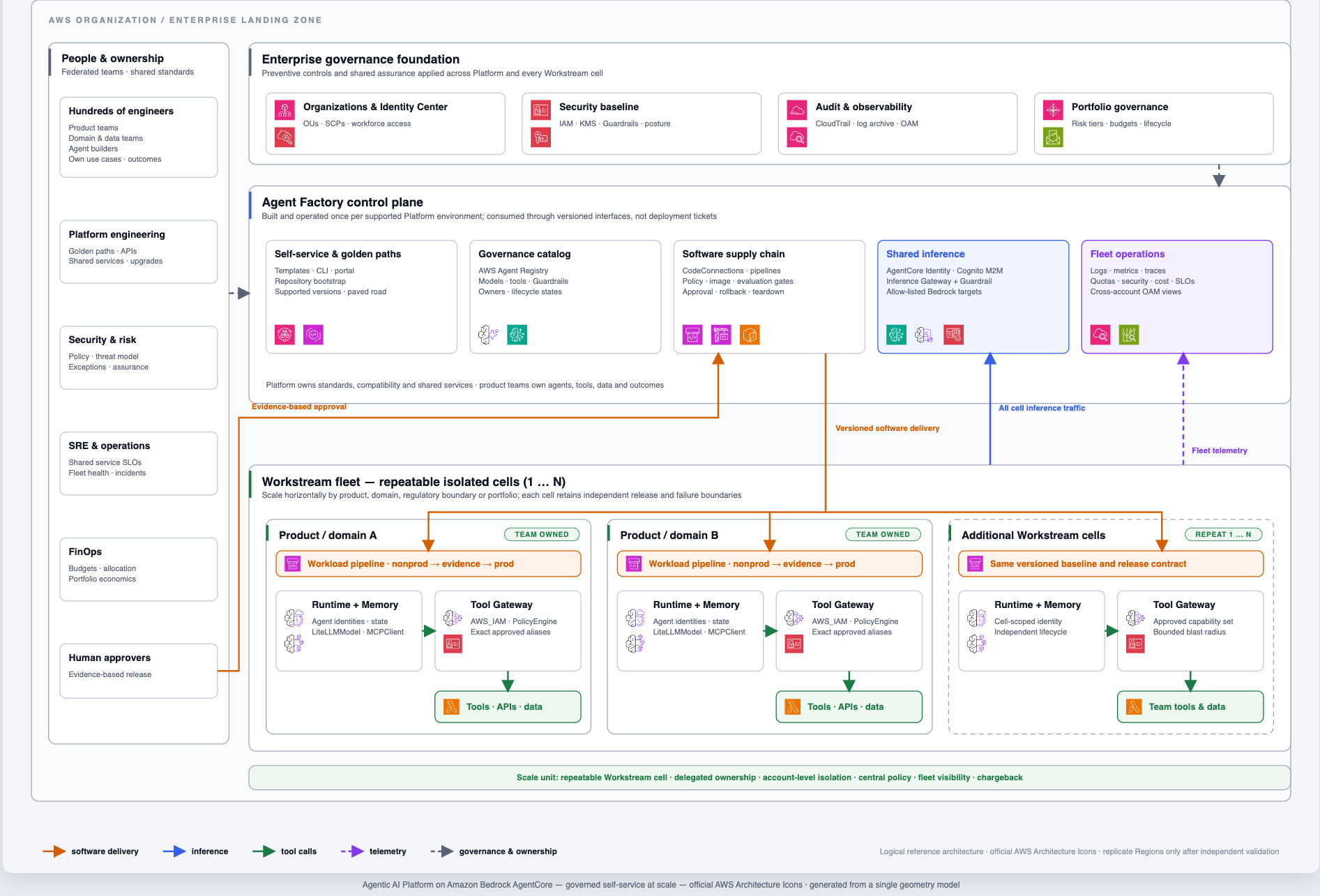
Determine 1: Enterprise Agentic AI Platform working mannequin, displaying the governance basis, the Platform management aircraft, repeatable team-owned Workstream cells, and the software program supply, inference, device, telemetry, and possession flows between them.
The structure consists of the next account layers:
- Administration and governance basis. AWS Organizations, AWS IAM Id Middle, preventive coverage, audit, retention, and price coverage set up the enterprise boundary. These are logical tasks that may map to an current AWS Management Tower touchdown zone slightly than requiring a reproduction account construction.
- Safety, audit, and observability layer. AWS CloudTrail, AWS Config, AWS Safety Hub, Amazon GuardDuty, log archive, and an Amazon CloudWatch OAM sink present unbiased control-plane proof and fleet visibility. Central operators can question shared alerts with out gaining write entry to Workstream assets.
- Platform layer of Agentic AI Platform. Separate Platform environments personal golden paths, the governance catalog, Guardrails, shared Inference Gateways, precise device aliases, pipelines, compatibility, quotas, and customary operational interfaces. Platform modifications are examined in opposition to consultant cells earlier than wider rollout.
- Workstream fleet layer. Every product, area, or regulated boundary receives a number of nonproduction and manufacturing cells. Groups personal Runtime, Reminiscence, Software Gateway, instruments, information, prompts, analysis instances, utility incidents, and service-level goals (SLOs). The identical baseline will be repeated throughout many cells whereas preserving account-level isolation.
Answer walkthrough
The next sections hint the important thing design choices: account topology, preventive and detective controls, the AgentCore execution path, and the supply pipeline.
Account topology and organizational items
The blueprint defines logical account roles that separate enterprise governance, shared Platform providers, and team-owned execution:
| Function | Touchdown-zone placement | Function |
| Administration basis | Root / Safety and Administration | Organizations, Id Middle, preventive coverage, audit, retention, and price coverage |
| Safety and log archive | Safety | CloudTrail, AWS Config, Safety Hub, GuardDuty, and retained audit information |
| Observability | Safety or Operations | CloudWatch OAM sink and fleet logs, metrics, traces, and price views |
| Agentic AI Platform | Agent Platform | Golden paths, AWS Agent Registry, Guardrails, Inference Gateways, pipelines, and fleet controls |
| Workstream cell | Agent Workstreams | Staff-owned Runtime, Reminiscence, Software Gateway, instruments, information, analysis, and utility SLOs |
| Extra Workstream cells | Agent Workstreams | Repeat the identical baseline per product, area, atmosphere, or regulated boundary |
This topology integrates into an current touchdown zone, a pre-configured, safe, and scalable multi-account AWS atmosphere, the place the Administration, Platform, and Workstream labels describe tasks slightly than a set three-account property. A company can function a number of validated Platform environments and lots of Workstream account pairs. Begin with one consultant cell and show onboarding, manufacturing promotion, rollback, centralized observability, and zero-residual retirement earlier than repeating the baseline.
Service management insurance policies
Service management insurance policies constrain the utmost permissions obtainable to Platform and Workstream accounts. They complement, slightly than exchange, IAM, gateway authorization, Guardrails, useful resource insurance policies, community controls, and pipeline proof. The blueprint renders and opinions the efficient insurance policies for the precise account and Area as an alternative of counting on source-code intent alone.
- Mannequin and Area admission: Group coverage and Gateway execution roles limit inference to authorized fashions and the supported Area. Including a mannequin or Area requires service availability, residency, IAM, high quality, price, rollback, observability, and denial validation.
- Guardrail and inference enforcement: Brokers don’t name mannequin suppliers immediately. Inference crosses the ruled gateway, the place the stage Guardrail and mannequin allow-list are utilized.
- Pipeline-only Workstream mutation: Workstream groups open pull requests and use the Workload pipeline. Direct developer deployment into Workstream accounts is outdoors the supported working mannequin, which retains the reviewed launch and proof path non-bypassable.
- Registry and Gateway governance: Workstream Gateway synthesis fails when a subscribed Registry report is lacking, modified, or not authorized.
- Scoped deployment roles: Bootstrap insurance policies are generated per account and Area, validated with AWS Id and Entry Administration Entry (IAM) Analyzer, and checked by means of effective-policy simulation. Administrator entry is reserved for preliminary setup slightly than routine pipeline execution.
- Separation of duties and adversarial proof: Platform controls mannequin, Guardrail, Registry, and shared-service admission. Workstream groups management utility conduct. Each denied path is paired with a licensed constructive name and a mutation that proves the supposed management precipitated the denial.
An administrator inside a Workstream account can’t create a supported quick path round these controls. New or modified group insurance policies want a sandbox or representative-cell soak, precise permit and deny exams, and a rollback plan earlier than broad attachment.
CI/CD pipeline with analysis gates
The blueprint makes use of reviewed Platform and Workload pipelines to implement the next promotion sequence:
- Supply and evaluation: A pull request establishes the immutable supply revision. The pipeline pins the supposed department so an unmerged change can’t silently construct the repository default department.
- Construct and synth: The pipeline compiles code, runs exams and linting, creates the agent manifest, scans the digest-bound picture, validates insurance policies, resolves authorized Registry descriptors, and inspects synthesized AWS CloudFormation and cdk-nag output.
- Secure roles and permission handoff: The Workload pipeline creates steady Workstream roles and pauses. The Platform pipeline grants precise device aliases to the precise Gateway position, dwell insurance policies are verified, and solely then does the Workload pipeline proceed.
- Deploy to nonproduction: The pipeline deploys Runtime, Reminiscence, Software Gateway, observability, alarms, budgets, tags, and utility assets into the cell’s nonproduction boundary.
- Consider the deployed agent: The gate invokes the true Runtime and measures regression, high quality, device success, refusal conduct, first-token latency, and price. Each approved name is paired with an adversarial twin: the gate calls an authorized mannequin and confirms success, then calls an unapproved mannequin and confirms the denial. The identical sample applies to instruments, cross-account id, and throttling. If an anticipated denial is lacking, the gate fails the construct.
- Human approval: A reviewer examines the deployed proof, recognized limitations, and residual threat. A generic inexperienced construct just isn’t sufficient when a required probe, useful resource, or anticipated denial is lacking.
- Promote, observe, and roll again: Manufacturing promotion makes use of the reviewed revision and continuity checks. Runtime classes are sampled by means of replace, cancellation, rollback, restore, and re-run so the pipeline proves each the ahead path and restoration path.
No Workstream deployment step has a guide quick monitor. The Platform group owns the discharge contract, however Workstream groups function their very own pipeline cases and deployment cadence. Retirement follows a strict dependency order: Platform alias grants are revoked first, then Workstream Gateway and gear roles, then Runtime, Reminiscence, and utility assets. Every step is verified earlier than continuing, and a closing stock confirms zero residual assets stay.
Safety and governance
The blueprint implements protection in depth by means of reinforcing id, coverage, supply, information, and proof controls:
- Id and belief boundaries: AgentCore Id, a functionality of Amazon Bedrock AgentCore, and Amazon Cognito present short-lived inference credentials. AWS_IAM and SigV4 authenticate device site visitors. Precise Runtime and Gateway roles, issuer and viewers checks, account and Area context, and scoped bootstrap belief restrict every principal to its supposed path.
- Mannequin security and admission: Inference flows by means of the ruled gateway described within the Answer overview, making use of Guardrails and mannequin allow-lists earlier than each name.
- Software authorization: The Software Gateway invokes solely Registry-approved aliases, as detailed within the Answer overview. Cedar insurance policies present authorization, with a retained AWS Lambda wrapper for protection in depth.
- Tenant information safety: Workstream accounts isolate utility state. AgentCore reminiscence makes use of actor-scoped namespaces and customer-managed KMS keys. Instruments and utility information stay team-owned, and retention, deletion, and entry insurance policies are express slightly than inherited from a shared mutable workload account.
- Software program provide chain and launch: Reviewed supply, manifest hashing, reproducible builds, digest-bound picture scanning, coverage validation, cdk-nag checks, deployed-runtime analysis, human approval, rollback, and dependency-ordered teardown kind one launch contract. A lacking verify fails closed.
- Audit, observability, and price governance: CloudTrail and retained control-plane information corroborate pipeline proof. OAM shares logs, metrics, and traces with central operators. Commonplace allocation tags, budgets, quotas, and AWS Value and Utilization Report reconciliation assign possession with out giving the agent permission to rewrite its personal attribution.
The repository is a reference implementation. Builders can regulate it to deal with their wants. The deployment and obtainable options are primarily based on the eu-west-1 (Eire) Area. A substituted element, one other Area, or a wider organizational rollout requires its personal availability, safety, load, rollback, observability, and teardown proof.
Conclusion
On this publish, we walked by means of an enterprise Agentic AI Platform constructed on Amazon Bedrock AgentCore. The structure separates a centrally ruled Platform management aircraft from repeatable, team-owned Workstream cells, with distinct inference and gear gateways, and manufacturing promotion gated by deployed-runtime analysis.
The companion repository features a blueprint that validates these controls finish to finish, from pipeline gates and adversarial boundary exams by means of zero-residual teardown. The assist declare stops at that examined boundary.
To get began, deploy one consultant Workstream cell from the companion repository, show its full lifecycle, after which automate further cells from the identical versioned baseline.
Associated assets:
- Enterprise Agentic AI Platform Blueprint on GitHub
- Enterprise multi-account structure for operating agentic AI in manufacturing on AWS (Prescriptive Steerage)
- Constructing an Enterprise Agentic AI Platform on Amazon Bedrock AgentCore Workshop
- Amazon Bedrock AgentCore documentation
Concerning the authors