
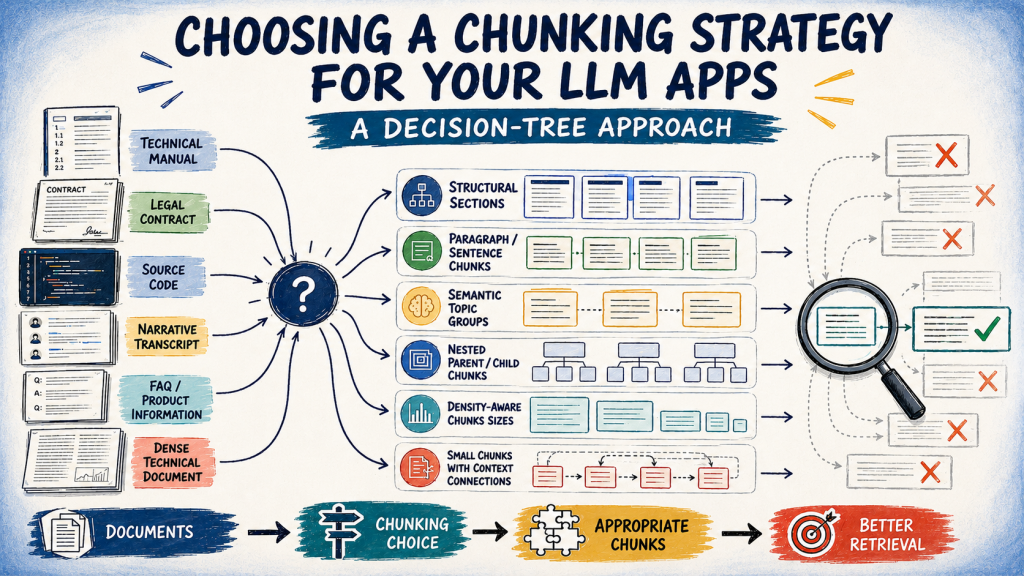
On this article, you’ll discover ways to select the suitable chunking technique for a retrieval-augmented technology system by working by means of a structured choice tree tied to the properties of your paperwork and retrieval job.
Subjects we are going to cowl embrace:
- What every main chunking technique assumes about your paperwork, and when these assumptions maintain.
- A six-question choice tree that maps concrete doc and retrieval situations to particular chunking methods.
- The failure indicators that point out a selected technique is just not working, and the fixes that are inclined to resolve them.
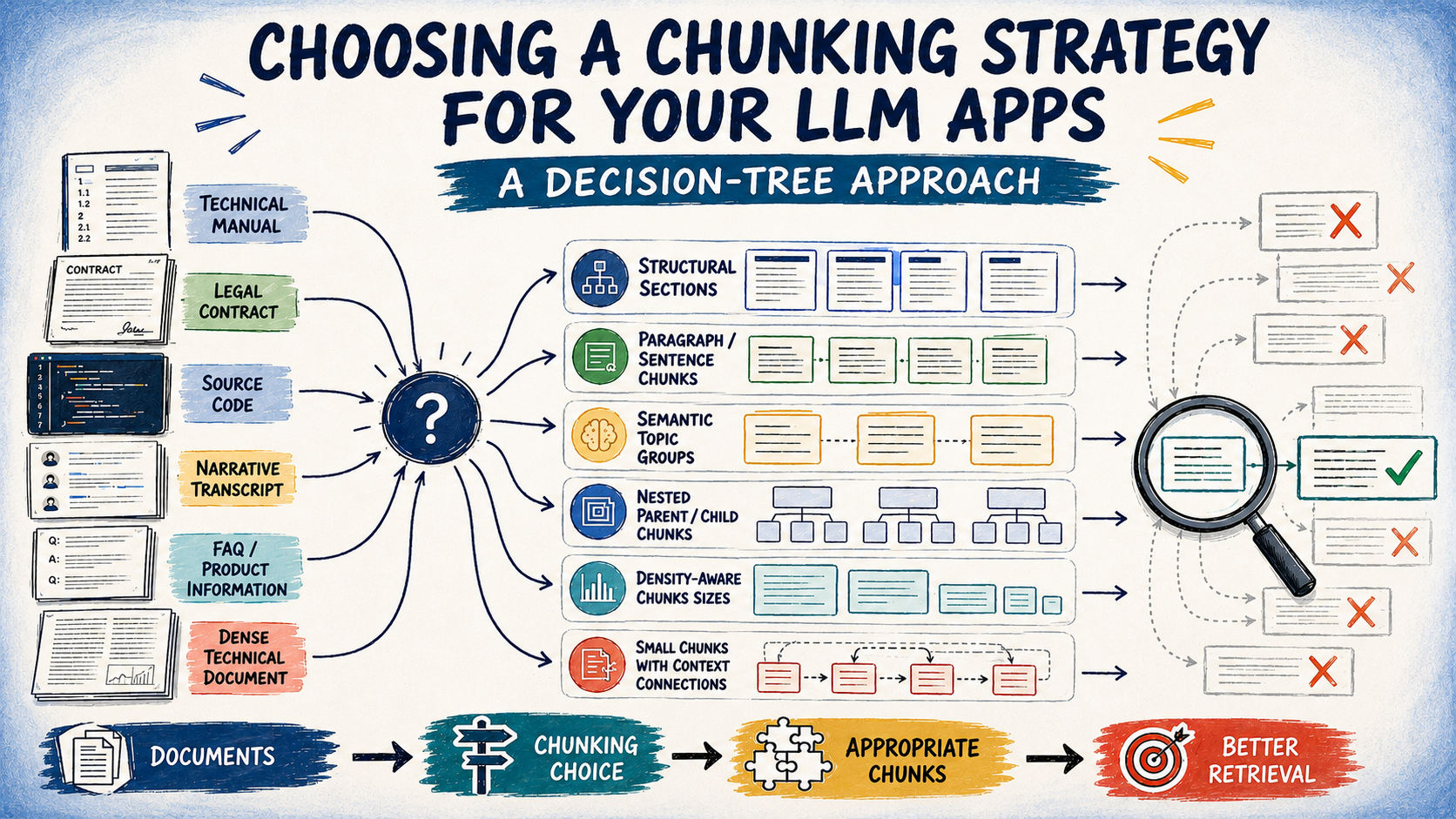
Introduction
If you end up constructing a retrieval-augmented technology system, you usually work with paperwork which are bigger than what an embedding mannequin or LLM context window can accommodate, so it’s worthwhile to break up them into smaller chunks. Chunk measurement and overlap might look like easy configuration decisions, however the best way you set these boundaries instantly impacts retrieval. Poor boundaries may cause retrieval to overlook the passage that solutions a question, or return a piece that’s technically related however lacks the encircling context wanted to make it helpful.
A chunking technique defines the way you determine the place to separate a doc, and that alternative can have a serious impact on retrieval high quality. When the boundaries protect the suitable context, embeddings, vector search, and technology have a stronger foundation to work with. When the boundaries break vital context, reranking and immediate tuning can not totally get better what was misplaced throughout splitting. No single chunking technique works nicely for each doc. The precise alternative, subsequently, is dependent upon the construction of the doc and the retrieval job.
This text covers:
- What every main chunking technique assumes about your paperwork
- A call tree that maps each a type of methods to a concrete situation price checking
- How the methods land on actual doc sorts, with tradeoffs laid out aspect by aspect
- The failure indicators that let you know a selected technique isn’t working
We begin with why this alternative is vital.
What Every Chunking Technique Assumes
Every chunking technique is predicated on a selected assumption concerning the doc. Selecting a method that matches the doc’s construction and wishes helps enhance retrieval high quality whereas avoiding pointless complexity:
| Technique | What It Assumes |
|---|---|
| Fastened-size chunking | Boundary placement doesn’t matter a lot, since overlap can patch no matter will get reduce mid-thought |
| Recursive chunking | Paragraph and sentence boundaries are a secure sufficient proxy for that means when no stronger construction is out there |
| Doc-based chunking | The doc’s personal construction — headers, sections, perform boundaries — traces up with its semantic construction |
| Semantic chunking | Subject shifts are detectable sentence by sentence by means of embedding distance |
| Late chunking | A piece’s that means is dependent upon the entire doc, not simply its personal textual content |
| Adaptive chunking | A single chunk measurement can’t serve sections that change sharply in info density |
| Hierarchical chunking | Retrieval must reply each broad and particular questions from the identical corpus |
| LLM-based chunking | Solely a mannequin studying the textual content can discover logical breakpoints that construction and embeddings miss |
| Agentic chunking | The gathering is different sufficient that no single rule handles all of it nicely |
When the technique matches the doc, its added complexity will be worthwhile. When it doesn’t, it provides overhead with out bettering retrieval. For instance, semantic chunking is pointless for a brief FAQ entry, whereas fixed-size chunking can break up associated clauses in a contract. These mismatches can result in retrieval issues that originate in preprocessing slightly than technology.
Working By means of a Resolution Tree to Select a Chunking Technique
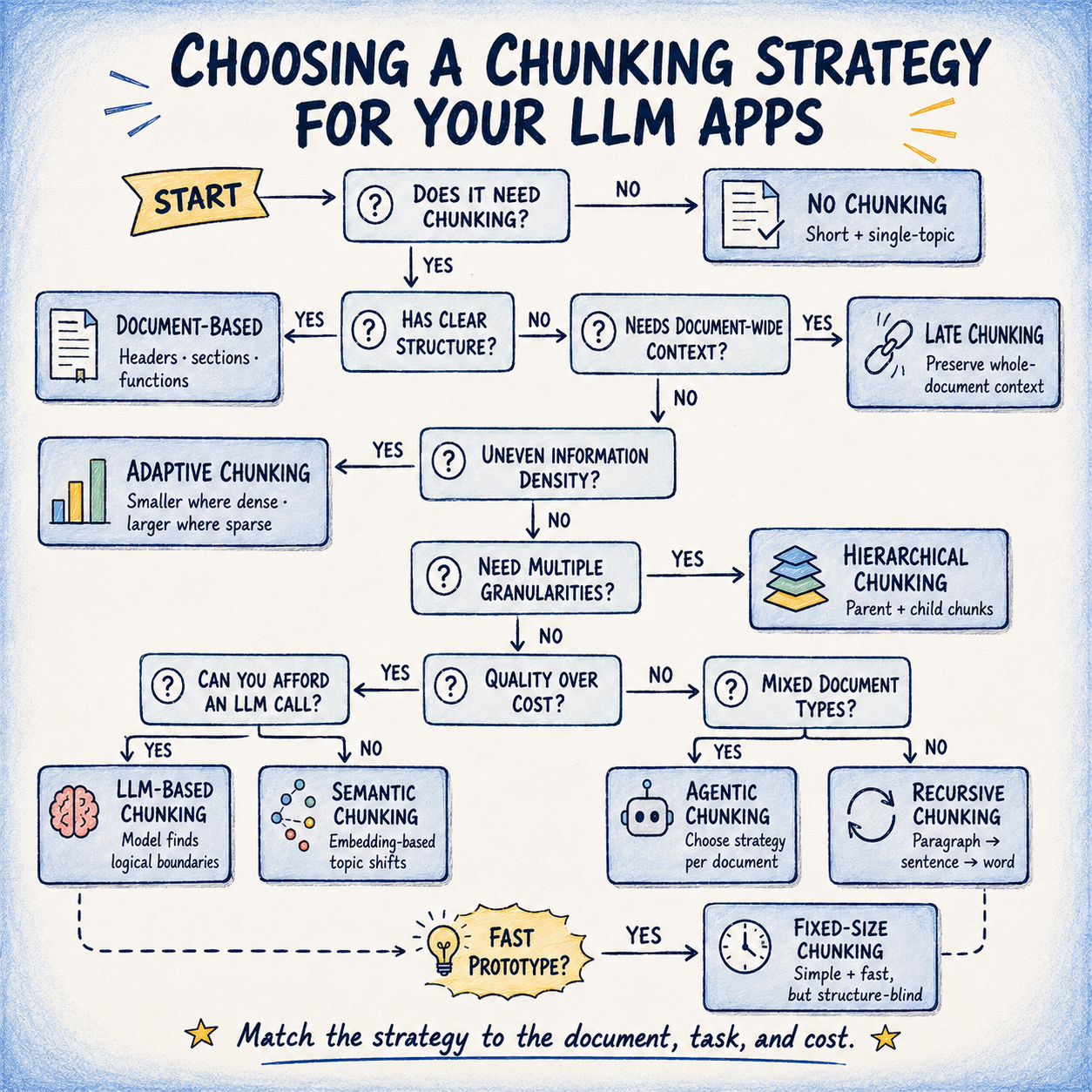
The tree has six branching questions, every narrowing the technique house based mostly on a concrete property of the doc or the retrieval job. Each query beneath ends with a direct reply: which technique to make use of if the situation holds, and the place to go subsequent if it doesn’t. Following them so as helps you select a method based mostly on the doc and retrieval job slightly than defaulting to a well-known possibility.
Query 1: Does the Doc Want Chunking at All?
Quick, self-contained content material — equivalent to FAQ entries, product descriptions, or single config snippets — usually matches comfortably inside one embedding name and covers precisely one subject.
If the doc sits nicely throughout the mannequin’s context window and doesn’t combine topics, embed it entire and skip chunking. Splitting content material that’s already coherent solely provides retrieval overhead. If the doc is simply too lengthy, or covers a couple of subject, transfer to Query 2.
Query 2: Does the Doc Have a Clear Inner Construction?
Some paperwork already comprise pure boundaries that replicate how their content material is organized. Markdown headings, HTML parts, PDF sections and tables, and code capabilities or lessons can all present significant chunk boundaries.
If the doc has a dependable construction that maps to logical content material items, use document-based chunking. The doc is parsed in line with its format, protecting sections, paragraphs, tables, capabilities, or different structural parts collectively. If the construction is inconsistent, incomplete, or doesn’t present helpful boundaries, transfer to Query 3.
Query 3: Do Chunks Want Context From Elsewhere within the Doc?
Some paperwork carry dependencies that span the entire textual content. Take, for instance, a authorized contract that defines a time period in part one and makes use of it in part eight, or a technical spec whose terminology solely is sensible subsequent to an earlier paragraph.
If retrieval must protect that document-wide relationship, use late chunking. Embed the total doc with a long-context mannequin first, then derive chunk-level embeddings from that end result, so every chunk nonetheless carries a hint of the entire doc. If chunks can stand on their very own with out dropping that means, transfer to Query 4.
Query 4: Does Data Density Range, or Do You Want A number of Ranges of Granularity?
This query covers two completely different situations, every pointing to a special technique:
- If info density varies throughout sections, use adaptive chunking to dynamically modify parameters equivalent to chunk measurement and overlap to match the content material. Dense, information-rich sections can use smaller, extra granular chunks, whereas broader or much less dense sections can use bigger chunks.
- If the identical corpus must assist each broad questions (equivalent to what a doc covers) and particular questions (equivalent to actual syntax), use hierarchical chunking, with coarse mum or dad chunks and finer-grained baby chunks.
If neither situation applies, transfer to Query 5.
Query 5: Does Retrieval High quality Matter Extra Than Price and Latency?
That is the price and high quality tradeoff. If retrieval high quality is the precedence and the price range helps a mannequin name per doc, use LLM-based chunking to determine logical breakpoints or atomic propositions. If high quality nonetheless issues however per-document mannequin calls are too expensive, and subject shifts are unpredictable, use semantic chunking based mostly on sentence-embedding distance. It is less expensive than an LLM go whereas nonetheless accounting for that means. If pace and price are the precedence, transfer to Query 6.
Query 6: Is This One Doc Sort, or a Heterogeneous Assortment?
If the corpus mixes doc sorts the place the suitable technique differs from one doc to the subsequent, use agentic chunking. For instance, a group would possibly comprise structured reviews, narrative transcripts, and code. An agent can examine every doc and choose the suitable strategy.
If the gathering in all fairness uniform, recursive chunking is a sensible default. It splits content material at paragraph, sentence, after which phrase boundaries till the chunks match the goal measurement, whereas preserving pure construction with out requiring per-document evaluation.
If pace issues greater than chunk high quality, fixed-size chunking is an inexpensive fallback for fast prototypes. After working by means of these questions, the choice tree ought to appear to be so:
Mapping the Resolution Tree to a Chunking Technique
Working by means of the tree lands you on one of many methods beneath. Methods usually mix a couple of, however the desk maps every technique to the scenario it matches greatest and the price that comes with it:
| Technique | Greatest For | Key Tradeoff |
|---|---|---|
| No chunking | Quick, single-topic content material that already matches the context window | None — skips preprocessing totally |
| Doc-based chunking | Content material with dependable structural markup (Markdown, HTML, code) | Breaks down when headers don’t monitor subject boundaries |
| Late chunking | Paperwork with cross-references or dependencies spanning sections | Requires a long-context embedding mannequin |
| Adaptive chunking | Corpora with sharply uneven info density | Added indexing and retrieval complexity |
| Hierarchical chunking | Corpora needing each broad and particular queries answered nicely | Two ranges of chunks to construct and hold in sync |
| LLM-based chunking | Advanced, high-stakes paperwork the place retrieval high quality justifies the price | Highest compute value per doc |
| Semantic chunking | Paperwork with unpredictable subject shifts on a average price range | Wants threshold tuning to keep away from inconsistent chunk counts |
| Agentic chunking | Heterogeneous collections the place the optimum technique varies by doc | Requires per-document evaluation earlier than chunking begins |
| Recursive chunking | Basic-purpose default for a fairly uniform corpus | Much less semantically exact than meaning-aware strategies |
| Fastened-size chunking | Quick prototyping when pace issues greater than chunk high quality | Ignores construction and that means totally |
The precise chunking technique is dependent upon the construction, complexity, and retrieval wants of your knowledge, with the aim of balancing retrieval high quality, computational value, and implementation complexity.
Recognizing Frequent Chunking Pitfalls
A method that seemed proper on paper can nonetheless misbehave as soon as it meets precise paperwork. The desk beneath lists the indicators price anticipating, what they normally imply, and the repair that tends to work:
| Symptom | Possible Trigger | Repair |
|---|---|---|
| Chunks persistently reduce mid-sentence or mid-table | A structure-blind technique utilized to a structured doc | Swap to recursive chunking as an alternative of widening overlap |
| Semantic chunking produces wildly inconsistent chunk counts throughout comparable paperwork | Similarity threshold is miscalibrated | Tighten the brink, or fall again to LLM-based boundaries for the paperwork that hold misbehaving |
| Doc-based chunks vary from one line to a number of pages | Headers don’t reliably monitor subject boundaries | Mix document-based splitting with a recursive go inside outsized sections |
| Hierarchical or adaptive chunking provides latency with out bettering solutions | Corpus is small and pretty uniform | Drop again to recursive chunking |
| Agentic chunking blows previous its compute price range on a big corpus | Per-document evaluation is repeated on each run as an alternative of cached | Cache technique selections, or run the evaluation on the assortment stage slightly than per doc |
These pitfalls may also help you determine when a chunking technique must be adjusted for higher retrieval and effectivity.
Wrapping Up
Selecting a chunking technique begins with understanding the construction of your paperwork and the retrieval job they should assist. Elements equivalent to doc construction, context dependencies, info density, retrieval necessities, and price all form that alternative.
Use the choice tree to determine an acceptable start line, then validate it with your individual queries and retrieval outcomes. Begin with the best technique that matches your wants, and introduce extra superior approaches solely once they deal with a selected retrieval problem.
The most effective outcomes come from matching chunk boundaries to the data it’s worthwhile to retrieve, whereas protecting the added complexity proportional to the worth it offers.